 Add to Chrome
 Add to Firefox
 Add to Edge
Physics-informed reservoir characterization from bulk and extreme pressure events with a differentiable simulator
Apr 14, 2026
Accurate characterization of subsurface heterogeneity is challenging but essential for applications such as reservoir pressure management, geothermal energy extraction and CO$_2$, H$_2$, and wastewater injection operations. This challenge becomes especially acute in extreme pressure events, which are rarely observed but can strongly affect operational risk. Traditional history matching and inversion techniques rely on expensive full-physics simulations, making it infeasible to handle uncertainty and extreme events at scale. Purely data-driven models often struggle to maintain physics consistency when dealing with sparse observations, complex geology, and extreme events. To overcome these limitations, we introduce a physics-informed machine learning method that embeds a differentiable subsurface flow simulator directly into neural network training. The network infers heterogeneous permeability fields from limited pressure observations, while training minimizes both permeability and pressure losses through the simulator, enforcing physical consistency. Because the simulator is used only during training, inference remains fast once the model is learned. In an initial test, the proposed method reduces the pressure inference error by half compared with a purely data-driven approach. We then extend the test over eight distinct data scenarios, and in every case, our method produces significantly lower pressure inference errors than the purely data-driven model. We also evaluate our method on extreme events, which represent high-consequence data in the tail of the sample distribution. Similar to the bulk distribution, the physics-informed model maintains higher pressure inference accuracy in the extreme event regimes. Overall, the proposed method enables rapid, physics-consistent subsurface inversion for real-time reservoir characterization and risk-aware decision-making.

Infinite-dimensional spherical-radial decomposition for probabilistic functions, with application to constrained optimal control and Gaussian process regression
Mar 20, 2026The spherical-radial decomposition (SRD) is an efficient method for estimating probabilistic functions and their gradients defined over finite-dimensional elliptical distributions. In this work, we generalize the SRD to infinite stochastic dimensions by combining subspace SRD with standard Monte Carlo methods. The resulting method, which we call hybrid infinite-dimensional SRD (hiSRD) provides an unbiased, low-variance estimator for convex sets arising, for instance, in chance-constrained optimization. We provide a theoretical analysis of the variance of finite-dimensional SRD as the dimension increases, and show that the proposed hybrid method eliminates truncation-induced bias, reduces variance, and allows the computation of derivatives of probabilistic functions. We present comprehensive numerical studies for a risk-neutral stochastic PDE optimal control problem with joint chance state constraints, and for optimizing kernel parameters in Gaussian process regression under the constraint that the posterior process satisfies joint chance constraints.
Bayesian neural network priors for edge-preserving inversion
Dec 20, 2021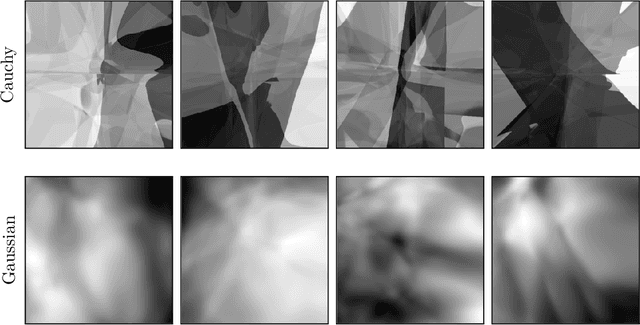
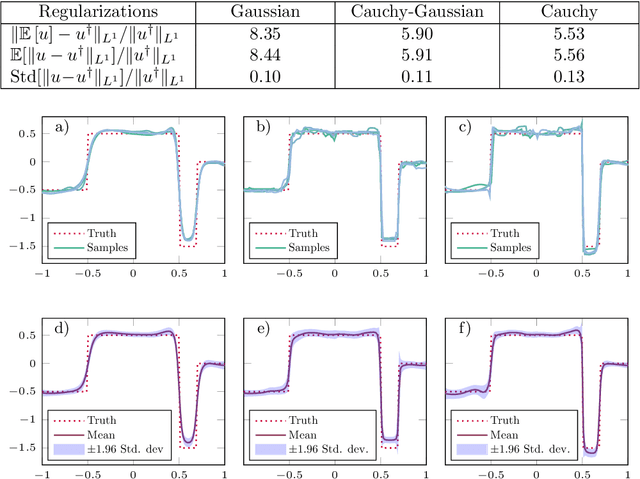
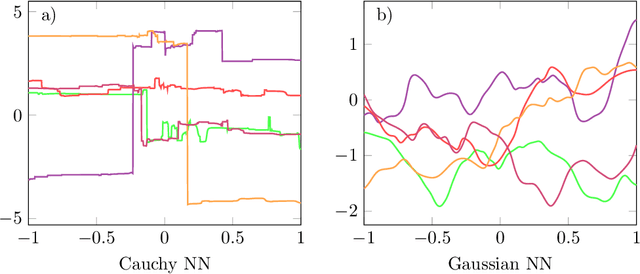

We consider Bayesian inverse problems wherein the unknown state is assumed to be a function with discontinuous structure a priori. A class of prior distributions based on the output of neural networks with heavy-tailed weights is introduced, motivated by existing results concerning the infinite-width limit of such networks. We show theoretically that samples from such priors have desirable discontinuous-like properties even when the network width is finite, making them appropriate for edge-preserving inversion. Numerically we consider deconvolution problems defined on one- and two-dimensional spatial domains to illustrate the effectiveness of these priors; MAP estimation, dimension-robust MCMC sampling and ensemble-based approximations are utilized to probe the posterior distribution. The accuracy of point estimates is shown to exceed those obtained from non-heavy tailed priors, and uncertainty estimates are shown to provide more useful qualitative information.