 Add to Chrome
 Add to Firefox
 Add to Edge
Self-Knowledge Retrieval Augmented Generation Framework for Patent Matching
Aug 11, 2026
Patent retrieval and matching based on large language models (LLMs) play a vital role in intellectual property protection. However, due to the complex structure of patent documents, dense technical terminology, and multi-modal information, traditional methods struggle to accurately identify subtle differences between patents. Existing LLM-based patent matching approaches typically rely on domain-specific pretrained or instruction tuning, which often entail high manual labeling costs and catastrophic forgetting. While retrieval-augmented generation (RAG) methods introduce external knowledge they fail to fully leverage LLM's capability to automatically parse patents and mine deep semantic relationships. To address these limitations, this paper proposes a self-knowledge RAG framework that guides LLMs to autonomously extract key technical entities and construct hierarchical ontological structures from patent matching queries, thereby enabling query expansion and precise retrieval. The method integrates the FAISS retrieval with a generative matching mechanism, leveraging self-knowledge to enhance the model's understanding of patent innovations and significantly improve retrieval and matching accuracy. Experimental results demonstrate the outstanding performance of the proposed method on real-world patent datasets, validating its effectiveness and application potential.

TEAMMix: Taxonomy Enrichment Augmentation and Minority-augmented Mixing Strategy for LLM-enhanced Weak-Supervised Hierarchical Text Classification
Aug 11, 2026Hierarchical Text Classification (HTC), as a critical text mining task, faces challenges such as complex label hierarchies and class imbalance. Existing methods based on large language models (LLMs) struggle to be efficiently applied to this task due to issues like lengthy prompts and loss of label structural information. To address these limitations, this paper proposes a weakly supervised HTC framework enhanced by LLM-based data augmentation. The framework first enriches the label hierarchy semantically through keyword generation and corpus mining, thereby enhancing the model's understanding of labels. Subsequently, it guides the LLM to generate pseudo-samples to mitigate the long-tail problem, and employs a Gaussian mixture model for confidence-based resampling to optimize the quality of generated data. Experimental results demonstrate that the proposed method effectively improves the reliability of LLM-generated pseudo-labels and significantly enhances classification performance on fine-grained and imbalanced datasets.
Inferring Human Observer Spectral Sensitivities from Video Game Data
Jul 01, 2020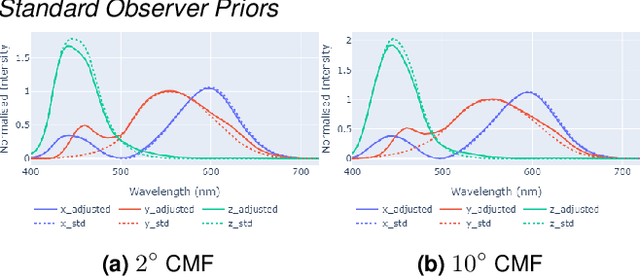
With the use of primaries which have increasingly narrow bandwidths in modern displays, observer metameric breakdown is becoming a significant factor. This can lead to discrepancies in the perceived color between different observers. If the spectral sensitivity of a user's eyes could be easily measured, next generation displays would be able to adjust the display content to ensure that the colors are perceived as intended by a given observer. We present a mathematical framework for calculating spectral sensitivities of a given human observer using a color matching experiment that could be done on a mobile phone display. This forgoes the need for expensive in-person experiments and allows system designers to easily calibrate displays to match the user's vision, in-the-wild. We show how to use sRGB pixel values along with a simple display model to calculate plausible color matching functions (CMFs) for the users of a given display device (e.g., a mobile phone). We evaluate the effect of different regularization functions on the shape of the calculated CMFs and the results show that a sum of squares regularizer is able to predict smooth and qualitatively realistic CMFs.