 Add to Chrome
 Add to Firefox
 Add to Edge
Lightweight 3D Gaussian Splatting Compression via Video Codec
Dec 12, 2025
Current video-based GS compression methods rely on using Parallel Linear Assignment Sorting (PLAS) to convert 3D GS into smooth 2D maps, which are computationally expensive and time-consuming, limiting the application of GS on lightweight devices. In this paper, we propose a Lightweight 3D Gaussian Splatting (GS) Compression method based on Video codec (LGSCV). First, a two-stage Morton scan is proposed to generate blockwise 2D maps that are friendly for canonical video codecs in which the coding units (CU) are square blocks. A 3D Morton scan is used to permute GS primitives, followed by a 2D Morton scan to map the ordered GS primitives to 2D maps in a blockwise style. However, although the blockwise 2D maps report close performance to the PLAS map in high-bitrate regions, they show a quality collapse at medium-to-low bitrates. Therefore, a principal component analysis (PCA) is used to reduce the dimensionality of spherical harmonics (SH), and a MiniPLAS, which is flexible and fast, is designed to permute the primitives within certain block sizes. Incorporating SH PCA and MiniPLAS leads to a significant gain in rate-distortion (RD) performance, especially at medium and low bitrates. MiniPLAS can also guide the setting of the codec CU size configuration and significantly reduce encoding time. Experimental results on the MPEG dataset demonstrate that the proposed LGSCV achieves over 20% RD gain compared with state-of-the-art methods, while reducing 2D map generation time to approximately 1 second and cutting encoding time by 50%. The code is available at https://github.com/Qi-Yangsjtu/LGSCV .

J-SGFT: Joint Spatial and Graph Fourier Domain Learning for Point Cloud Attribute Deblocking
Nov 07, 2025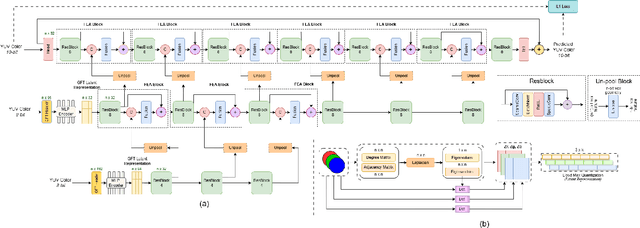
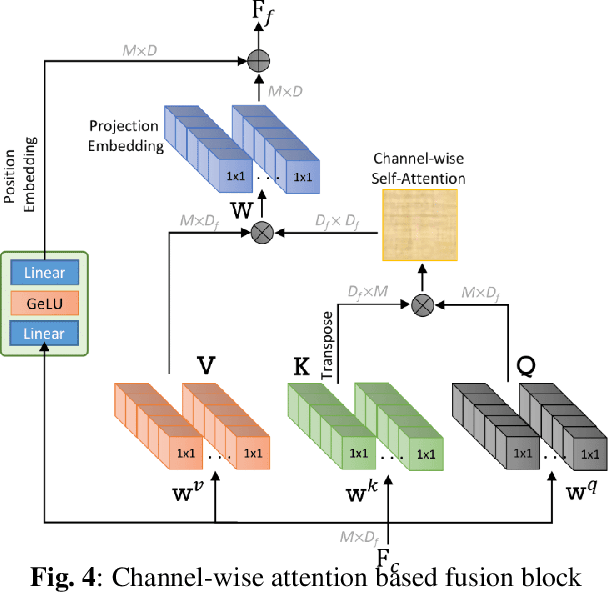
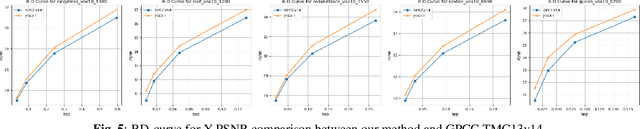
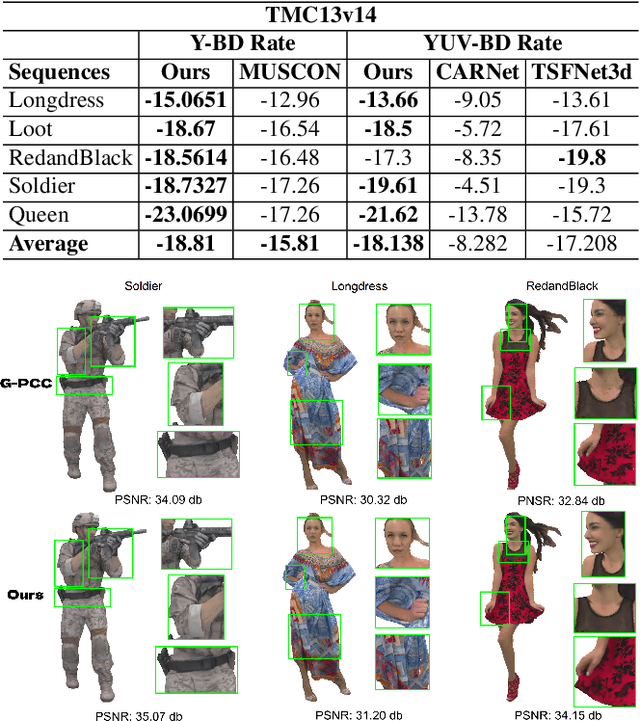
Point clouds (PC) are essential for AR/VR and autonomous driving but challenge compression schemes with their size, irregular sampling, and sparsity. MPEG's Geometry-based Point Cloud Compression (GPCC) methods successfully reduce bitrate; however, they introduce significant blocky artifacts in the reconstructed point cloud. We introduce a novel multi-scale postprocessing framework that fuses graph-Fourier latent attribute representations with sparse convolutions and channel-wise attention to efficiently deblock reconstructed point clouds. Against the GPCC TMC13v14 baseline, our approach achieves BD-rate reduction of 18.81\% in the Y channel and 18.14\% in the joint YUV on the 8iVFBv2 dataset, delivering markedly improved visual fidelity with minimal overhead.
HybridGS: High-Efficiency Gaussian Splatting Data Compression using Dual-Channel Sparse Representation and Point Cloud Encoder
May 03, 2025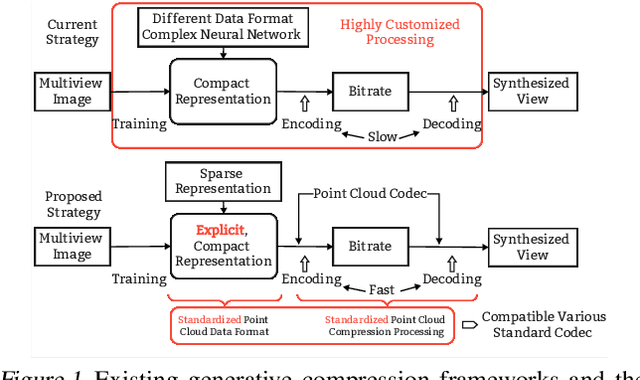
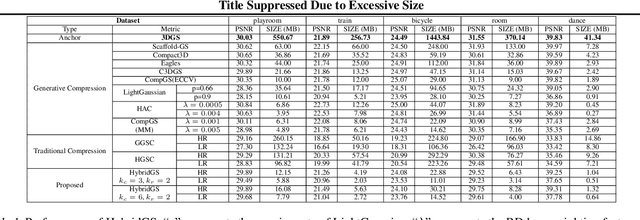
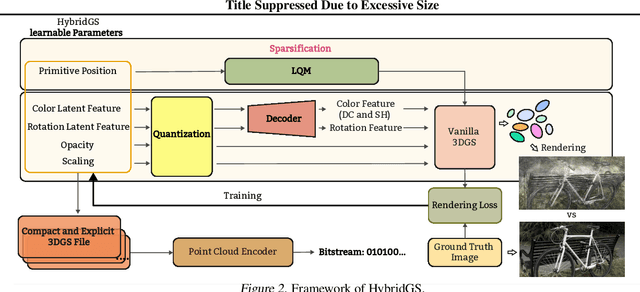
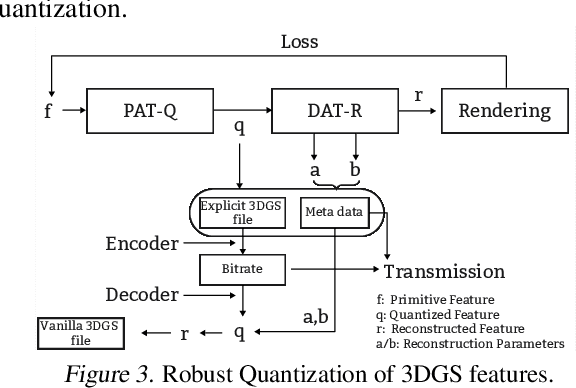
Most existing 3D Gaussian Splatting (3DGS) compression schemes focus on producing compact 3DGS representation via implicit data embedding. They have long coding times and highly customized data format, making it difficult for widespread deployment. This paper presents a new 3DGS compression framework called HybridGS, which takes advantage of both compact generation and standardized point cloud data encoding. HybridGS first generates compact and explicit 3DGS data. A dual-channel sparse representation is introduced to supervise the primitive position and feature bit depth. It then utilizes a canonical point cloud encoder to perform further data compression and form standard output bitstreams. A simple and effective rate control scheme is proposed to pivot the interpretable data compression scheme. At the current stage, HybridGS does not include any modules aimed at improving 3DGS quality during generation. But experiment results show that it still provides comparable reconstruction performance against state-of-the-art methods, with evidently higher encoding and decoding speed. The code is publicly available at https://github.com/Qi-Yangsjtu/HybridGS.