 Add to Chrome
 Add to Firefox
 Add to Edge
Minimal Clips, Maximum Salience: Long Video Summarization via Key Moment Extraction
Dec 12, 2025
Vision-Language Models (VLMs) are able to process increasingly longer videos. Yet, important visual information is easily lost throughout the entire context and missed by VLMs. Also, it is important to design tools that enable cost-effective analysis of lengthy video content. In this paper, we propose a clip selection method that targets key video moments to be included in a multimodal summary. We divide the video into short clips and generate compact visual descriptions of each using a lightweight video captioning model. These are then passed to a large language model (LLM), which selects the K clips containing the most relevant visual information for a multimodal summary. We evaluate our approach on reference clips for the task, automatically derived from full human-annotated screenplays and summaries in the MovieSum dataset. We further show that these reference clips (less than 6% of the movie) are sufficient to build a complete multimodal summary of the movies in MovieSum. Using our clip selection method, we achieve a summarization performance close to that of these reference clips while capturing substantially more relevant video information than random clip selection. Importantly, we maintain low computational cost by relying on a lightweight captioning model.

Integrating Video and Text: A Balanced Approach to Multimodal Summary Generation and Evaluation
May 10, 2025
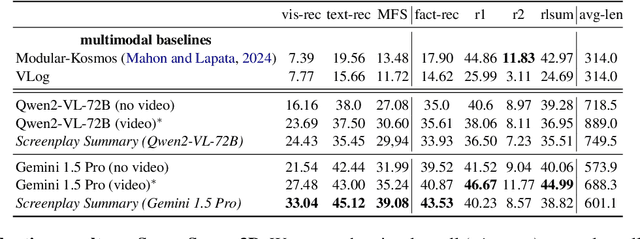
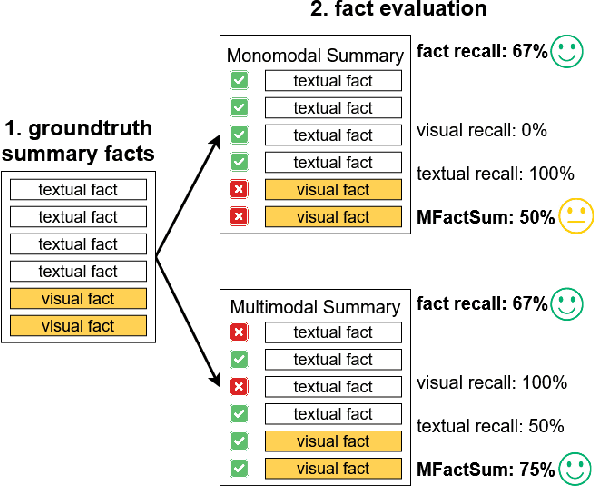

Vision-Language Models (VLMs) often struggle to balance visual and textual information when summarizing complex multimodal inputs, such as entire TV show episodes. In this paper, we propose a zero-shot video-to-text summarization approach that builds its own screenplay representation of an episode, effectively integrating key video moments, dialogue, and character information into a unified document. Unlike previous approaches, we simultaneously generate screenplays and name the characters in zero-shot, using only the audio, video, and transcripts as input. Additionally, we highlight that existing summarization metrics can fail to assess the multimodal content in summaries. To address this, we introduce MFactSum, a multimodal metric that evaluates summaries with respect to both vision and text modalities. Using MFactSum, we evaluate our screenplay summaries on the SummScreen3D dataset, demonstrating superiority against state-of-the-art VLMs such as Gemini 1.5 by generating summaries containing 20% more relevant visual information while requiring 75% less of the video as input.