 Add to Chrome
 Add to Firefox
 Add to Edge
Generalization Limits in Vehicle Re-Identification
Jun 01, 2026
Vehicle re-identification focuses on retrieving images of the same vehicle from a gallery given a query image. Upon closer inspection of commonly used datasets, we observe that vehicles with few visual differences-e.g., the same make, model, and color-appear in both the training and test sets. As a result, methods that effectively memorize the training data tend to perform well on these test sets but struggle to generalize to other datasets. In this paper, we address this issue by proposing a novel evaluation approach that more effectively measures generalization capability to unseen vehicle types. To further study generalization performance, we also propose splitting the evaluation based on view, allowing us to differentiate the effect of viewpoint robustness from that of same-view re-identification. Our findings reveal that most state-of-the-art methods struggle with unseen vehicle types, and that their robustness to viewpoint changes and attention to detail are limited to vehicle types seen during training.

SPHERE-JEPA: Spherical Prediction with Homogeneous Embeddings
May 26, 2026A fundamental open question in self-supervised learning (SSL) is the explicit characterization of the optimal geometry of the learned representations. Recently, LeJEPA identified isotropic Gaussian embeddings as optimal for minimizing downstream prediction risk in Euclidean spaces. However, the corresponding problem for distributions supported on lower-dimensional manifolds, such as the hypersphere, remains unexplored. In this work, we demonstrate that extending this minimax analysis to smooth distributions on Riemannian manifolds fundamentally changes the optimal solution. We show that, under a worst-case formulation, both k-nearest neighbors and kernel ridge regression induce hyperspherical uniformity. More precisely, we show that uniform distributions on manifolds are optimal for k-nearest neighbors, and that the uniform distribution on the sphere is optimal for kernel ridge regression with both the exponential dot-product kernel and the linear kernel. This theoretical insight reveals a fundamental limitation of Gaussian embeddings: their non-uniform density induces anisotropic k-NN neighborhoods, severely biasing the estimator. To correct this, we introduce SPHERE-JEPA, a theoretically grounded SSL framework. We adapt LeJEPA's Cram{é}r-Wold projection mechanism to enforce hyperspherical uniformity rather than a Gaussian prior. Empirically, SPHERE-JEPA yields significant improvements, boosting texture retrieval mAP by over 6%, while consistently matching or outperforming LeJEPA on standard benchmarks-including a +1.8% linear probing gain on ImageNet-1K (ViT-B/14).
Unlocking Few-Shot Capabilities in LVLMs via Prompt Conditioning and Head Selection
Mar 25, 2026Current Large Vision Language Models (LVLMs) excel at many zero-shot tasks like image captioning, visual question answering and OCR. However, these same models suffer from poor performance at image classification tasks, underperforming against CLIP-based methods. Notably, this gap is surprising because many LVLMs use CLIP-pretrained vision encoders. Yet LVLMs are not inherently limited by CLIP's architecture with independent vision and text encoders. In CLIP, this separation biases classification toward class-name matching rather than joint visual-text reasoning. In this paper we show that, despite their poor raw performance, LVLMs can improve visual feature class separability at inference using prompt conditioning, and LVLMs' internal representations, especially attention heads, can outperform the model itself at zero-shot and few-shot classification. We introduce Head Ensemble Classifiers (HEC) to bridge the performance gap between CLIP-based and LVLM-based classification methods. Inspired by Gaussian Discriminant Analysis, HEC ranks the most discriminative vision and text heads and combines them into a training-free classifier. We show that HEC achieves state-of-the-art performance in few-shot and zero-shot classification across 12 datasets.
Comparative analysis of dual-form networks for live land monitoring using multi-modal satellite image time series
Mar 25, 2026Multi-modal Satellite Image Time Series (SITS) analysis faces significant computational challenges for live land monitoring applications. While Transformer architectures excel at capturing temporal dependencies and fusing multi-modal data, their quadratic computational complexity and the need to reprocess entire sequences for each new acquisition limit their deployment for regular, large-area monitoring. This paper studies various dual-form attention mechanisms for efficient multi-modal SITS analysis, that enable parallel training while supporting recurrent inference for incremental processing. We compare linear attention and retention mechanisms within a multi-modal spectro-temporal encoder. To address SITS-specific challenges of temporal irregularity and unalignment, we develop temporal adaptations of dual-form mechanisms that compute token distances based on actual acquisition dates rather than sequence indices. Our approach is evaluated on two tasks using Sentinel-1 and Sentinel-2 data: multi-modal SITS forecasting as a proxy task, and real-world solar panel construction monitoring. Experimental results demonstrate that dual-form mechanisms achieve performance comparable to standard Transformers while enabling efficient recurrent inference. The multimodal framework consistently outperforms mono-modal approaches across both tasks, demonstrating the effectiveness of dual mechanisms for sensor fusion. The results presented in this work open new opportunities for operational land monitoring systems requiring regular updates over large geographic areas.
Deep S2P: Integrating Learning Based Stereo Matching Into the Satellite Stereo Pipeline
Mar 23, 2026Digital Surface Model generation from satellite imagery is a core task in Earth observation and is commonly addressed using classical stereoscopic matching algorithms in satellite pipelines as in the Satellite Stereo Pipeline (S2P). While recent learning-based stereo matchers achieve state-of-the-art performance on standard benchmarks, their integration into operational satellite pipelines remains challenging due to differences in viewing geometry and disparity assumptions. In this work, we integrate several modern learning-based stereo matchers, including StereoAnywhere, MonSter, Foundation Stereo, and a satellite fine-tuned variant of MonSter, into the Satellite Stereo Pipeline, adapting the rectification stage to enforce compatible disparity polarity and range. We release the corresponding code to enable reproducible use of these methods in large-scale Earth observation workflows. Experiments on satellite imagery show consistent improvements over classical cost-volume-based approaches in terms of Digital Surface Model accuracy, although commonly used metrics such as mean absolute error exhibit saturation effects. Qualitative results reveal substantially improved geometric detail and sharper structures, highlighting the need for evaluation strategies that better reflect perceptual and structural fidelity. At the same time, performance over challenging surface types such as vegetation remains limited across all evaluated models, indicating open challenges for learning-based stereo in natural environments.
An Industrial Dataset for Scene Acquisitions and Functional Schematics Alignment
Feb 17, 2026Aligning functional schematics with 2D and 3D scene acquisitions is crucial for building digital twins, especially for old industrial facilities that lack native digital models. Current manual alignment using images and LiDAR data does not scale due to tediousness and complexity of industrial sites. Inconsistencies between schematics and reality, and the scarcity of public industrial datasets, make the problem both challenging and underexplored. This paper introduces IRIS-v2, a comprehensive dataset to support further research. It includes images, point clouds, 2D annotated boxes and segmentation masks, a CAD model, 3D pipe routing information, and the P&ID (Piping and Instrumentation Diagram). The alignment is experimented on a practical case study, aiming at reducing the time required for this task by combining segmentation and graph matching.
Diachronic Stereo Matching for Multi-Date Satellite Imagery
Jan 30, 2026Recent advances in image-based satellite 3D reconstruction have progressed along two complementary directions. On one hand, multi-date approaches using NeRF or Gaussian-splatting jointly model appearance and geometry across many acquisitions, achieving accurate reconstructions on opportunistic imagery with numerous observations. On the other hand, classical stereoscopic reconstruction pipelines deliver robust and scalable results for simultaneous or quasi-simultaneous image pairs. However, when the two images are captured months apart, strong seasonal, illumination, and shadow changes violate standard stereoscopic assumptions, causing existing pipelines to fail. This work presents the first Diachronic Stereo Matching method for satellite imagery, enabling reliable 3D reconstruction from temporally distant pairs. Two advances make this possible: (1) fine-tuning a state-of-the-art deep stereo network that leverages monocular depth priors, and (2) exposing it to a dataset specifically curated to include a diverse set of diachronic image pairs. In particular, we start from a pretrained MonSter model, trained initially on a mix of synthetic and real datasets such as SceneFlow and KITTI, and fine-tune it on a set of stereo pairs derived from the DFC2019 remote sensing challenge. This dataset contains both synchronic and diachronic pairs under diverse seasonal and illumination conditions. Experiments on multi-date WorldView-3 imagery demonstrate that our approach consistently surpasses classical pipelines and unadapted deep stereo models on both synchronic and diachronic settings. Fine-tuning on temporally diverse images, together with monocular priors, proves essential for enabling 3D reconstruction from previously incompatible acquisition dates. Left image (winter) Right image (autumn) DSM geometry Ours (1.23 m) Zero-shot (3.99 m) LiDAR GT Figure 1. Output geometry for a winter-autumn image pair from Omaha (OMA 331 test scene). Our method recovers accurate geometry despite the diachronic nature of the pair, exhibiting strong appearance changes, which cause existing zero-shot methods to fail. Missing values due to perspective shown in black. Mean altitude error in parentheses; lower is better.
Remote Sensing Change Detection via Weak Temporal Supervision
Jan 05, 2026Semantic change detection in remote sensing aims to identify land cover changes between bi-temporal image pairs. Progress in this area has been limited by the scarcity of annotated datasets, as pixel-level annotation is costly and time-consuming. To address this, recent methods leverage synthetic data or generate artificial change pairs, but out-of-domain generalization remains limited. In this work, we introduce a weak temporal supervision strategy that leverages additional temporal observations of existing single-temporal datasets, without requiring any new annotations. Specifically, we extend single-date remote sensing datasets with new observations acquired at different times and train a change detection model by assuming that real bi-temporal pairs mostly contain no change, while pairing images from different locations to generate change examples. To handle the inherent noise in these weak labels, we employ an object-aware change map generation and an iterative refinement process. We validate our approach on extended versions of the FLAIR and IAILD aerial datasets, achieving strong zero-shot and low-data regime performance across different benchmarks. Lastly, we showcase results over large areas in France, highlighting the scalability potential of our method.
EOGS: Gaussian Splatting for Earth Observation
Dec 17, 2024
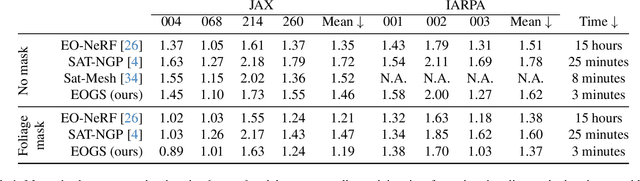

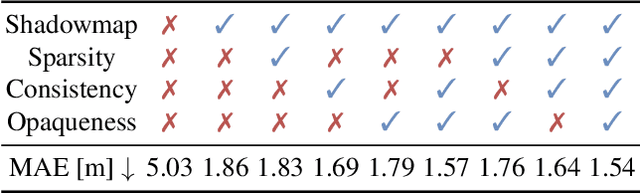
Recently, Gaussian splatting has emerged as a strong alternative to NeRF, demonstrating impressive 3D modeling capabilities while requiring only a fraction of the training and rendering time. In this paper, we show how the standard Gaussian splatting framework can be adapted for remote sensing, retaining its high efficiency. This enables us to achieve state-of-the-art performance in just a few minutes, compared to the day-long optimization required by the best-performing NeRF-based Earth observation methods. The proposed framework incorporates remote-sensing improvements from EO-NeRF, such as radiometric correction and shadow modeling, while introducing novel components, including sparsity, view consistency, and opacity regularizations.
Structure Tensor Representation for Robust Oriented Object Detection
Nov 15, 2024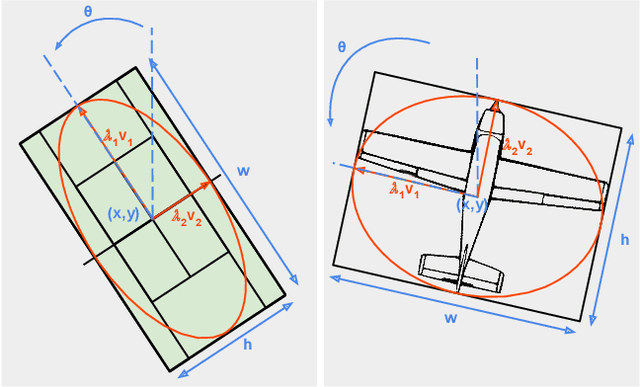
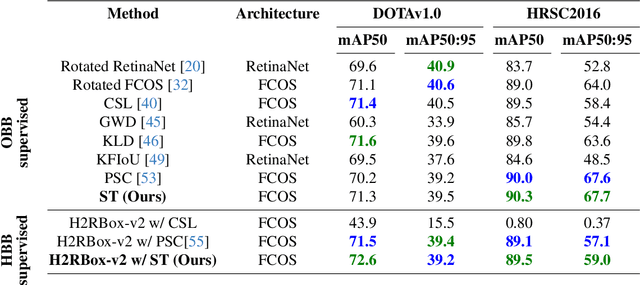
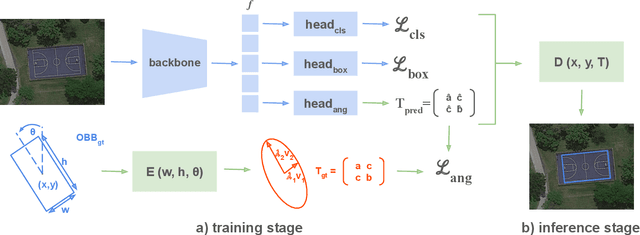
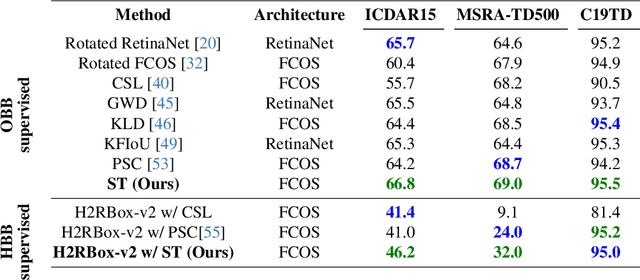
Oriented object detection predicts orientation in addition to object location and bounding box. Precisely predicting orientation remains challenging due to angular periodicity, which introduces boundary discontinuity issues and symmetry ambiguities. Inspired by classical works on edge and corner detection, this paper proposes to represent orientation in oriented bounding boxes as a structure tensor. This representation combines the strengths of Gaussian-based methods and angle-coder solutions, providing a simple yet efficient approach that is robust to angular periodicity issues without additional hyperparameters. Extensive evaluations across five datasets demonstrate that the proposed structure tensor representation outperforms previous methods in both fully-supervised and weakly supervised tasks, achieving high precision in angular prediction with minimal computational overhead. Thus, this work establishes structure tensors as a robust and modular alternative for encoding orientation in oriented object detection. We make our code publicly available, allowing for seamless integration into existing object detectors.