 Add to Chrome
 Add to Firefox
 Add to Edge
Comparative analysis of dual-form networks for live land monitoring using multi-modal satellite image time series
Mar 25, 2026
Multi-modal Satellite Image Time Series (SITS) analysis faces significant computational challenges for live land monitoring applications. While Transformer architectures excel at capturing temporal dependencies and fusing multi-modal data, their quadratic computational complexity and the need to reprocess entire sequences for each new acquisition limit their deployment for regular, large-area monitoring. This paper studies various dual-form attention mechanisms for efficient multi-modal SITS analysis, that enable parallel training while supporting recurrent inference for incremental processing. We compare linear attention and retention mechanisms within a multi-modal spectro-temporal encoder. To address SITS-specific challenges of temporal irregularity and unalignment, we develop temporal adaptations of dual-form mechanisms that compute token distances based on actual acquisition dates rather than sequence indices. Our approach is evaluated on two tasks using Sentinel-1 and Sentinel-2 data: multi-modal SITS forecasting as a proxy task, and real-world solar panel construction monitoring. Experimental results demonstrate that dual-form mechanisms achieve performance comparable to standard Transformers while enabling efficient recurrent inference. The multimodal framework consistently outperforms mono-modal approaches across both tasks, demonstrating the effectiveness of dual mechanisms for sensor fusion. The results presented in this work open new opportunities for operational land monitoring systems requiring regular updates over large geographic areas.

Paving the way toward foundation models for irregular and unaligned Satellite Image Time Series
Jul 11, 2024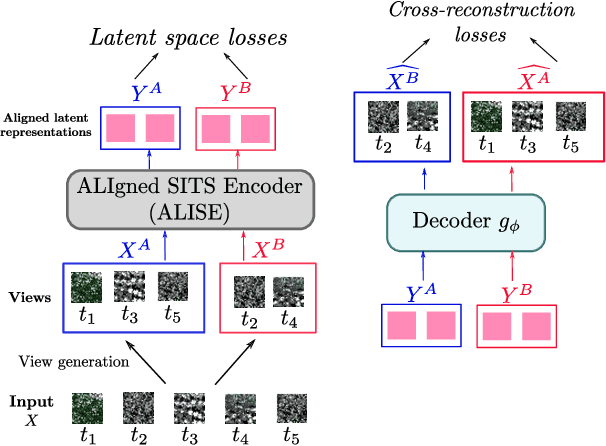

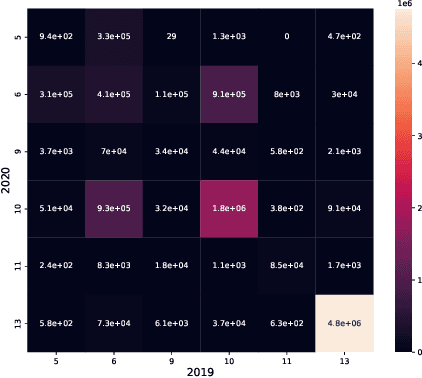
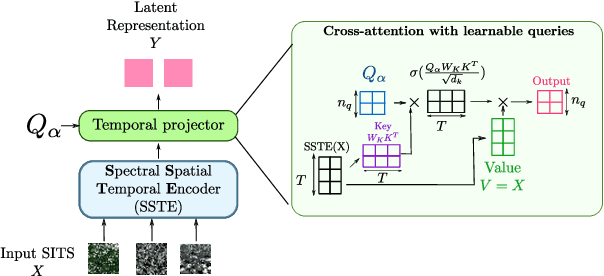
Although recently several foundation models for satellite remote sensing imagery have been proposed, they fail to address major challenges of real/operational applications. Indeed, embeddings that don't take into account the spectral, spatial and temporal dimensions of the data as well as the irregular or unaligned temporal sampling are of little use for most real world uses.As a consequence, we propose an ALIgned Sits Encoder (ALISE), a novel approach that leverages the spatial, spectral, and temporal dimensions of irregular and unaligned SITS while producing aligned latent representations. Unlike SSL models currently available for SITS, ALISE incorporates a flexible query mechanism to project the SITS into a common and learned temporal projection space. Additionally, thanks to a multi-view framework, we explore integration of instance discrimination along a masked autoencoding task to SITS. The quality of the produced representation is assessed through three downstream tasks: crop segmentation (PASTIS), land cover segmentation (MultiSenGE), and a novel crop change detection dataset. Furthermore, the change detection task is performed without supervision. The results suggest that the use of aligned representations is more effective than previous SSL methods for linear probing segmentation tasks.