 Add to Chrome
 Add to Firefox
 Add to Edge
Active IoT User Detection in Near-Field with Location Information
Feb 23, 2026
In this paper, we address active users detection (AUD) in near-field Internet of Things (IoT) networks by exploring prior knowledge of users' locations. We consider a scenario where users are distributed in a semi-circular area within the Rayleigh distance of a multi-antenna base station (BS). We propose the BS to use location estimates of the users to reconstruct their line-of-sight (LoS) channel components, hence assisting the AUD process. For this, the BS combines these reconstructed channels with users' pilot sequences, enhancing the correlation between received signals and active users. We formulate the location-aided AUD as a convex optimization problem, solved via the alternating direction method of multipliers (ADMM). {Our proposal has a higher computational complexity compared to the baseline ADMM approach where location information is not used. Moreover, the proposal requires location information of users, which can be readily informed if users are static, or inferred via established localization algorithms if they are mobile.} Simulation results compare our proposal against the baseline across varying systems parameters, such as number of users, pilot length and LoS component strength. We demonstrate that under perfect location estimation and strong LoS, our proposed method significantly outperforms the baseline. Furthermore, robustness analysis shows that performance gains persist under imperfect location estimation, provided the estimation error remains within bounds determined by the system parameters.

Age of Information in Multi-Relay Networks with Maximum Age Scheduling
Mar 20, 2025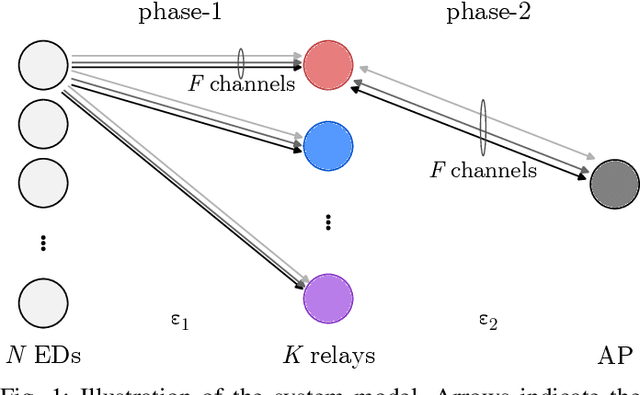
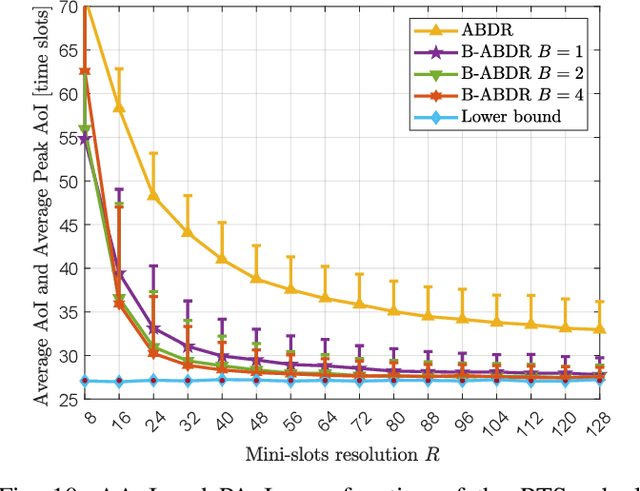
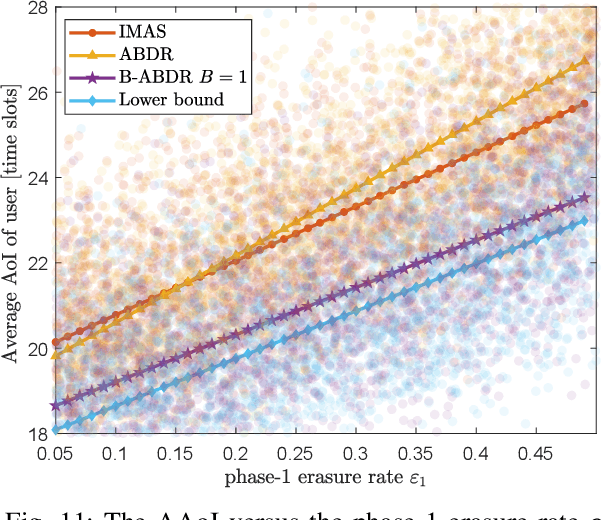
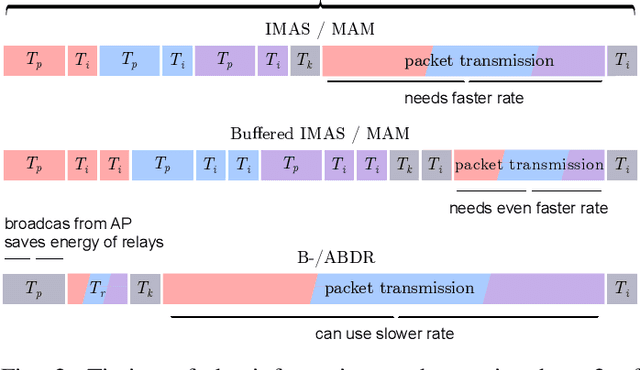
We propose and evaluate age of information (AoI)-aware multiple access mechanisms for the Internet of Things (IoT) in multi-relay two-hop networks. The network considered comprises end devices (EDs) communicating with a set of relays in ALOHA fashion, with new information packets to be potentially transmitted every time slot. The relays, in turn, forward the collected packets to an access point (AP), the final destination of the information generated by the EDs. More specifically, in this work we investigate the performance of four age-aware algorithms that prioritize older packets to be transmitted, namely max-age matching (MAM), iterative max-age scheduling (IMAS), age-based delayed request (ABDR), and buffered ABDR (B-ABDR). The former two algorithms are adapted into the multi-relay setup from previous research, and achieve satisfactory average AoI and average peak AoI performance, at the expense of a significant amount of information exchange between the relays and the AP. The latter two algorithms are newly proposed to let relays decide which one(s) will transmit in a given time slot, requiring less signaling than the former algorithms. We provide an analytical formulation for the AoI lower bound performance, compare the performance of all algorithms in this set-up, and show that they approach the lower bound. The latter holds especially true for B-ABDR, which approaches the lower bound the most closely, tilting the scale in its favor, as it also requires far less signaling than MAM and IMAS.
Assessment of the Sparsity-Diversity Trade-offs in Active Users Detection for mMTC
Feb 08, 2024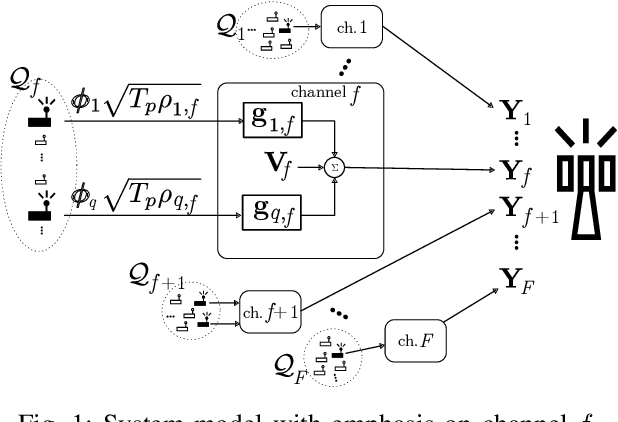
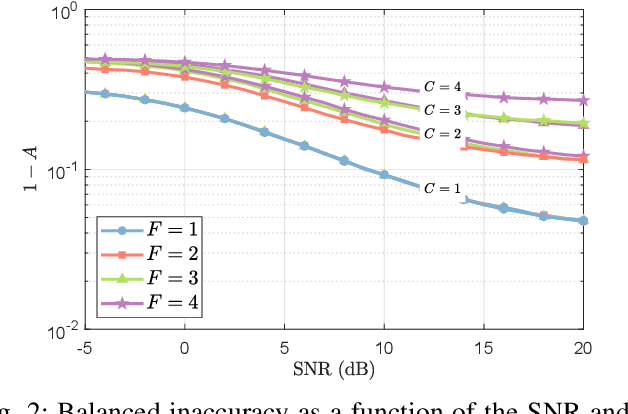
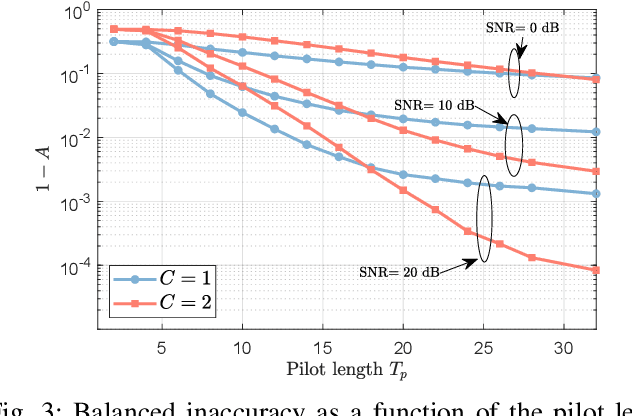
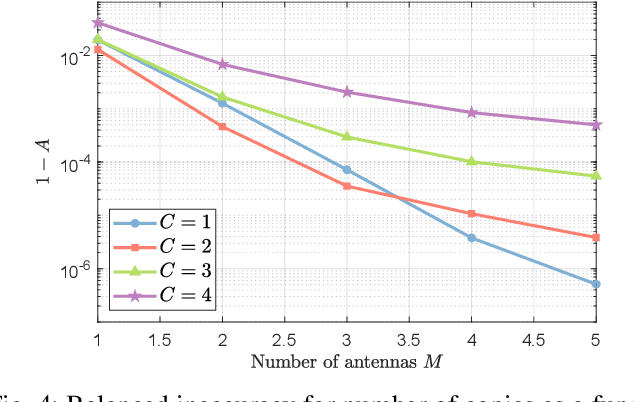
Wireless communication systems must increasingly support a multitude of machine-type communications (MTC) devices, thus calling for advanced strategies for active user detection (AUD). Recent literature has delved into AUD techniques based on compressed sensing, highlighting the critical role of signal sparsity. This study investigates the relationship between frequency diversity and signal sparsity in the AUD problem. Single-antenna users transmit multiple copies of non-orthogonal pilots across multiple frequency channels and the base station independently performs AUD in each channel using the orthogonal matching pursuit algorithm. We note that, although frequency diversity may improve the likelihood of successful reception of the signals, it may also damage the channel sparsity level, leading to important trade-offs. We show that a sparser signal significantly benefits AUD, surpassing the advantages brought by frequency diversity in scenarios with limited temporal resources and/or high numbers of receive antennas. Conversely, with longer pilots and fewer receive antennas, investing in frequency diversity becomes more impactful, resulting in a tenfold AUD performance improvement.