 Add to Chrome
 Add to Firefox
 Add to Edge
DiG-bench: Discovery in Games
Aug 12, 2026
Discovery---formulating novel generalizations---is a central part of the scientific process. Despite its importance, there is a gap in the current AI benchmark landscape, with few benchmarks directly probing the capacity for discovering new knowledge with experimentation in controlled environments where the objective is unknown. To address this gap, we release a new benchmark: DiG-bench (Discovery in Games). DiG-bench consists of a set of 70 independent games. Each game is encoded as a short string and has unique transformation rules that must be discovered through interaction and experimentation. The levels of the game present a series of challenges to test whether the rules have been discovered, where the win conditions for each level are also unknown. We provide games at seven tiers of difficulty for AI agents. The lowest tier is routinely solvable by multiple models, while the highest tier challenges the best models in agentic harnesses. All 70 games were solved by at least one human on first attempt. A subset of 21 games is released publicly, and the remainder is held private for secure evaluation.

Improving Reward Models with Synthetic Critiques
May 31, 2024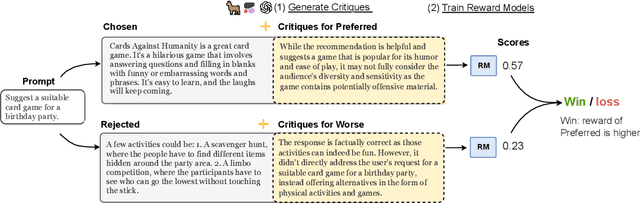

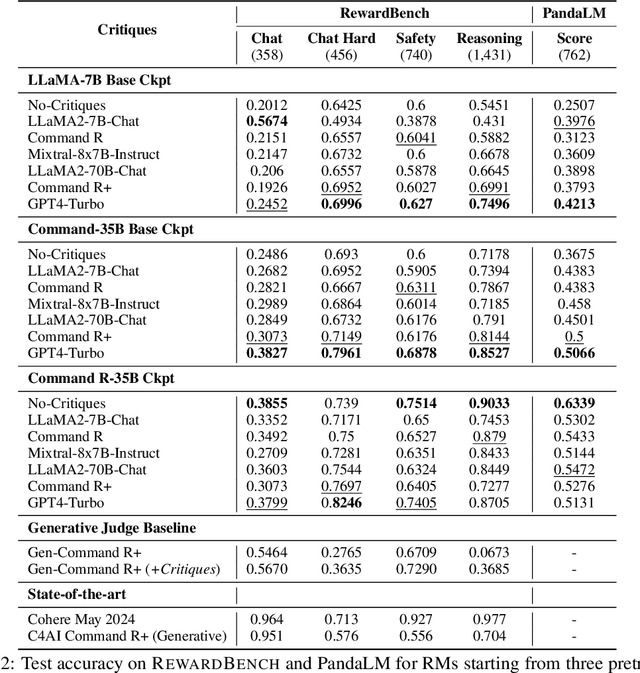

Reward models (RM) play a critical role in aligning language models through the process of reinforcement learning from human feedback. RMs are trained to predict a score reflecting human preference, which requires significant time and cost for human annotation. Additionally, RMs tend to quickly overfit on superficial features in the training set, hindering their generalization performance on unseen distributions. We propose a novel approach using synthetic natural language critiques generated by large language models to provide additional feedback, evaluating aspects such as instruction following, correctness, and style. This offers richer signals and more robust features for RMs to assess and score on. We demonstrate that high-quality critiques improve the performance and data efficiency of RMs initialized from different pretrained models. Conversely, we also show that low-quality critiques negatively impact performance. Furthermore, incorporating critiques enhances the interpretability and robustness of RM training.