 Add to Chrome
 Add to Firefox
 Add to Edge
A PAC-Bayesian approach to generalization for quantum models
Mar 24, 2026
Generalization is a central concept in machine learning theory, yet for quantum models, it is predominantly analyzed through uniform bounds that depend on a model's overall capacity rather than the specific function learned. These capacity-based uniform bounds are often too loose and entirely insensitive to the actual training and learning process. Previous theoretical guarantees have failed to provide non-uniform, data-dependent bounds that reflect the specific properties of the learned solution rather than the worst-case behavior of the entire hypothesis class. To address this limitation, we derive the first PAC-Bayesian generalization bounds for a broad class of quantum models by analyzing layered circuits composed of general quantum channels, which include dissipative operations such as mid-circuit measurements and feedforward. Through a channel perturbation analysis, we establish non-uniform bounds that depend on the norms of learned parameter matrices; we extend these results to symmetry-constrained equivariant quantum models; and we validate our theoretical framework with numerical experiments. This work provides actionable model design insights and establishes a foundational tool for a more nuanced understanding of generalization in quantum machine learning.

Classical surrogates for quantum learning models
Jun 23, 2022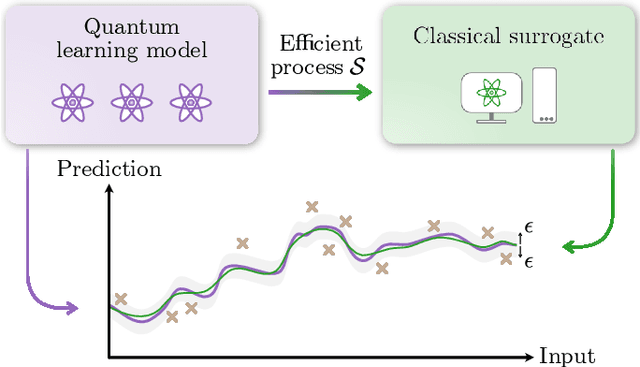
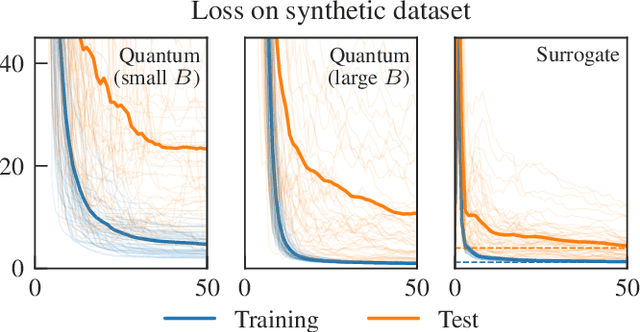
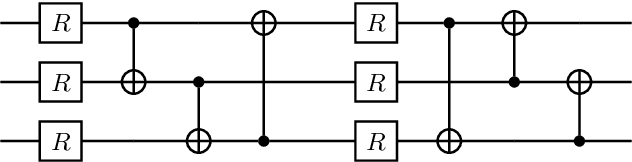
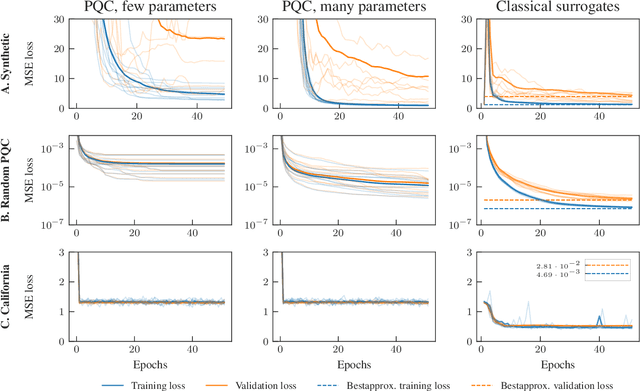
The advent of noisy intermediate-scale quantum computers has put the search for possible applications to the forefront of quantum information science. One area where hopes for an advantage through near-term quantum computers are high is quantum machine learning, where variational quantum learning models based on parametrized quantum circuits are discussed. In this work, we introduce the concept of a classical surrogate, a classical model which can be efficiently obtained from a trained quantum learning model and reproduces its input-output relations. As inference can be performed classically, the existence of a classical surrogate greatly enhances the applicability of a quantum learning strategy. However, the classical surrogate also challenges possible advantages of quantum schemes. As it is possible to directly optimize the ansatz of the classical surrogate, they create a natural benchmark the quantum model has to outperform. We show that large classes of well-analyzed re-uploading models have a classical surrogate. We conducted numerical experiments and found that these quantum models show no advantage in performance or trainability in the problems we analyze. This leaves only generalization capability as possible point of quantum advantage and emphasizes the dire need for a better understanding of inductive biases of quantum learning models.