 Add to Chrome
 Add to Firefox
 Add to Edge
Cura 1T: Specialized Model for Agentic Healthcare
Jul 15, 2026
Healthcare spans high-stakes communication, expert reasoning, and workflow execution, yet specialized LLMs that cover these use cases together remain limited. A healthcare model must handle patient consultation, clinical reasoning over text and images, interactive diagnosis, and electronic health record (EHR) tool use. These capabilities fail in different ways, and a narrow update for one task can degrade another. We present Cura 1T, a healthcare-specialized LLM trained through a human-gated self-evolution loop. In each evolution round, a training agent plans a target capability, trains the model, evaluates benchmark trajectories, and refines the data mixture from observed failures. This data-centered loop improves the model through targeted synthetic and curated examples rather than a single generic medical-data update. Across the healthcare evaluation suite, Cura 1T ranks at or near the top among frontier baselines, while remaining competitive on out-of-domain reasoning and agentic benchmarks.

Quantile Rendering: Efficiently Embedding High-dimensional Feature on 3D Gaussian Splatting
Dec 24, 2025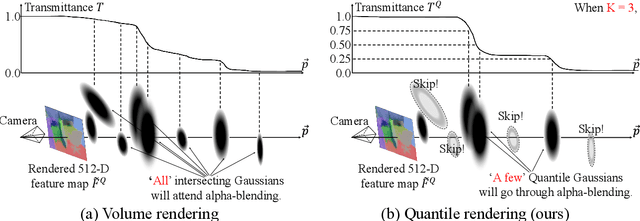

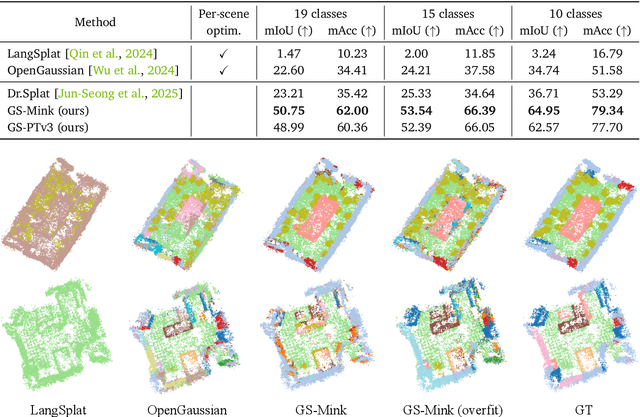
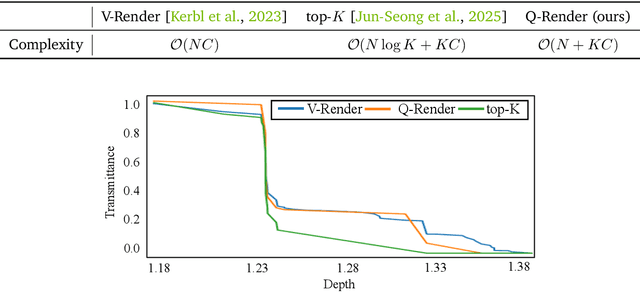
Recent advancements in computer vision have successfully extended Open-vocabulary segmentation (OVS) to the 3D domain by leveraging 3D Gaussian Splatting (3D-GS). Despite this progress, efficiently rendering the high-dimensional features required for open-vocabulary queries poses a significant challenge. Existing methods employ codebooks or feature compression, causing information loss, thereby degrading segmentation quality. To address this limitation, we introduce Quantile Rendering (Q-Render), a novel rendering strategy for 3D Gaussians that efficiently handles high-dimensional features while maintaining high fidelity. Unlike conventional volume rendering, which densely samples all 3D Gaussians intersecting each ray, Q-Render sparsely samples only those with dominant influence along the ray. By integrating Q-Render into a generalizable 3D neural network, we also propose Gaussian Splatting Network (GS-Net), which predicts Gaussian features in a generalizable manner. Extensive experiments on ScanNet and LeRF demonstrate that our framework outperforms state-of-the-art methods, while enabling real-time rendering with an approximate ~43.7x speedup on 512-D feature maps. Code will be made publicly available.
The Many Faces of Robustness: A Critical Analysis of Out-of-Distribution Generalization
Jun 29, 2020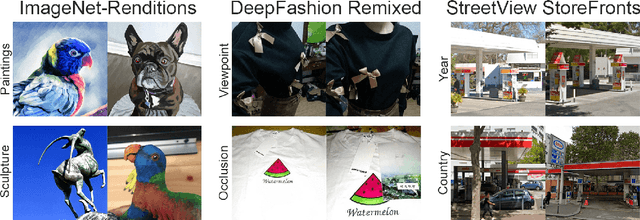
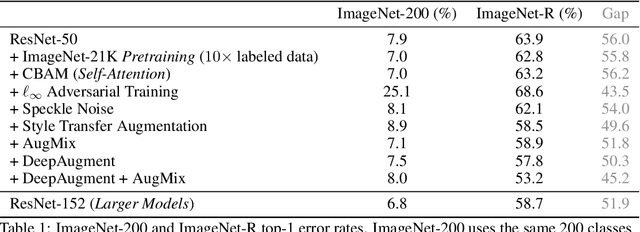

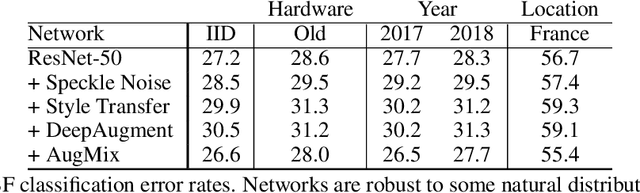
We introduce three new robustness benchmarks consisting of naturally occurring distribution changes in image style, geographic location, camera operation, and more. Using our benchmarks, we take stock of previously proposed hypotheses for out-of-distribution robustness and put them to the test. We find that using larger models and synthetic data augmentation can improve robustness on real-world distribution shifts, contrary to claims in prior work. Motivated by this, we introduce a new data augmentation method which advances the state-of-the-art and outperforms models pretrained with 1000x more labeled data. We find that some methods consistently help with distribution shifts in texture and local image statistics, but these methods do not help with some other distribution shifts like geographic changes. We conclude that future research must study multiple distribution shifts simultaneously.
A Nonlinear Model for Time Synchronization
Mar 01, 2019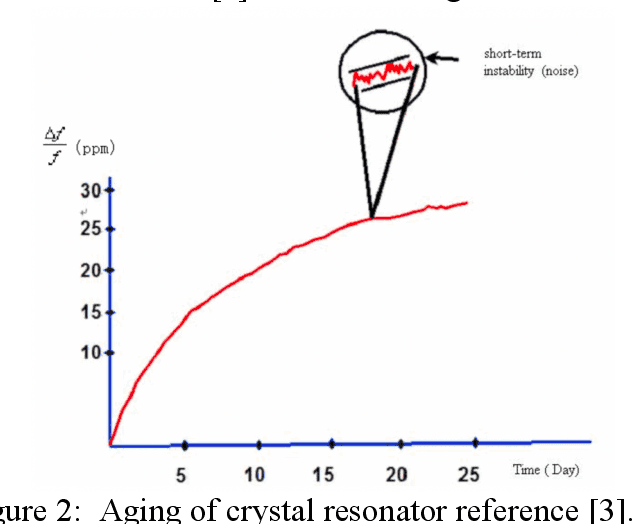


The current algorithms are based on linear model, for example, Precision Time Protocol (PTP) which requires frequent synchronization in order to handle the effects of clock frequency drift. This paper introduces a nonlinear approach to clock time synchronize. This approach can accurately model the frequency shift. Therefore, the required time interval to synchronize clocks can be longer. Meanwhile, it also offers better performance and relaxes the synchronization process. The idea of the nonlinear algorithm and some numerical examples will be presented in this paper in detail.