 Add to Chrome
 Add to Firefox
 Add to Edge
Benchmarking the Open Science Data Federation services to develop XRootD best practices
May 13, 2026
Research has become dependent on processing power and storage, one crucial aspect being data sharing. The Open Science Data Federation (OSDF) project aims to create a scientific global data distribution network based on the Pelican Platform. OSDF relies on the XRootD and Pelican projects. Nevertheless, OSDF must understand the XRootD limits under various configuration options, including transfer rate limits, proper buffer configuration, and storage type effect. We have thus executed a set of benchmarks to create a set of recommendations to share with the XRootD and Pelican teams. This work describes the tests and results performed using National Research Platform (NRP) hosts. The tests cover various file sizes and parallel streams and use clients from various distances from the server host. We also used several standalone clients (wget, curl, pelican) and the native HTCondor file transfer mechanisms. Applying the methodology creates a possibility to track how XRootD and the Pelican layer perform in different scenarios.

Access Trends of In-network Cache for Scientific Data
May 11, 2022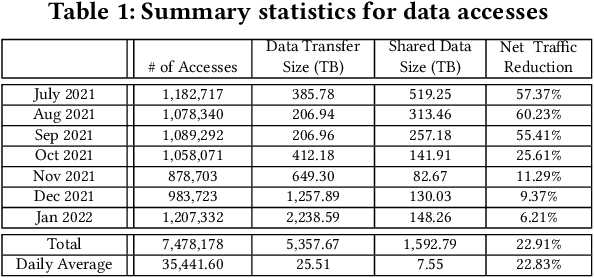
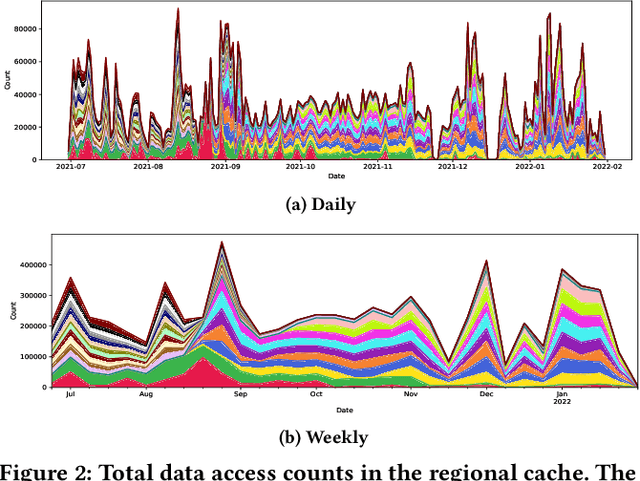
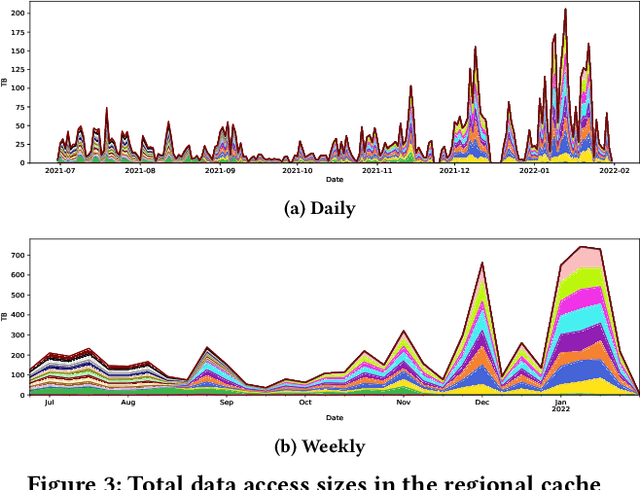
Scientific collaborations are increasingly relying on large volumes of data for their work and many of them employ tiered systems to replicate the data to their worldwide user communities. Each user in the community often selects a different subset of data for their analysis tasks; however, members of a research group often are working on related research topics that require similar data objects. Thus, there is a significant amount of data sharing possible. In this work, we study the access traces of a federated storage cache known as the Southern California Petabyte Scale Cache. By studying the access patterns and potential for network traffic reduction by this caching system, we aim to explore the predictability of the cache uses and the potential for a more general in-network data caching. Our study shows that this distributed storage cache is able to reduce the network traffic volume by a factor of 2.35 during a part of the study period. We further show that machine learning models could predict cache utilization with an accuracy of 0.88. This demonstrates that such cache usage is predictable, which could be useful for managing complex networking resources such as in-network caching.