 Add to Chrome
 Add to Firefox
 Add to Edge
From Natural Language to Control Signals: A Conceptual Framework for Semantic Channel Finding in Complex Experimental Infrastructure
Dec 21, 2025
Modern experimental platforms such as particle accelerators, fusion devices, telescopes, and industrial process control systems expose tens to hundreds of thousands of control and diagnostic channels accumulated over decades of evolution. Operators and AI systems rely on informal expert knowledge, inconsistent naming conventions, and fragmented documentation to locate signals for monitoring, troubleshooting, and automated control, creating a persistent bottleneck for reliability, scalability, and language-model-driven interfaces. We formalize semantic channel finding-mapping natural-language intent to concrete control-system signals-as a general problem in complex experimental infrastructure, and introduce a four-paradigm framework to guide architecture selection across facility-specific data regimes. The paradigms span (i) direct in-context lookup over curated channel dictionaries, (ii) constrained hierarchical navigation through structured trees, (iii) interactive agent exploration using iterative reasoning and tool-based database queries, and (iv) ontology-grounded semantic search that decouples channel meaning from facility-specific naming conventions. We demonstrate each paradigm through proof-of-concept implementations at four operational facilities spanning two orders of magnitude in scale-from compact free-electron lasers to large synchrotron light sources-and diverse control-system architectures, from clean hierarchies to legacy environments. These implementations achieve 90-97% accuracy on expert-curated operational queries.

GAIA: A General AI Assistant for Intelligent Accelerator Operations
May 02, 2024Large-scale machines like particle accelerators are usually run by a team of experienced operators. In case of a particle accelerator, these operators possess suitable background knowledge on both accelerator physics and the technology comprising the machine. Due to the complexity of the machine, particular subsystems of the machine are taken care of by experts, who the operators can turn to. In this work the reasoning and action (ReAct) prompting paradigm is used to couple an open-weights large language model (LLM) with a high-level machine control system framework and other tools, e.g. the electronic logbook or machine design documentation. By doing so, a multi-expert retrieval augmented generation (RAG) system is implemented, which assists operators in knowledge retrieval tasks, interacts with the machine directly if needed, or writes high level control system scripts. This consolidation of expert knowledge and machine interaction can simplify and speed up machine operation tasks for both new and experienced human operators.
Learning to Do or Learning While Doing: Reinforcement Learning and Bayesian Optimisation for Online Continuous Tuning
Jun 06, 2023
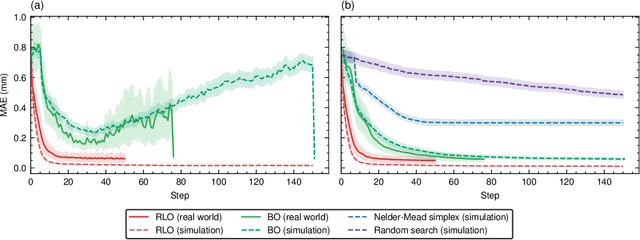

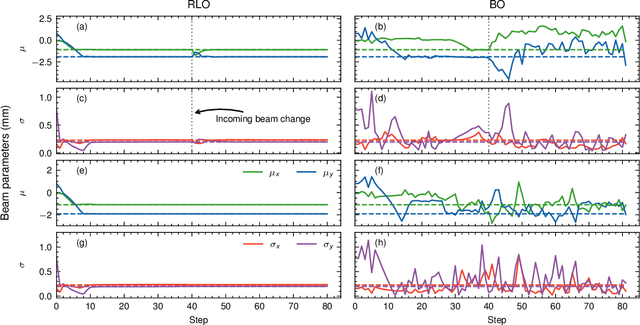
Online tuning of real-world plants is a complex optimisation problem that continues to require manual intervention by experienced human operators. Autonomous tuning is a rapidly expanding field of research, where learning-based methods, such as Reinforcement Learning-trained Optimisation (RLO) and Bayesian optimisation (BO), hold great promise for achieving outstanding plant performance and reducing tuning times. Which algorithm to choose in different scenarios, however, remains an open question. Here we present a comparative study using a routine task in a real particle accelerator as an example, showing that RLO generally outperforms BO, but is not always the best choice. Based on the study's results, we provide a clear set of criteria to guide the choice of algorithm for a given tuning task. These can ease the adoption of learning-based autonomous tuning solutions to the operation of complex real-world plants, ultimately improving the availability and pushing the limits of operability of these facilities, thereby enabling scientific and engineering advancements.