 Add to Chrome
 Add to Firefox
 Add to Edge
A Methodology for Investigating AI Patterns Prevalence in Software Repositories
Jul 01, 2026
As Artificial Intelligence(AI)-based applications take off, a clear understanding of AI patterns can uplift the quality of AI applications. Many AI patterns have been proposed in the literature; however, their prevalence in real-life code has not yet been validated. Understanding the actual use of those patterns in practice can clarify our understanding both of the significance of these patterns and their utility. In this paper, we present a methodology to a) identify relevant patterns by mining the literature and then to b) validate their presence and prevalence in actual code repositories using active learning. To that end, we identify 14 AI pattern classes by mining 44 published AI pattern-related sources. Then we use an active learning approach to determine the prevalence of the most common pattern class across 100 GitHub open AI repositories. Using prevalence estimation, we propose bounds on the accuracy of the occurrences. The model achieves 56\% accuracy and 55\% recall in an 8-way classification task, significantly outperforming the 11\% random-chance baseline. Furthermore, the prevalence estimation offers usable bounds for analyzing pattern applications. This methodology provides a robust foundation to start understanding how AI patterns are used in practice, a field that currently lacks empirical data.

Robust Agent Compensation (RAC): Teaching AI Agents to Compensate
May 05, 2026We present Robust Agent Compensation (RAC), a log-based recovery paradigm (providing a safety net) implemented through an architectural extension that can be applied to most Agent frameworks to support reliable executions (avoiding unintended side effects). Users can choose to enable RAC without changing their current agent code (e.g., LangGraph agents). The proposed approach can be implemented in most existing agent frameworks via their existing extension points. We present an implementation based on LangChain, demonstrate its viability through the $τ$-bench and REALM-Bench, and show that when solving complex problems, RAC is 1.5-8X or more better in both latency and token economy compared to state-of-the-art LLM-based recovery approaches.
Architectural Vision for Quantum Computing in the Edge-Cloud Continuum
May 09, 2023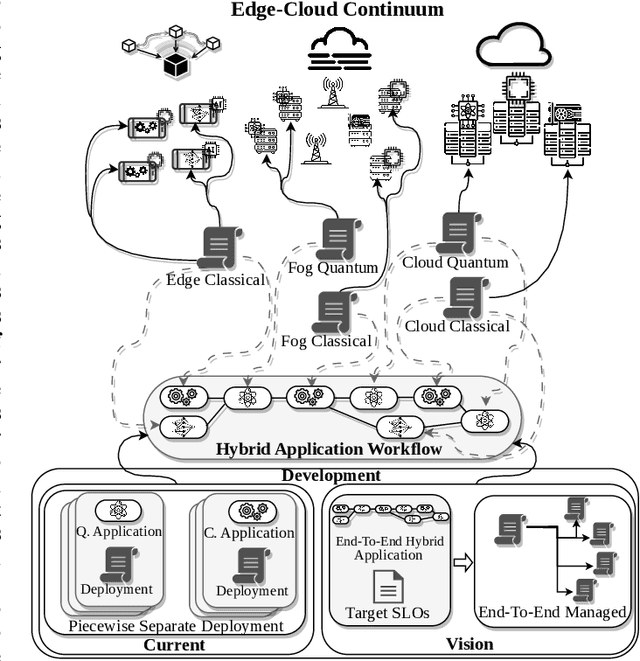

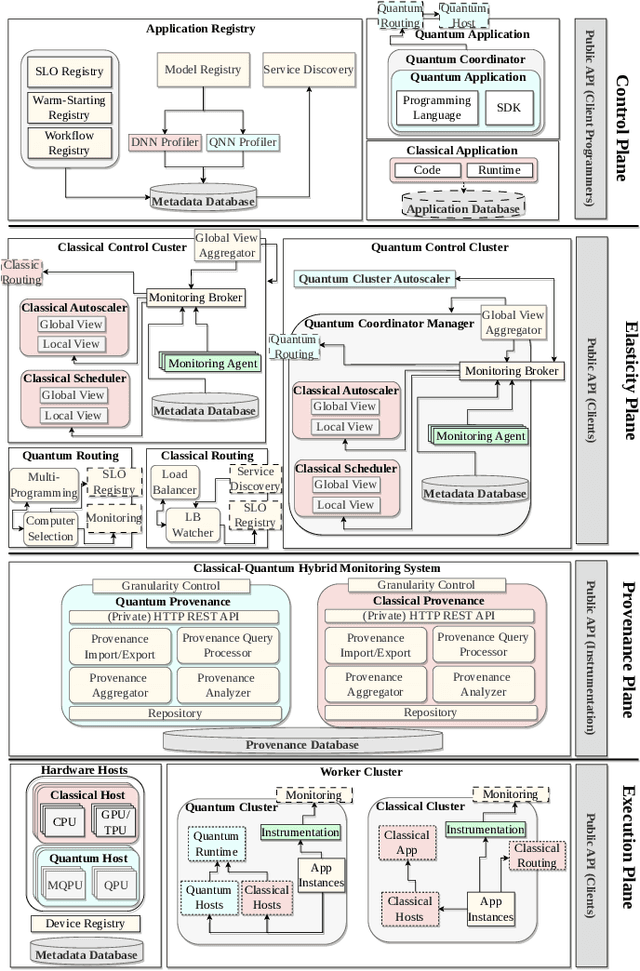
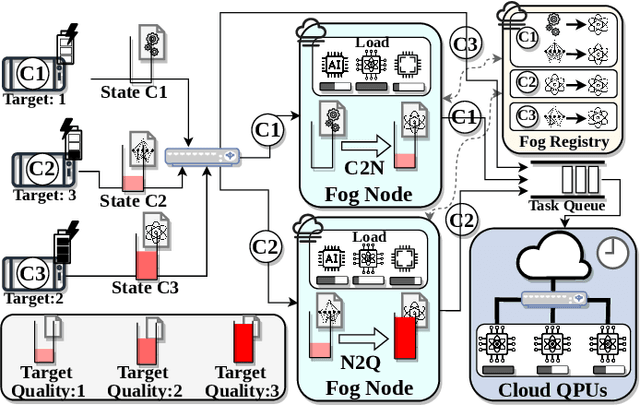
Quantum processing units (QPUs) are currently exclusively available from cloud vendors. However, with recent advancements, hosting QPUs is soon possible everywhere. Existing work has yet to draw from research in edge computing to explore systems exploiting mobile QPUs, or how hybrid applications can benefit from distributed heterogeneous resources. Hence, this work presents an architecture for Quantum Computing in the edge-cloud continuum. We discuss the necessity, challenges, and solution approaches for extending existing work on classical edge computing to integrate QPUs. We describe how warm-starting allows defining workflows that exploit the hierarchical resources spread across the continuum. Then, we introduce a distributed inference engine with hybrid classical-quantum neural networks (QNNs) to aid system designers in accommodating applications with complex requirements that incur the highest degree of heterogeneity. We propose solutions focusing on classical layer partitioning and quantum circuit cutting to demonstrate the potential of utilizing classical and quantum computation across the continuum. To evaluate the importance and feasibility of our vision, we provide a proof of concept that exemplifies how extending a classical partition method to integrate quantum circuits can improve the solution quality. Specifically, we implement a split neural network with optional hybrid QNN predictors. Our results show that extending classical methods with QNNs is viable and promising for future work.