 Add to Chrome
 Add to Firefox
 Add to Edge
Beyond Backscatter: InSAR coherence from detected SAR images
Jun 05, 2026
In this work, we propose a deep learning framework for coherence regression directly from detected SAR images, without the need for accurate coregistration. A Residual U-Net is trained using coherence maps derived from precisely coregistered Sentinel-1 SLC data to learn the relationship between backscatter magnitudes and coherence. The model is trained on 12-day SLC pairs and evaluated across different datasets, including coregistered SLC products and open access analysis-ready data, covering diverse radiometric properties, geometries, and locations. Experimental results demonstrate that the proposed method achieves high-resolution coherence regression with improved accuracy compared to existing intensity-based approaches. The network generalizes well across diverse geographical locations and even across different temporal baselines that were never seen at training time. Additionally, the ability to operate on globally available analysis-ready data, such as ground range detected data, e.g., distributed through Google Earth Engine, enables its large-scale application in mission design, change monitoring, and diverse mapping tasks.

Prompting Foundation Models for Zero-Shot Ship Instance Segmentation in SAR Imagery
Apr 20, 2026Synthetic Aperture Radar (SAR) plays a critical role in maritime surveillance, yet deep learning for SAR analysis is limited by the lack of pixel-level annotations. This paper explores how general-purpose vision foundation models can enable zero-shot ship instance segmentation in SAR imagery, eliminating the need for pixel-level supervision. A YOLOv11-based detector trained on open SAR datasets localizes ships via bounding boxes, which then prompt the Segment Anything Model 2 (SAM2) to produce instance masks without any mask annotations. Unlike prior SAM-based SAR approaches that rely on fine tuning or adapters, our method demonstrates that spatial constraints from a SAR-trained detector alone can effectively regularize foundation model predictions. This design partially mitigates the optical-SAR domain gap and enables downstream applications such as vessel classification, size estimation, and wake analysis. Experiments on the SSDD benchmark achieve a mean IoU of 0.637 (89% of a fully supervised baseline) with an overall ship detection rate of 89.2%, confirming a scalable, annotation-efficient pathway toward foundation-model-driven SAR image understanding.
There Are No Data Like More Data- Datasets for Deep Learning in Earth Observation
Oct 30, 2023

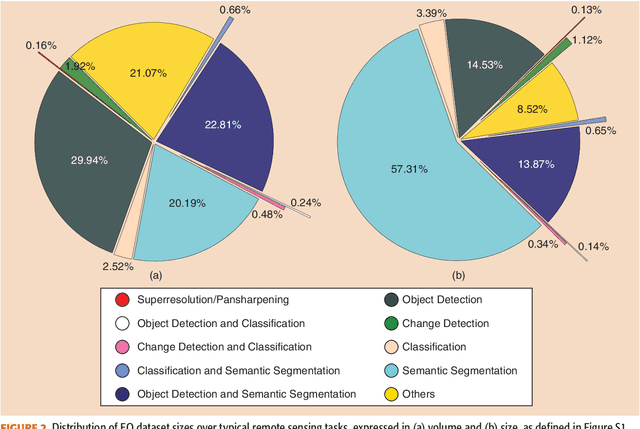

Carefully curated and annotated datasets are the foundation of machine learning, with particularly data-hungry deep neural networks forming the core of what is often called Artificial Intelligence (AI). Due to the massive success of deep learning applied to Earth Observation (EO) problems, the focus of the community has been largely on the development of ever-more sophisticated deep neural network architectures and training strategies largely ignoring the overall importance of datasets. For that purpose, numerous task-specific datasets have been created that were largely ignored by previously published review articles on AI for Earth observation. With this article, we want to change the perspective and put machine learning datasets dedicated to Earth observation data and applications into the spotlight. Based on a review of the historical developments, currently available resources are described and a perspective for future developments is formed. We hope to contribute to an understanding that the nature of our data is what distinguishes the Earth observation community from many other communities that apply deep learning techniques to image data, and that a detailed understanding of EO data peculiarities is among the core competencies of our discipline.
Deep Learning Solutions for TanDEM-X-based Forest Classification
Feb 01, 2019
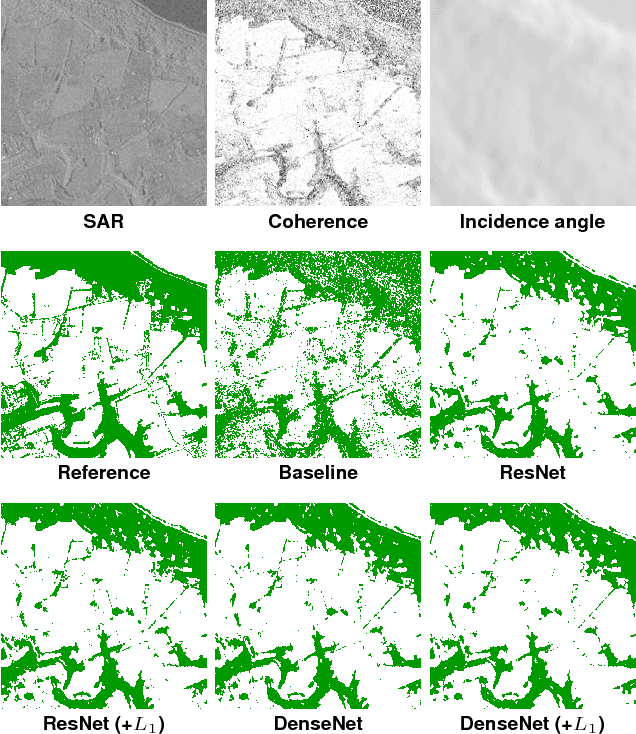
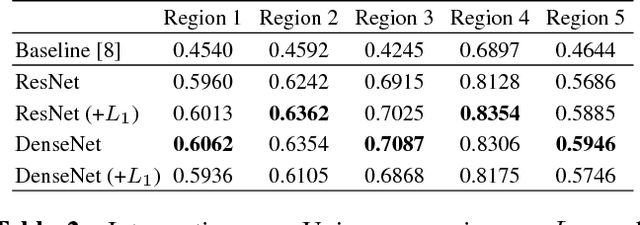
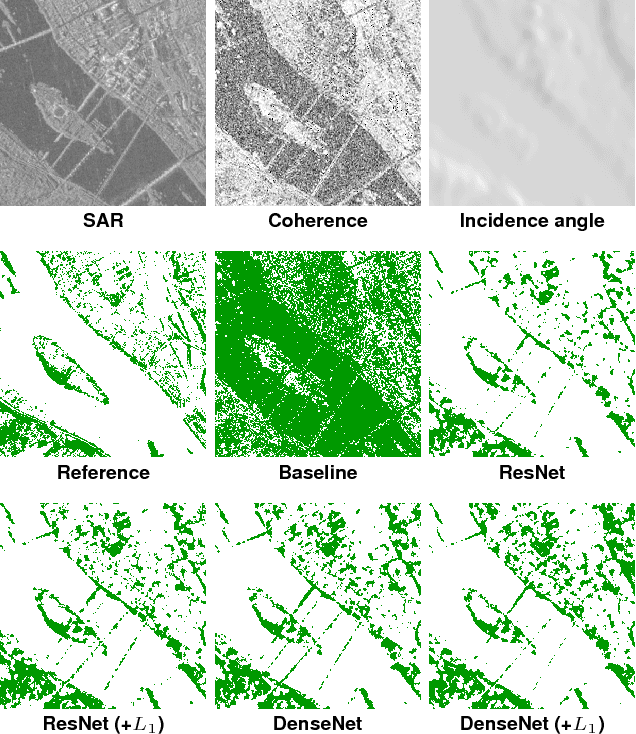
In the last few years, deep learning (DL) has been successfully and massively employed in computer vision for discriminative tasks, such as image classification or object detection. This kind of problems are core to many remote sensing (RS) applications as well, though with domain-specific peculiarities. Therefore, there is a growing interest on the use of DL methods for RS tasks. Here, we consider the forest/non-forest classification problem with TanDEM-X data, and test two state-of-the-art DL models, suitably adapting them to the specific task. Our experiments confirm the great potential of DL methods for RS applications.