 Add to Chrome
 Add to Firefox
 Add to Edge
OTA Characterization of Dual-User IEEE 802.11be EHT-MU Under Transmit-Chain Imbalance
May 26, 2026
This paper presents a controlled over-the-air (OTA) characterization of dual-user IEEE 802.11be Extremely High Throughput Multi-User (EHT-MU) transmission under transmit-chain imbalance. The objective is to determine whether attenuation applied to one access-point transmit chain produces packet-global degradation or appears primarily as stream-dependent payload degradation after receiver processing. Measurements are performed in a shielded RF enclosure using two NI USRP-2953R and NI USRP-2942R software-defined radios, with one USRP generating a dual-user non-OFDMA EHT-MU waveform and the other implementing synchronized dual-branch packet recovery. A calibrated attenuation sweep is applied to the second AP transmit chain (TX2), and performance is evaluated using bit error rate (BER), EHT-Data error vector magnitude (EVM), control-field success probability, payload-success probability, and subcarrier-level EVM distributions. The results show that the stream decoded as User~1 remains at the BER floor over the tested range, while the stream decoded as User~2 exhibits progressive EVM degradation followed by threshold-like BER and payload-success collapse. Common signaling fields remain recoverable, indicating that the dominant observed failure mode is stream-local at the receiver output than the packet-global. Replacing User~2 binary convolutional coding (BCC) with low density parity check (LDPC) coding delays the BER and payload-success collapse by approximately \(5\)~dB of TX2 attenuation, demonstrating a measurable coding-dependent robustness margin for the more sensitive stream.

Over-the-Air Successive Interference Cancellation for Efficient 5G NR and Wi-Fi Spectrum Reuse
May 26, 2026An over-the-air (OTA) experimental evaluation of concurrent 5G New Radio (5G NR) and Wi-Fi transmission using successive interference cancellation (SIC) in a shielded-box environment is presented. A USRP is used as the receiver, which captures the composite waveform containing both air-interface signals and applies sample-domain SIC to suppress the dominant 5G-NR signal and recover Wi-Fi signal from the residual waveform. The framework reports error vector magnitude (EVM), bit error rate (BER), sample-domain cancellation depth, and channel-estimate suppression, and, at the representative \(18\) dB attenuation point, measures \(11.88\) dB cancellation depth and \(26.96\) dB 5G channel suppression. The proposed methodology provides a practical basis for assessing cross-technology coexistence and receiver-side interference suppression under controlled OTA conditions.
LE3D: A Lightweight Ensemble Framework of Data Drift Detectors for Resource-Constrained Devices
Nov 18, 2022


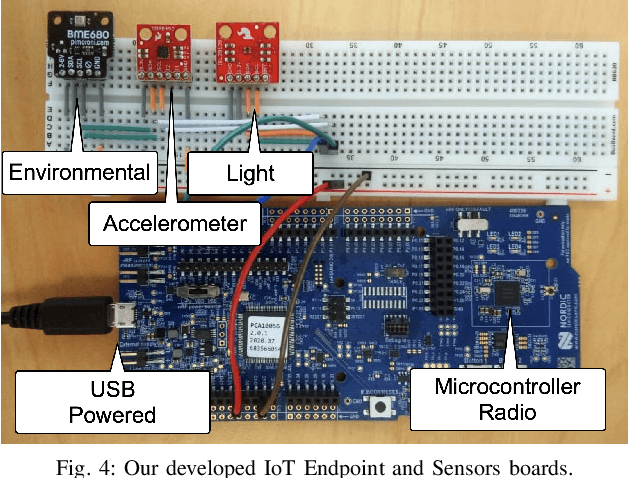
Data integrity becomes paramount as the number of Internet of Things (IoT) sensor deployments increases. Sensor data can be altered by benign causes or malicious actions. Mechanisms that detect drifts and irregularities can prevent disruptions and data bias in the state of an IoT application. This paper presents LE3D, an ensemble framework of data drift estimators capable of detecting abnormal sensor behaviours. Working collaboratively with surrounding IoT devices, the type of drift (natural/abnormal) can also be identified and reported to the end-user. The proposed framework is a lightweight and unsupervised implementation able to run on resource-constrained IoT devices. Our framework is also generalisable, adapting to new sensor streams and environments with minimal online reconfiguration. We compare our method against state-of-the-art ensemble data drift detection frameworks, evaluating both the real-world detection accuracy as well as the resource utilisation of the implementation. Experimenting with real-world data and emulated drifts, we show the effectiveness of our method, which achieves up to 97% of detection accuracy while requiring minimal resources to run.