 Add to Chrome
 Add to Firefox
 Add to Edge
Leveraging Multi-Rater Annotations to Calibrate Object Detectors in Microscopy Imaging
Jan 30, 2026
Deep learning-based object detectors have achieved impressive performance in microscopy imaging, yet their confidence estimates often lack calibration, limiting their reliability for biomedical applications. In this work, we introduce a new approach to improve model calibration by leveraging multi-rater annotations. We propose to train separate models on the annotations from single experts and aggregate their predictions to emulate consensus. This improves upon label sampling strategies, where models are trained on mixed annotations, and offers a more principled way to capture inter-rater variability. Experiments on a colorectal organoid dataset annotated by two experts demonstrate that our rater-specific ensemble strategy improves calibration performance while maintaining comparable detection accuracy. These findings suggest that explicitly modelling rater disagreement can lead to more trustworthy object detectors in biomedical imaging.

Expressivity of Graph Neural Networks Through the Lens of Adversarial Robustness
Aug 16, 2023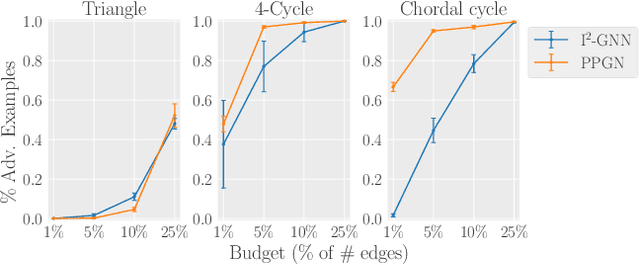
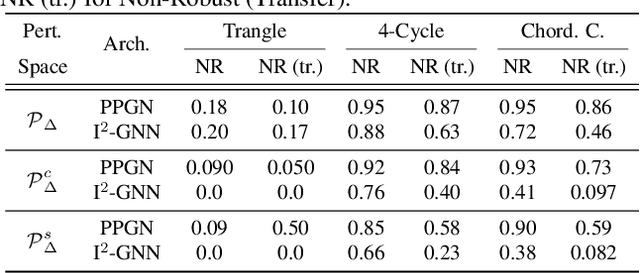
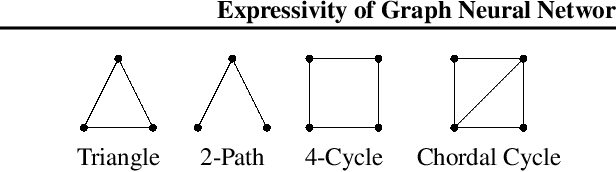
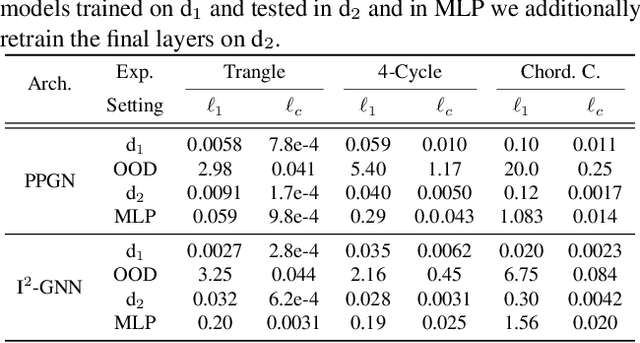
We perform the first adversarial robustness study into Graph Neural Networks (GNNs) that are provably more powerful than traditional Message Passing Neural Networks (MPNNs). In particular, we use adversarial robustness as a tool to uncover a significant gap between their theoretically possible and empirically achieved expressive power. To do so, we focus on the ability of GNNs to count specific subgraph patterns, which is an established measure of expressivity, and extend the concept of adversarial robustness to this task. Based on this, we develop efficient adversarial attacks for subgraph counting and show that more powerful GNNs fail to generalize even to small perturbations to the graph's structure. Expanding on this, we show that such architectures also fail to count substructures on out-of-distribution graphs.