 Add to Chrome
 Add to Firefox
 Add to Edge
How to Optimize Multispecies Set Predictions in Presence-Absence Modeling ?
Feb 12, 2026
Species distribution models (SDMs) commonly produce probabilistic occurrence predictions that must be converted into binary presence-absence maps for ecological inference and conservation planning. However, this binarization step is typically heuristic and can substantially distort estimates of species prevalence and community composition. We present MaxExp, a decision-driven binarization framework that selects the most probable species assemblage by directly maximizing a chosen evaluation metric. MaxExp requires no calibration data and is flexible across several scores. We also introduce the Set Size Expectation (SSE) method, a computationally efficient alternative that predicts assemblages based on expected species richness. Using three case studies spanning diverse taxa, species counts, and performance metrics, we show that MaxExp consistently matches or surpasses widely used thresholding and calibration methods, especially under strong class imbalance and high rarity. SSE offers a simpler yet competitive option. Together, these methods provide robust, reproducible tools for multispecies SDM binarization.

Modelling Species Distributions with Deep Learning to Predict Plant Extinction Risk and Assess Climate Change Impacts
Jan 10, 2024The post-2020 global biodiversity framework needs ambitious, research-based targets. Estimating the accelerated extinction risk due to climate change is critical. The International Union for Conservation of Nature (IUCN) measures the extinction risk of species. Automatic methods have been developed to provide information on the IUCN status of under-assessed taxa. However, these compensatory methods are based on current species characteristics, mainly geographical, which precludes their use in future projections. Here, we evaluate a novel method for classifying the IUCN status of species benefiting from the generalisation power of species distribution models based on deep learning. Our method matches state-of-the-art classification performance while relying on flexible SDM-based features that capture species' environmental preferences. Cross-validation yields average accuracies of 0.61 for status classification and 0.78 for binary classification. Climate change will reshape future species distributions. Under the species-environment equilibrium hypothesis, SDM projections approximate plausible future outcomes. Two extremes of species dispersal capacity are considered: unlimited or null. The projected species distributions are translated into features feeding our IUCN classification method. Finally, trends in threatened species are analysed over time and i) by continent and as a function of average ii) latitude or iii) altitude. The proportion of threatened species is increasing globally, with critical rates in Africa, Asia and South America. Furthermore, the proportion of threatened species is predicted to peak around the two Tropics, at the Equator, in the lowlands and at altitudes of 800-1,500 m.
AI-based Mapping of the Conservation Status of Orchid Assemblages at Global Scale
Jan 09, 2024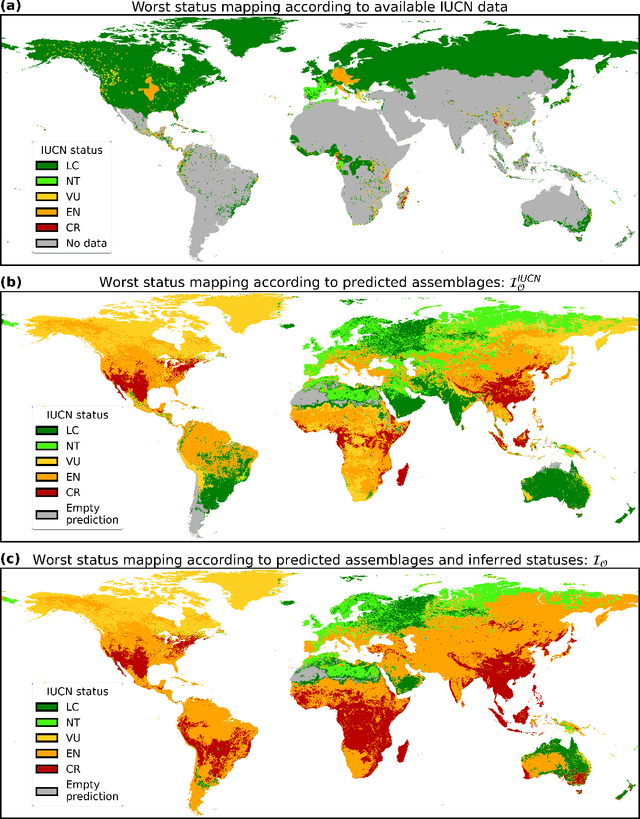
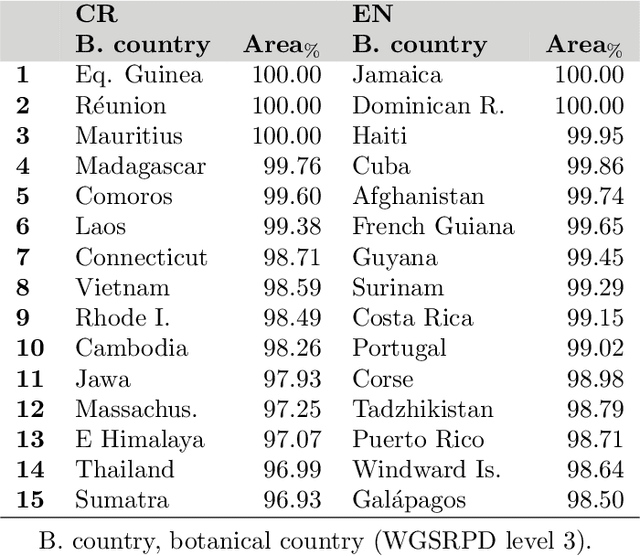

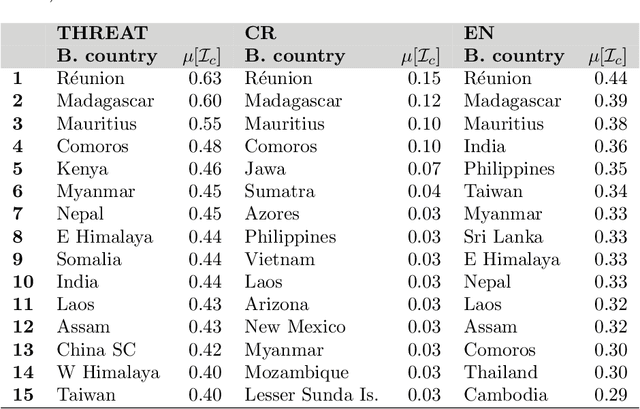
Although increasing threats on biodiversity are now widely recognised, there are no accurate global maps showing whether and where species assemblages are at risk. We hereby assess and map at kilometre resolution the conservation status of the iconic orchid family, and discuss the insights conveyed at multiple scales. We introduce a new Deep Species Distribution Model trained on 1M occurrences of 14K orchid species to predict their assemblages at global scale and at kilometre resolution. We propose two main indicators of the conservation status of the assemblages: (i) the proportion of threatened species, and (ii) the status of the most threatened species in the assemblage. We show and analyze the variation of these indicators at World scale and in relation to currently protected areas in Sumatra island. Global and interactive maps available online show the indicators of conservation status of orchid assemblages, with sharp spatial variations at all scales. The highest level of threat is found at Madagascar and the neighbouring islands. In Sumatra, we found good correspondence of protected areas with our indicators, but supplementing current IUCN assessments with status predictions results in alarming levels of species threat across the island. Recent advances in deep learning enable reliable mapping of the conservation status of species assemblages on a global scale. As an umbrella taxon, orchid family provides a reference for identifying vulnerable ecosystems worldwide, and prioritising conservation actions both at international and local levels.