 Add to Chrome
 Add to Firefox
 Add to Edge
How to Optimize Multispecies Set Predictions in Presence-Absence Modeling ?
Feb 12, 2026
Species distribution models (SDMs) commonly produce probabilistic occurrence predictions that must be converted into binary presence-absence maps for ecological inference and conservation planning. However, this binarization step is typically heuristic and can substantially distort estimates of species prevalence and community composition. We present MaxExp, a decision-driven binarization framework that selects the most probable species assemblage by directly maximizing a chosen evaluation metric. MaxExp requires no calibration data and is flexible across several scores. We also introduce the Set Size Expectation (SSE) method, a computationally efficient alternative that predicts assemblages based on expected species richness. Using three case studies spanning diverse taxa, species counts, and performance metrics, we show that MaxExp consistently matches or surpasses widely used thresholding and calibration methods, especially under strong class imbalance and high rarity. SSE offers a simpler yet competitive option. Together, these methods provide robust, reproducible tools for multispecies SDM binarization.

Observation-only learning of neural mapping schemes for gappy satellite-derived ocean colour parameters
Mar 14, 2025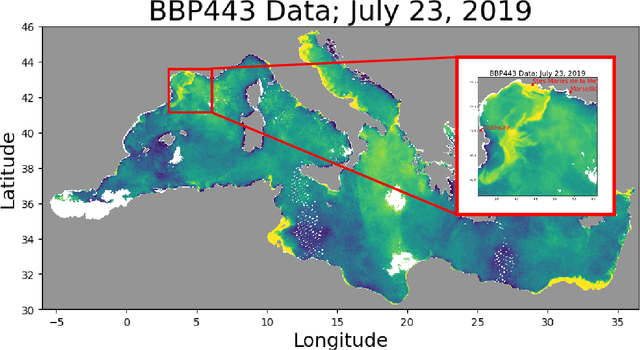
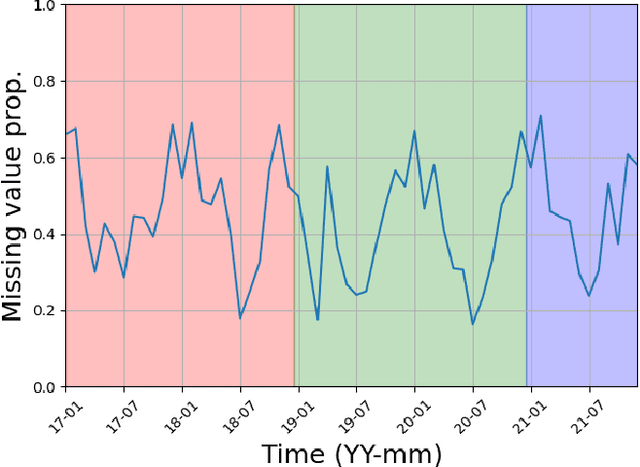
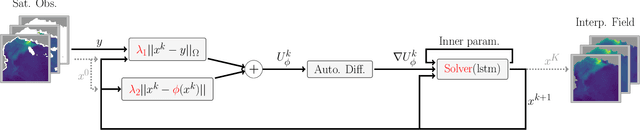
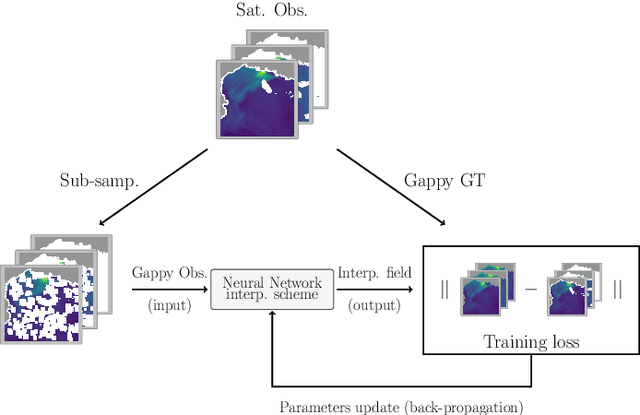
Monitoring optical properties of coastal and open ocean waters is crucial to assessing the health of marine ecosystems. Deep learning offers a promising approach to address these ecosystem dynamics, especially in scenarios where gap-free ground-truth data is lacking, which poses a challenge for designing effective training frameworks. Using an advanced neural variational data assimilation scheme (called 4DVarNet), we introduce a comprehensive training framework designed to effectively train directly on gappy data sets. Using the Mediterranean Sea as a case study, our experiments not only highlight the high performance of the chosen neural network in reconstructing gap-free images from gappy datasets but also demonstrate its superior performance over state-of-the-art algorithms such as DInEOF and Direct Inversion, whether using CNN or UNet architectures.