 Add to Chrome
 Add to Firefox
 Add to Edge
Muown Implicitly Performs Angular Step-size Decay
Jun 22, 2026
Matrix-aware optimizers such as Muon and Muown have recently shown strong empirical performance for pre-training Transformers. In particular, Muown separates each weight matrix into row magnitudes and an un-normalized direction variable, updating the former with Adam and the latter with Muon. We show that the directional update of Muown is equivalent to a Riemannian step on the normalized directions, while the magnitude of the un-normalized parameterization only modulates the angular step size. This explains the step-size stability of Muown and suggests making the angular step size explicit. The resulting method, AngularMuown, optimizes directly over the normalized directions and uses a schedulable angular multiplier decoupled from the radial magnitude update. AngularMuown improves over Muown and, at the time of writing, a preliminary version is leading the per-optimizer category of the modded nanoGPT speedrunning competition. Further experiments on Qwen2-0.5B, and 1.1B parameter mixture-of-experts models confirm the algorithm scales beyond small models. An implementation of the algorithm is available at https://github.com/fhueb/angular-muown

Free Heavy-Tailed Lunch for Muon: A Theoretical Justification of Empirical Success
Jun 12, 2026Non-Euclidean optimisation methods with matrix-valued updates, such as Muon and Scion, have recently shown strong empirical performance for training Transformer models, yet their theoretical advantages over Euclidean methods remain poorly understood. We address this gap in the heavy-tailed non-convex regime, where stochastic gradients have bounded $p$-th central moments, $p \in (1,2]$. We show that certain non-Euclidean methods achieve optimal sample complexity under stronger stationarity measures, while Euclidean methods incur additional dimension-dependent costs. As a consequence, for $m \times n$ matrices, Muon finds an $\varepsilon$-stationary point in nuclear norm within $\mathcal{O}\left(\min\{m, n\} \frac{Δ_1 L}{\varepsilon^2} \left(\frac σ\varepsilon \right)^{\frac p {p-1}}\right)$ samples, absorbing heavy-tailed noise without extra dimension dependence, unlike Euclidean methods. We further prove this sample complexity, including its dimension dependence, is optimal for all first-order methods under nuclear-norm stationarity. Experiments on large language models support our theory. Surprisingly, our results suggest that other Schatten geometries beyond the spectral geometry of Muon can perform competitively in certain settings.
Muown: Row-Norm Control for Muon Optimization
May 11, 2026Muon has emerged as a strong competitor to AdamW for language model pre-training, yet its behavior at scale is sensitive to weight decay. Recent work has observed that, for Muon without decoupled weight decay, the spectral norm of weight matrices drifts upward over training. Through a decomposition of the spectral norm into a row-magnitude factor and a row-coherence factor, we identify the former as the empirical driver of this drift under Muon, while the latter remains well-behaved along the trajectory. Motivated by this diagnosis, we introduce Muown, a drop-in replacement for Muon that treats the row-magnitude vector as an explicit optimizer variable, updating it under the $\ell_\infty$ geometry induced by the decomposition, while applying Muon unchanged to the remaining direction component. We prove that Muown attains the optimal non-convex rates in both deterministic and stochastic regimes under a dual norm aligned with the underlying geometries and with a stochastic noise coefficient that empirically remains below that of Muon throughout training. Across GPT-style pre-training on FineWeb-Edu with model sizes from 124M up to 2.7B parameters, Muown improves perplexity over Muon, SOAP, AdamW, and Lion. It also widens the plateau of near-optimal learning rates across model scales, reduces sensitivity to weight decay, and avoids the spectral norm drift at negligible step-time overhead when appropriately sharded.
Can SGD Handle Heavy-Tailed Noise?
Aug 06, 2025Stochastic Gradient Descent (SGD) is a cornerstone of large-scale optimization, yet its theoretical behavior under heavy-tailed noise -- common in modern machine learning and reinforcement learning -- remains poorly understood. In this work, we rigorously investigate whether vanilla SGD, devoid of any adaptive modifications, can provably succeed under such adverse stochastic conditions. Assuming only that stochastic gradients have bounded $p$-th moments for some $p \in (1, 2]$, we establish sharp convergence guarantees for (projected) SGD across convex, strongly convex, and non-convex problem classes. In particular, we show that SGD achieves minimax optimal sample complexity under minimal assumptions in the convex and strongly convex regimes: $\mathcal{O}(\varepsilon^{-\frac{p}{p-1}})$ and $\mathcal{O}(\varepsilon^{-\frac{p}{2(p-1)}})$, respectively. For non-convex objectives under H\"older smoothness, we prove convergence to a stationary point with rate $\mathcal{O}(\varepsilon^{-\frac{2p}{p-1}})$, and complement this with a matching lower bound specific to SGD with arbitrary polynomial step-size schedules. Finally, we consider non-convex Mini-batch SGD under standard smoothness and bounded central moment assumptions, and show that it also achieves a comparable $\mathcal{O}(\varepsilon^{-\frac{2p}{p-1}})$ sample complexity with a potential improvement in the smoothness constant. These results challenge the prevailing view that heavy-tailed noise renders SGD ineffective, and establish vanilla SGD as a robust and theoretically principled baseline -- even in regimes where the variance is unbounded.
From Gradient Clipping to Normalization for Heavy Tailed SGD
Oct 17, 2024Recent empirical evidence indicates that many machine learning applications involve heavy-tailed gradient noise, which challenges the standard assumptions of bounded variance in stochastic optimization. Gradient clipping has emerged as a popular tool to handle this heavy-tailed noise, as it achieves good performance in this setting both theoretically and practically. However, our current theoretical understanding of non-convex gradient clipping has three main shortcomings. First, the theory hinges on large, increasing clipping thresholds, which are in stark contrast to the small constant clipping thresholds employed in practice. Second, clipping thresholds require knowledge of problem-dependent parameters to guarantee convergence. Lastly, even with this knowledge, current sampling complexity upper bounds for the method are sub-optimal in nearly all parameters. To address these issues, we study convergence of Normalized SGD (NSGD). First, we establish a parameter-free sample complexity for NSGD of $\mathcal{O}\left(\varepsilon^{-\frac{2p}{p-1}}\right)$ to find an $\varepsilon$-stationary point. Furthermore, we prove tightness of this result, by providing a matching algorithm-specific lower bound. In the setting where all problem parameters are known, we show this complexity is improved to $\mathcal{O}\left(\varepsilon^{-\frac{3p-2}{p-1}}\right)$, matching the previously known lower bound for all first-order methods in all problem dependent parameters. Finally, we establish high-probability convergence of NSGD with a mild logarithmic dependence on the failure probability. Our work complements the studies of gradient clipping under heavy tailed noise improving the sample complexities of existing algorithms and offering an alternative mechanism to achieve high probability convergence.
Parameter-Agnostic Optimization under Relaxed Smoothness
Nov 06, 2023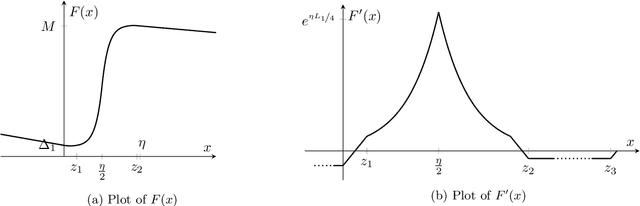
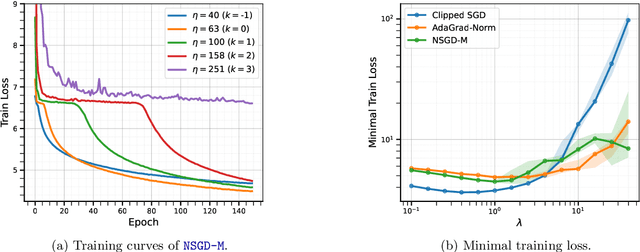
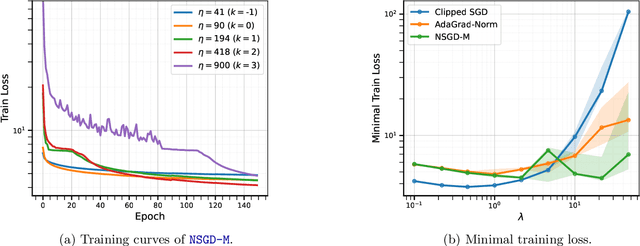
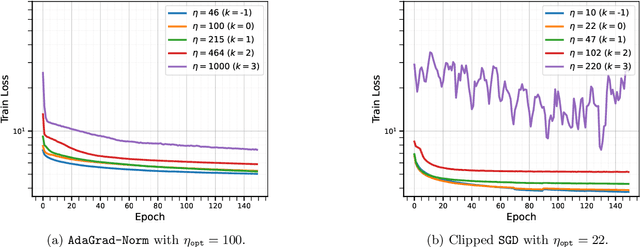
Tuning hyperparameters, such as the stepsize, presents a major challenge of training machine learning models. To address this challenge, numerous adaptive optimization algorithms have been developed that achieve near-optimal complexities, even when stepsizes are independent of problem-specific parameters, provided that the loss function is $L$-smooth. However, as the assumption is relaxed to the more realistic $(L_0, L_1)$-smoothness, all existing convergence results still necessitate tuning of the stepsize. In this study, we demonstrate that Normalized Stochastic Gradient Descent with Momentum (NSGD-M) can achieve a (nearly) rate-optimal complexity without prior knowledge of any problem parameter, though this comes at the cost of introducing an exponential term dependent on $L_1$ in the complexity. We further establish that this exponential term is inevitable to such schemes by introducing a theoretical framework of lower bounds tailored explicitly for parameter-agnostic algorithms. Interestingly, in deterministic settings, the exponential factor can be neutralized by employing Gradient Descent with a Backtracking Line Search. To the best of our knowledge, these findings represent the first parameter-agnostic convergence results under the generalized smoothness condition. Our empirical experiments further confirm our theoretical insights.