 Add to Chrome
 Add to Firefox
 Add to Edge
MirrorCode: AI can rebuild entire programs from behavior alone
Jun 29, 2026
AI models are rapidly improving at autonomous coding, as shown by benchmark progress and one-off demonstrations such as AI implementing a C compiler. However, existing coding benchmarks tend to focus on shorter tasks, and one-off demonstrations are hard to compare systematically because they often have some human guidance, and are not standardized or repeated across models. To address these challenges, we introduce MirrorCode, a long-horizon coding benchmark based on reimplementing entire software projects. In MirrorCode, AI agents must replicate the functionalities of an existing program, without access to its source code. AI solutions must match the original program's output exactly on end-to-end tests, including held-out tests. MirrorCode's 25 target programs span different areas of computing: Unix utilities, data serialization and query tools, bioinformatics, interpreters, static analysis, cryptography, and compression. Existing AI models can already reimplement complex software, with the strongest model scoring 56% across the benchmark. For example, AI can reimplement gotree, a 16,000-line bioinformatics toolkit - a task that we believe would take weeks for a human engineer. However, studying the frontier of performance requires a larger inference budget than typical benchmarks, for example, \$2,600 over 19 days for a single attempt on a large task. We show that AI agents can already complete long-horizon software engineering tasks, especially when requirements are precisely specified. More broadly, our work suggests AI will have transformative effects on software engineering, as autonomous agents continue to improve.

The ATOM Report: Measuring the Open Language Model Ecosystem
Apr 08, 2026We present a comprehensive adoption snapshot of the leading open language models and who is building them, focusing on the ~1.5K mainline open models from the likes of Alibaba's Qwen, DeepSeek, Meta's Llama, that are the foundation of an ecosystem crucial to researchers, entrepreneurs, and policy advisors. We document a clear trend where Chinese models overtook their counterparts built in the U.S. in the summer of 2025 and subsequently widened the gap over their western counterparts. We study a mix of Hugging Face downloads and model derivatives, inference market share, performance metrics and more to make a comprehensive picture of the ecosystem.
ReadBench: Measuring the Dense Text Visual Reading Ability of Vision-Language Models
May 25, 2025
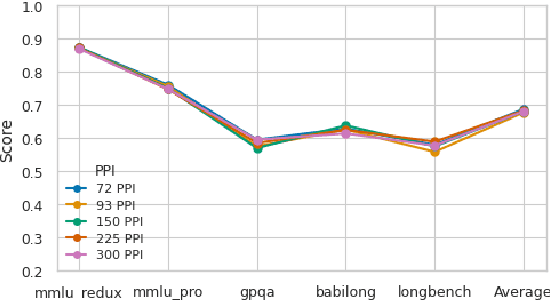
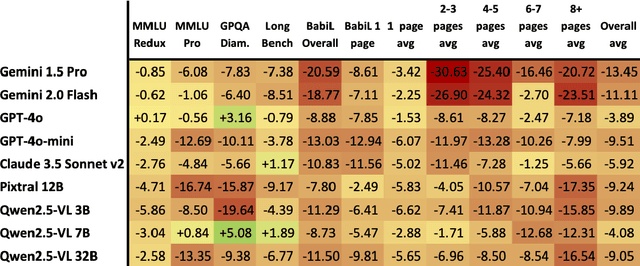
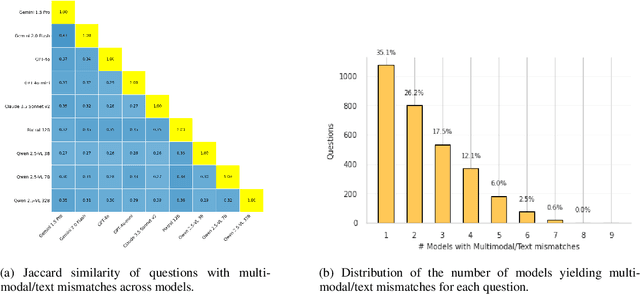
Recent advancements in Large Vision-Language Models (VLMs), have greatly enhanced their capability to jointly process text and images. However, despite extensive benchmarks evaluating visual comprehension (e.g., diagrams, color schemes, OCR tasks...), there is limited assessment of VLMs' ability to read and reason about text-rich images effectively. To fill this gap, we introduce ReadBench, a multimodal benchmark specifically designed to evaluate the reading comprehension capabilities of VLMs. ReadBench transposes contexts from established text-only benchmarks into images of text while keeping textual prompts and questions intact. Evaluating leading VLMs with ReadBench, we find minimal-but-present performance degradation on short, text-image inputs, while performance sharply declines for longer, multi-page contexts. Our experiments further reveal that text resolution has negligible effects on multimodal performance. These findings highlight needed improvements in VLMs, particularly their reasoning over visually presented extensive textual content, a capability critical for practical applications. ReadBench is available at https://github.com/answerdotai/ReadBench .