 Add to Chrome
 Add to Firefox
 Add to Edge
MirrorCode: AI can rebuild entire programs from behavior alone
Jun 29, 2026
AI models are rapidly improving at autonomous coding, as shown by benchmark progress and one-off demonstrations such as AI implementing a C compiler. However, existing coding benchmarks tend to focus on shorter tasks, and one-off demonstrations are hard to compare systematically because they often have some human guidance, and are not standardized or repeated across models. To address these challenges, we introduce MirrorCode, a long-horizon coding benchmark based on reimplementing entire software projects. In MirrorCode, AI agents must replicate the functionalities of an existing program, without access to its source code. AI solutions must match the original program's output exactly on end-to-end tests, including held-out tests. MirrorCode's 25 target programs span different areas of computing: Unix utilities, data serialization and query tools, bioinformatics, interpreters, static analysis, cryptography, and compression. Existing AI models can already reimplement complex software, with the strongest model scoring 56% across the benchmark. For example, AI can reimplement gotree, a 16,000-line bioinformatics toolkit - a task that we believe would take weeks for a human engineer. However, studying the frontier of performance requires a larger inference budget than typical benchmarks, for example, \$2,600 over 19 days for a single attempt on a large task. We show that AI agents can already complete long-horizon software engineering tasks, especially when requirements are precisely specified. More broadly, our work suggests AI will have transformative effects on software engineering, as autonomous agents continue to improve.

A Future Capabilities Agent for Tactical Air Traffic Control
Jan 07, 2026Escalating air traffic demand is driving the adoption of automation to support air traffic controllers, but existing approaches face a trade-off between safety assurance and interpretability. Optimisation-based methods such as reinforcement learning offer strong performance but are difficult to verify and explain, while rules-based systems are transparent yet rarely check safety under uncertainty. This paper outlines Agent Mallard, a forward-planning, rules-based agent for tactical control in systemised airspace that embeds a stochastic digital twin directly into its conflict-resolution loop. Mallard operates on predefined GPS-guided routes, reducing continuous 4D vectoring to discrete choices over lanes and levels, and constructs hierarchical plans from an expert-informed library of deconfliction strategies. A depth-limited backtracking search uses causal attribution, topological plan splicing, and monotonic axis constraints to seek a complete safe plan for all aircraft, validating each candidate manoeuvre against uncertain execution scenarios (e.g., wind variation, pilot response, communication loss) before commitment. Preliminary walkthroughs with UK controllers and initial tests in the BluebirdDT airspace digital twin indicate that Mallard's behaviour aligns with expert reasoning and resolves conflicts in simplified scenarios. The architecture is intended to combine model-based safety assessment, interpretable decision logic, and tractable computational performance in future structured en-route environments.
Learning strange attractors with reservoir systems
Aug 11, 2021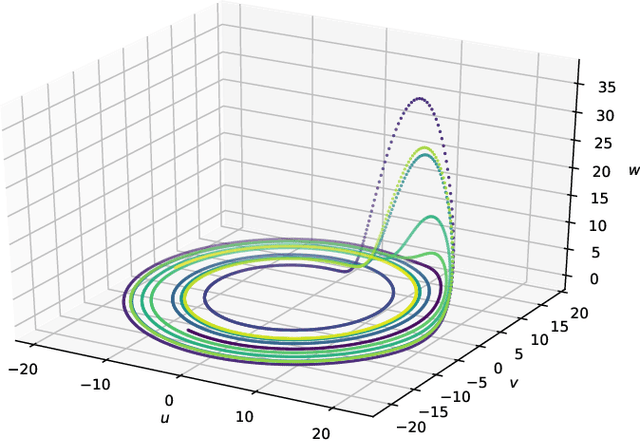
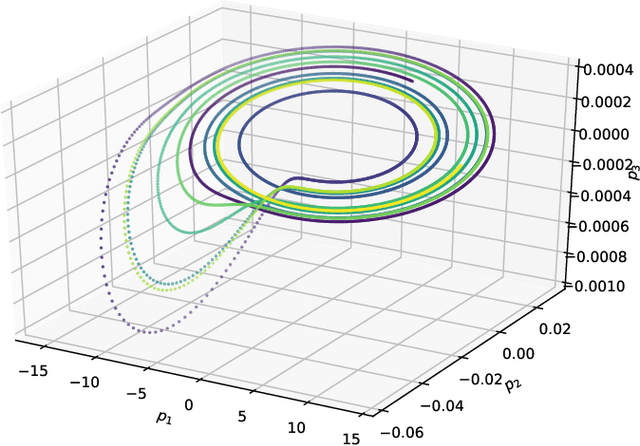
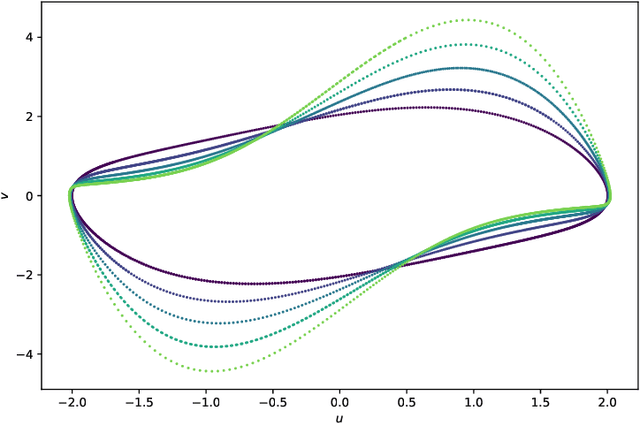
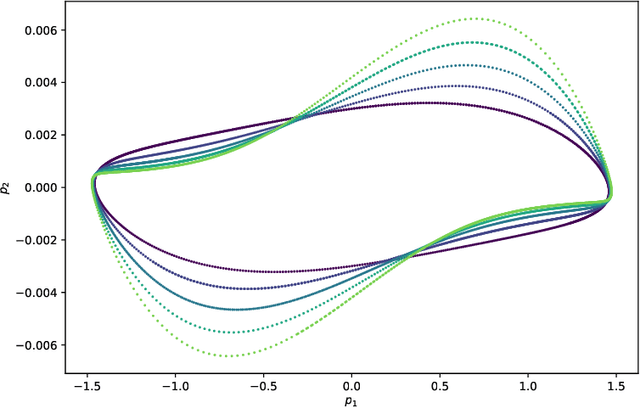
This paper shows that the celebrated Embedding Theorem of Takens is a particular case of a much more general statement according to which, randomly generated linear state-space representations of generic observations of an invertible dynamical system carry in their wake an embedding of the phase space dynamics into the chosen Euclidean state space. This embedding coincides with a natural generalized synchronization that arises in this setup and that yields a topological conjugacy between the state-space dynamics driven by the generic observations of the dynamical system and the dynamical system itself. This result provides additional tools for the representation, learning, and analysis of chaotic attractors and sheds additional light on the reservoir computing phenomenon that appears in the context of recurrent neural networks.