 Add to Chrome
 Add to Firefox
 Add to Edge
Improving Constraint Models with LLM Agents
Aug 08, 2026
The runtime of Constraint Programming (CP) solvers is highly sensitive to modeling choices, such as symmetry breaking, implied constraints, global constraints, constraint reformulation, and variable representation. Improving these constraint models has traditionally required human expertise, and existing automated reformulation systems are restricted to a predefined library of hand-crafted transformation rules. We introduce an agentic framework that instead reformulates a constraint model from an open-ended space and establishes correctness empirically rather than by construction: a Large Language Model (LLM) agent, given a model and three training instances, proposes alternative formulations, validates each by injecting its solution back into the original model, and diagnoses and repairs failures, returning the best variant it finds in a median of about fifteen minutes. The models are expressed in the CPMpy modeling library, and each proposed model is evaluated on three larger test instances. Across nine combinatorial optimization problems, the generated models outperform the originals on 21 of 27 test instances, and on some problems solve more than two orders of magnitude faster. A comparison against non-agentic baselines that reuse the same validation and selection tools indicates that the gains stem from the agent's iterative diagnosis and repair, not merely from sampling several candidates. These results demonstrate that autonomous agentic methods can support the improvement of constraint models.

Streamliners for Answer Set Programming
Apr 21, 2026Streamliner constraints reduce the search space of combinatorial problems by ruling out portions of the solution space. We adapt the StreamLLM approach, which uses Large Language Models (LLMs) to generate streamliners for Constraint Programming, to Answer Set Programming (ASP). Given an ASP encoding and a few small training instances, we prompt multiple LLMs to propose candidate constraints. Candidates that cause syntax errors, render satisfiable instances unsatisfiable, or degrade performance on all training instances are discarded. The surviving streamliners are evaluated together with the original encoding, and we report results for a virtual best encoding (VBE) that, for each instance, selects the fastest among the original encoding and its streamlined variants. On three ASP Competition benchmarks (Partner Units Problem, Sokoban, Towers of Hanoi), the VBE achieves speedups of up to 4--5x over the original encoding. Different LLMs produce semantically diverse constraints, not mere syntactic variations, indicating that the approach captures genuine problem structure.
Realtime Generation of Streamliners with Large Language Models
Aug 16, 2024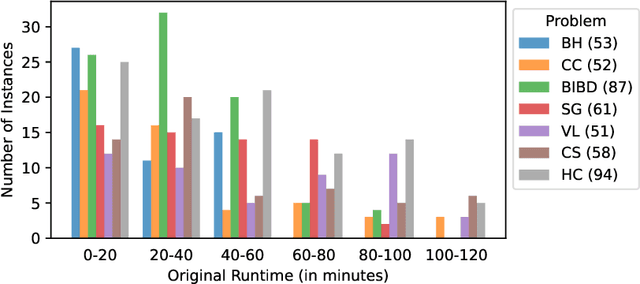

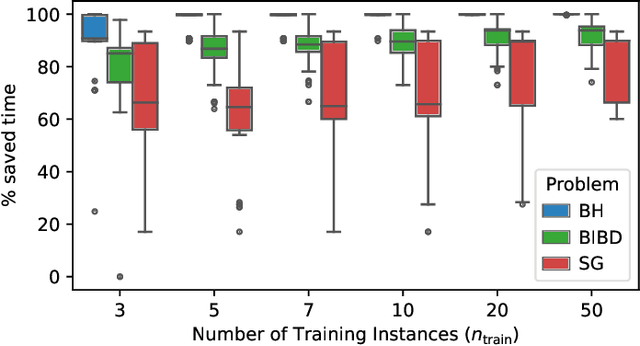
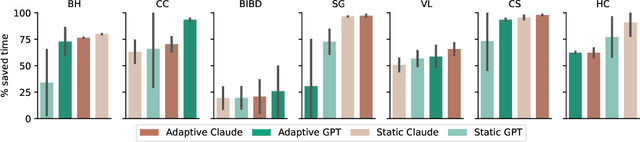
This paper presents the novel method StreamLLM for generating streamliners in constraint programming using Large Language Models (LLMs). Streamliners are constraints that narrow the search space, enhancing the speed and feasibility of solving complex problems. Traditionally, streamliners were crafted manually or generated through systematically combined atomic constraints with high-effort offline testing. Our approach uses LLMs to propose effective streamliners. Our system StreamLLM generates streamlines for problems specified in the MiniZinc constraint programming language and integrates feedback to the LLM with quick empirical tests. Our rigorous empirical evaluation involving ten problems with several hundreds of test instances shows robust results that are highly encouraging, showcasing the transforming power of LLMs in the domain of constraint programming.