 Add to Chrome
 Add to Firefox
 Add to Edge
Pitch Spelling Jazz Lead Sheets, Solo Transcriptions, Classical Piano and Monophonic Scores
Jun 18, 2026
We present an algorithm for pitch spelling and key estimation. Given an input in MIDI-like format, containing information on note pitches (expressed in semitones relative to the lowest reference note) and bar boundaries, it estimates the appropriate note names, a global Key Signature, and a local scale for each bar. This related information elements are evaluated jointly during two stages of optimisation. During an initial 'modal' stage, a probable scale is proposed for each bar, minimising the number of accidentals to be printed in the printed score with a shortest-path search. Then, during a second stage called 'tonal', these local scales are used to estimate the Key Signature and note names that would result in the best musical notation for the entire piece. We present evaluations conducted on datasets comprising a variety of digital musical scores: jazz lead sheets taken from the Real Book, transcriptions of recordings of jazz soli and bass lines, traditional tunes, as well as classical scores for piano and monophonic instruments. Our procedure was originally designed for use in music transcription, specifically for building digital collections of jazz solos transcribed from audio recordings, for the purposes of music analysis, teaching and the preservation of cultural heritage. This method should also prove useful for other tasks related to the processing of musical notation. Furthermore, to this end, we have defined new distances between various common jazz scales, which may be of some interest to musicological studies.

Engraving Oriented Joint Estimation of Pitch Spelling and Local and Global Keys
Feb 15, 2024


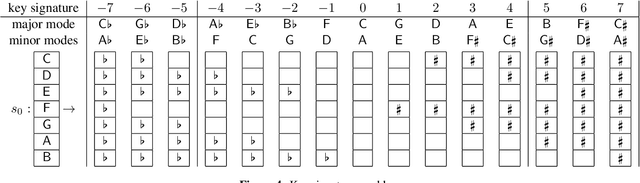
We revisit the problems of pitch spelling and tonality guessing with a new algorithm for their joint estimation from a MIDI file including information about the measure boundaries. Our algorithm does not only identify a global key but also local ones all along the analyzed piece. It uses Dynamic Programming techniques to search for an optimal spelling in term, roughly, of the number of accidental symbols that would be displayed in the engraved score. The evaluation of this number is coupled with an estimation of the global key and some local keys, one for each measure. Each of the three informations is used for the estimation of the other, in a multi-steps procedure. An evaluation conducted on a monophonic and a piano dataset, comprising 216 464 notes in total, shows a high degree of accuracy, both for pitch spelling (99.5% on average on the Bach corpus and 98.2% on the whole dataset) and global key signature estimation (93.0% on average, 95.58% on the piano dataset). Designed originally as a backend tool in a music transcription framework, this method should also be useful in other tasks related to music notation processing.
8+8=4: Formalizing Time Units to Handle Symbolic Music Durations
Oct 23, 2023This paper focuses on the nominal durations of musical events (notes and rests) in a symbolic musical score, and on how to conveniently handle these in computer applications. We propose the usage of a temporal unit that is directly related to the graphical symbols in musical scores and pair this with a set of operations that cover typical computations in music applications. We formalize this time unit and the more commonly used approach in a single mathematical framework, as semirings, algebraic structures that enable an abstract description of algorithms/processing pipelines. We then discuss some practical use cases and highlight when our system can improve such pipelines by making them more efficient in terms of data type used and the number of computations.