 Add to Chrome
 Add to Firefox
 Add to Edge
From Prediction to Collaboration: Interactive Symbolic Music Analysis
Jul 15, 2026
Automatic symbolic music analysis has made substantial progress, yet existing systems are typically designed for a single mode of use, such as full-score prediction, and therefore do not match the broader range of operations that arise in analysis workflows, including partial completion, local correction, and iterative refinement. As a result, there remains a gap between strong benchmark models and systems that can support interactive analytical use. We present a unified framework for symbolic Roman-numeral (RN) analysis that narrows this gap by combining strong predictive performance with direct support for constrained completion and revision. The method is designed to provide a practical trade-off between accuracy and interactive responsiveness by computing expensive pretrained representations once and reusing them during iterative refinement, making powerful pretrained models more amenable to interactive settings. It supports complete score analysis, targeted revision of existing labels, and inference of missing annotations from partial context through a shared modeling framework. Experiments on Dilemmadata, the largest and most heterogeneous benchmark of its kind, show that the proposed approach is a strong RN-analysis baseline while also supporting masked completion from partial labels. Together with a prototype interface for multi-level candidate inspection and editing, these results position automatic RN analysis not only as a prediction problem, but also as a foundation for future interactive tools for music analysis.

Dilemmadata: On the Interoperability of Heterogeneous Roman Numeral Datasets
Jun 30, 2026In recent years, there has been growing effort to annotate and collect large-scale corpora of Roman numeral analyses in support of data-driven studies in tonal harmony. We introduce dilemmadata, the first resource to reconcile two major collections, the AugmentedNet Dataset (AN) and the Distant Listening Corpus (DLC), making them interoperable through a shared note-wise TSV schema. The reconciliation confronts four families of dilemmata: annotation-standard (the two encode the same musical fact differently in terms of vocabulary size, syntax, conventions for chord extensions, inventory of special chord functions), representational (what counts as a row, and which information survives the conversion), toolchain (incompatible Python ecosystems built around music21 vs. ms3+dimcat), and curatorial (which pieces to include, exclude, or retain twice). We resolve each by deliberately transforming, augmenting, and omitting information, formalising the mismatches, preserving musical semantics, and flagging transformations that may subtly affect annotation fidelity. Consistency checks and qualitative inspections offer a preliminary assessment of post-conversion validity and a basis for critiquing the theoretical assumptions embedded in each original standard. After removing duplicates and merging the two collections, the resulting dilemmadata (1,621 pieces and aprox. 2.8 M note-wise annotations) is the largest homogeneous Roman-numeral corpus currently available, albeit far from perfect. Crucially, we retain 84 pieces common to both corpora under each of their original analyses, yielding a shared reference set in which two equally legitimate analytical traditions can be compared note-for-note over identical musical material. Released on Zenodo, dilemmadata supports interoperability, comparative harmonization modeling, and future refinement of Roman-numeral encoding standards.
Multi-Stage Music Source Restoration with BandSplit-RoFormer Separation and HiFi++ GAN
Mar 04, 2026Music Source Restoration (MSR) targets recovery of original, unprocessed instrument stems from fully mixed and mastered audio, where production effects and distribution artifacts violate common linear-mixture assumptions. This technical report presents the CP-JKU team's system for the MSR ICASSP Challenge 2025. Our approach decomposes MSR into separation and restoration. First, a single BandSplit-RoFormer separator predicts eight stems plus an auxiliary other stem, and is trained with a three-stage curriculum that progresses from 4-stem warm-start fine-tuning (with LoRA) to 8-stem extension via head expansion. Second, we apply a HiFi++ GAN waveform restorer trained as a generalist and then specialized into eight instrument-specific experts.
How Far Can Pretrained LLMs Go in Symbolic Music? Controlled Comparisons of Supervised and Preference-based Adaptation
Jan 30, 2026Music often shares notable parallels with language, motivating the use of pretrained large language models (LLMs) for symbolic music understanding and generation. Despite growing interest, the practical effectiveness of adapting instruction-tuned LLMs to symbolic music remains insufficiently characterized. We present a controlled comparative study of finetuning strategies for ABC-based generation and understanding, comparing an off-the-shelf instruction-tuned backbone to domain-adapted variants and a music-specialized LLM baseline. Across multiple symbolic music corpora and evaluation signals, we provide some insights into adaptation choices for symbolic music applications. We highlight the domain adaptation vs.~preserving prior information tradeoff as well as the distinct behaviour of metrics used to measure the domain adaptation for symbolic music.
MUSE-Explainer: Counterfactual Explanations for Symbolic Music Graph Classification Models
Sep 30, 2025Interpretability is essential for deploying deep learning models in symbolic music analysis, yet most research emphasizes model performance over explanation. To address this, we introduce MUSE-Explainer, a new method that helps reveal how music Graph Neural Network models make decisions by providing clear, human-friendly explanations. Our approach generates counterfactual explanations by making small, meaningful changes to musical score graphs that alter a model's prediction while ensuring the results remain musically coherent. Unlike existing methods, MUSE-Explainer tailors its explanations to the structure of musical data and avoids unrealistic or confusing outputs. We evaluate our method on a music analysis task and show it offers intuitive insights that can be visualized with standard music tools such as Verovio.
Language Models for Music Medicine Generation
Nov 13, 2024
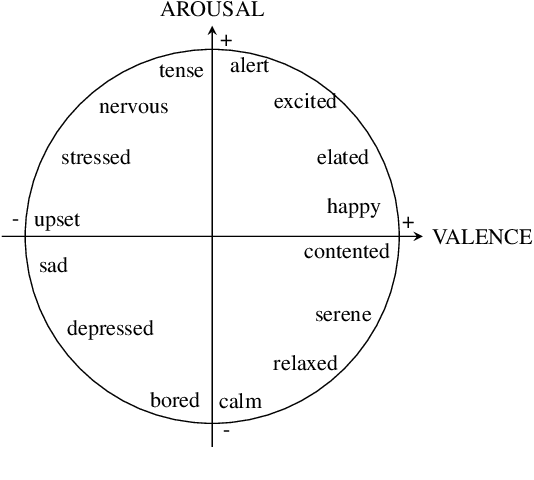
Music therapy has been shown in recent years to provide multiple health benefits related to emotional wellness. In turn, maintaining a healthy emotional state has proven to be effective for patients undergoing treatment, such as Parkinson's patients or patients suffering from stress and anxiety. We propose fine-tuning MusicGen, a music-generating transformer model, to create short musical clips that assist patients in transitioning from negative to desired emotional states. Using low-rank decomposition fine-tuning on the MTG-Jamendo Dataset with emotion tags, we generate 30-second clips that adhere to the iso principle, guiding patients through intermediate states in the valence-arousal circumplex. The generated music is evaluated using a music emotion recognition model to ensure alignment with intended emotions. By concatenating these clips, we produce a 15-minute "music medicine" resembling a music therapy session. Our approach is the first model to leverage Language Models to generate music medicine. Ultimately, the output is intended to be used as a temporary relief between music therapy sessions with a board-certified therapist.
GraphMuse: A Library for Symbolic Music Graph Processing
Jul 17, 2024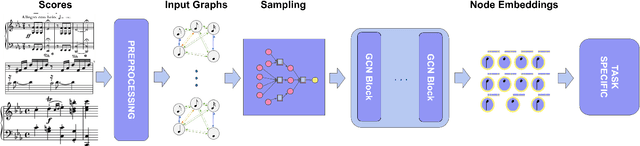
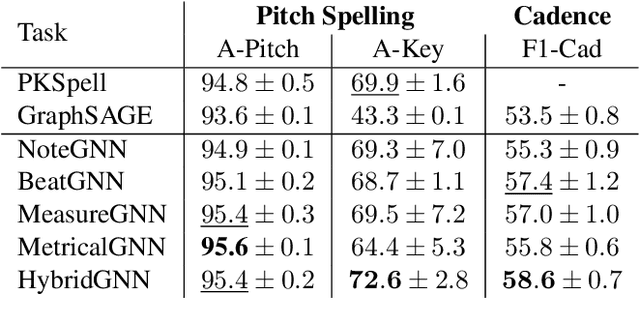
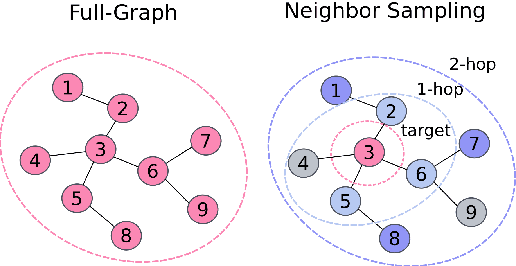
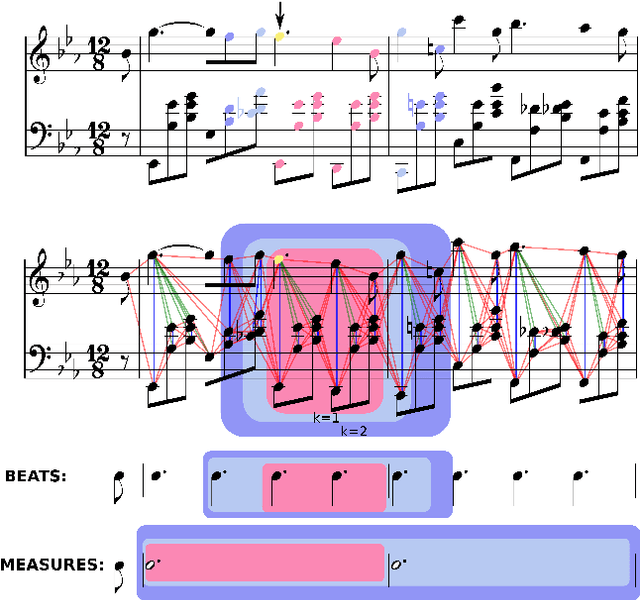
Graph Neural Networks (GNNs) have recently gained traction in symbolic music tasks, yet a lack of a unified framework impedes progress. Addressing this gap, we present GraphMuse, a graph processing framework and library that facilitates efficient music graph processing and GNN training for symbolic music tasks. Central to our contribution is a new neighbor sampling technique specifically targeted toward meaningful behavior in musical scores. Additionally, GraphMuse integrates hierarchical modeling elements that augment the expressivity and capabilities of graph networks for musical tasks. Experiments with two specific musical prediction tasks -- pitch spelling and cadence detection -- demonstrate significant performance improvement over previous methods. Our hope is that GraphMuse will lead to a boost in, and standardization of, symbolic music processing based on graph representations. The library is available at https://github.com/manoskary/graphmuse
SMUG-Explain: A Framework for Symbolic Music Graph Explanations
May 15, 2024In this work, we present Score MUsic Graph (SMUG)-Explain, a framework for generating and visualizing explanations of graph neural networks applied to arbitrary prediction tasks on musical scores. Our system allows the user to visualize the contribution of input notes (and note features) to the network output, directly in the context of the musical score. We provide an interactive interface based on the music notation engraving library Verovio. We showcase the usage of SMUG-Explain on the task of cadence detection in classical music. All code is available on https://github.com/manoskary/SMUG-Explain.
Perception-Inspired Graph Convolution for Music Understanding Tasks
May 15, 2024



We propose a new graph convolutional block, called MusGConv, specifically designed for the efficient processing of musical score data and motivated by general perceptual principles. It focuses on two fundamental dimensions of music, pitch and rhythm, and considers both relative and absolute representations of these components. We evaluate our approach on four different musical understanding problems: monophonic voice separation, harmonic analysis, cadence detection, and composer identification which, in abstract terms, translate to different graph learning problems, namely, node classification, link prediction, and graph classification. Our experiments demonstrate that MusGConv improves the performance on three of the aforementioned tasks while being conceptually very simple and efficient. We interpret this as evidence that it is beneficial to include perception-informed processing of fundamental musical concepts when developing graph network applications on musical score data.
Sounding Out Reconstruction Error-Based Evaluation of Generative Models of Expressive Performance
Dec 31, 2023Generative models of expressive piano performance are usually assessed by comparing their predictions to a reference human performance. A generative algorithm is taken to be better than competing ones if it produces performances that are closer to a human reference performance. However, expert human performers can (and do) interpret music in different ways, making for different possible references, and quantitative closeness is not necessarily aligned with perceptual similarity, raising concerns about the validity of this evaluation approach. In this work, we present a number of experiments that shed light on this problem. Using precisely measured high-quality performances of classical piano music, we carry out a listening test indicating that listeners can sometimes perceive subtle performance difference that go unnoticed under quantitative evaluation. We further present tests that indicate that such evaluation frameworks show a lot of variability in reliability and validity across different reference performances and pieces. We discuss these results and their implications for quantitative evaluation, and hope to foster a critical appreciation of the uncertainties involved in quantitative assessments of such performances within the wider music information retrieval (MIR) community.