 Add to Chrome
 Add to Firefox
 Add to Edge
Vision-Based Dribbling for Humanoid Soccer via Privileged Representation Learning
Jul 14, 2026
Recent advances in humanoid robotics have highlighted the importance of deployable loco-manipulation skills. Dribbling a soccer ball while evading active opponents requires simultaneous balance, precise ball control, and awareness of a dynamic adversary under onboard sensing and real-time constraints. Existing approaches typically separate perception and motion, which can be effective in controlled settings but may fail under occlusions, fast ball movements, and complex opponent interactions, since perception is not directly optimized for control. We propose an integrated approach in which a temporal depth encoder is embedded into a reinforcement learning policy through a task-specific projection layer. We apply this framework to a simulated Booster T1 humanoid robot and show that it is possible to learn vision-based, opponent-aware dribbling directly from depth observations, without explicit state estimation or privileged scene information. The learned policy achieves 100% success in nominal target-driven dribbling and 96% success with a single static obstacle, while reaching 46% success against an actively moving ball-attacker opponent. These results demonstrate that the proposed framework supports robust vision-based dribbling in nominal and moderately dynamic settings, and provides a strong foundation for handling more challenging moving-adversary scenarios.

Real-Time Multimodal Signal Processing for HRI in RoboCup: Understanding a Human Referee
Nov 26, 2024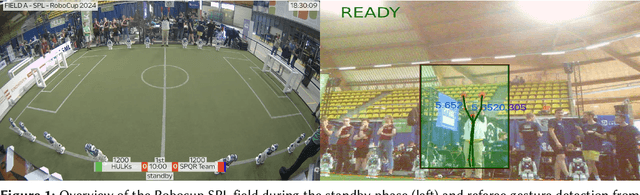
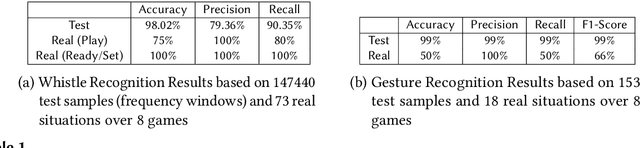
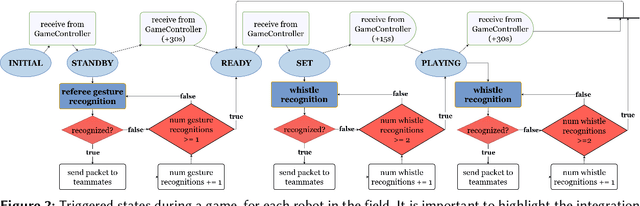
Advancing human-robot communication is crucial for autonomous systems operating in dynamic environments, where accurate real-time interpretation of human signals is essential. RoboCup provides a compelling scenario for testing these capabilities, requiring robots to understand referee gestures and whistle with minimal network reliance. Using the NAO robot platform, this study implements a two-stage pipeline for gesture recognition through keypoint extraction and classification, alongside continuous convolutional neural networks (CCNNs) for efficient whistle detection. The proposed approach enhances real-time human-robot interaction in a competitive setting like RoboCup, offering some tools to advance the development of autonomous systems capable of cooperating with humans.
Multi-Agent Coordination for a Partially Observable and Dynamic Robot Soccer Environment with Limited Communication
Jan 26, 2024RoboCup represents an International testbed for advancing research in AI and robotics, focusing on a definite goal: developing a robot team that can win against the human world soccer champion team by the year 2050. To achieve this goal, autonomous humanoid robots' coordination is crucial. This paper explores novel solutions within the RoboCup Standard Platform League (SPL), where a reduction in WiFi communication is imperative, leading to the development of new coordination paradigms. The SPL has experienced a substantial decrease in network packet rate, compelling the need for advanced coordination architectures to maintain optimal team functionality in dynamic environments. Inspired by market-based task assignment, we introduce a novel distributed coordination system to orchestrate autonomous robots' actions efficiently in low communication scenarios. This approach has been tested with NAO robots during official RoboCup competitions and in the SimRobot simulator, demonstrating a notable reduction in task overlaps in limited communication settings.