 Add to Chrome
 Add to Firefox
 Add to Edge
BFS-PO: Best-First Search for Large Reasoning Models
Feb 16, 2026
Large Reasoning Models (LRMs) such as OpenAI o1 and DeepSeek-R1 have shown excellent performance in reasoning tasks using long reasoning chains. However, this has also led to a significant increase of computational costs and the generation of verbose output, a phenomenon known as overthinking. The tendency to overthinking is often exacerbated by Reinforcement Learning (RL) algorithms such as GRPO/DAPO. In this paper, we propose BFS-PO, an RL algorithm which alleviates this problem using a Best-First Search exploration strategy. Specifically, BFS-PO looks for the shortest correct answer using a backtracking mechanism based on maximum entropy nodes. By generating progressively shorter responses during training, BFS-PO learns to produce concise reasoning chains. Using different benchmarks and base LRMs, we show that BFS-PO can simultaneously increase the LRM accuracy and shorten its answers.

Restoring Exploration after Post-Training: Latent Exploration Decoding for Large Reasoning Models
Feb 02, 2026Large Reasoning Models (LRMs) have recently achieved strong mathematical and code reasoning performance through Reinforcement Learning (RL) post-training. However, we show that modern reasoning post-training induces an unintended exploration collapse: temperature-based sampling no longer increases pass@$n$ accuracy. Empirically, the final-layer posterior of post-trained LRMs exhibit sharply reduced entropy, while the entropy of intermediate layers remains relatively high. Motivated by this entropy asymmetry, we propose Latent Exploration Decoding (LED), a depth-conditioned decoding strategy. LED aggregates intermediate posteriors via cumulative sum and selects depth configurations with maximal entropy as exploration candidates. Without additional training or parameters, LED consistently improves pass@1 and pass@16 accuracy by 0.61 and 1.03 percentage points across multiple reasoning benchmarks and models. Project page: https://GitHub.com/Xiaomi-Research/LED.
Causal Graphical Models for Vision-Language Compositional Understanding
Dec 12, 2024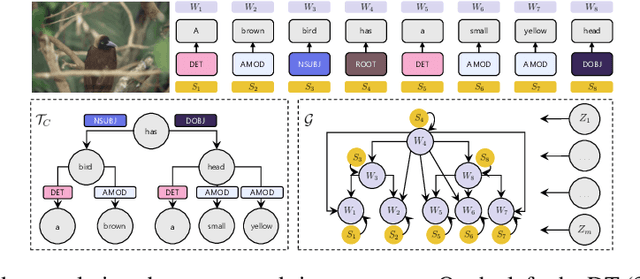

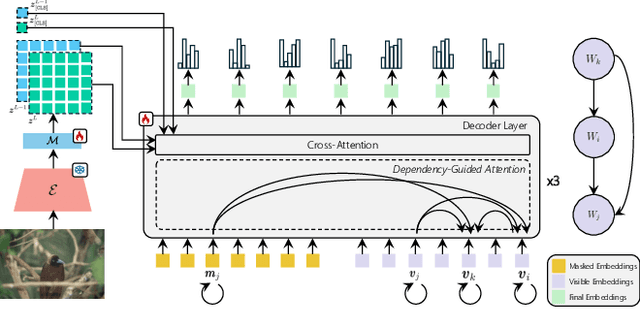

Recent work has empirically shown that Vision-Language Models (VLMs) struggle to fully understand the compositional properties of the human language, usually modeling an image caption as a "bag of words". As a result, they perform poorly on compositional tasks, which require a deeper understanding of the different entities of a sentence (subject, verb, etc.) jointly with their mutual relationships in order to be solved. In this paper, we model the dependency relations among textual and visual tokens using a Causal Graphical Model (CGM), built using a dependency parser, and we train a decoder conditioned by the VLM visual encoder. Differently from standard autoregressive or parallel predictions, our decoder's generative process is partially-ordered following the CGM structure. This structure encourages the decoder to learn only the main causal dependencies in a sentence discarding spurious correlations. Using extensive experiments on five compositional benchmarks, we show that our method significantly outperforms all the state-of-the-art compositional approaches by a large margin, and it also improves over methods trained using much larger datasets.