 Add to Chrome
 Add to Firefox
 Add to Edge
The Readability Spectrum: Patterns, Issues, and Prompt Effects in LLM-Generated Code
May 13, 2026
As Large Language Models (LLMs) are transforming software development, the functional quality of generated code has become a central focus, leaving readability, one of critical non-functional attributes, understudied. Given that LLM-generated code still needs human review before adoption, it is important to understand its readability especially compared with human-written code and the role of prompt design in shaping it. We therefore set out to conduct a systematic investigation into the code readability of LLM-generated code. To systematically quantify code readability, We establish a comprehensive readability model that synthesizes textual, structural, program, and visual features of code. Based on the model, we evaluate the readability of code generated by the mainstream LLMs under 5,869 scenarios extracted from large code base including World of Code (WoC) and LeetCode. We find that current LLMs produce code with overall readability comparable to human-written code, but displaying distinct readability issue patterns. We further examine how different prompt dimensions affect the readability of LLM-generated code, and find that function signatures, constraints and style descriptions emerge as the most influential factors, while the overall impact of prompt design remains limited. Our findings indicate that, on one hand, LLM-generated code is at least comparable to human-written code in readability, validating its potential for systematic integration into software workflows from a non-functional perspective; on the other hand, distinct readability issue patterns and limited effectiveness of prompt engineering reveal a latent technical debt, highlighting the need for future research to improve the readability of LLM-generated code and thus ensure long-term maintainability.

A Plug-and-Play Bregman ADMM Module for Inferring Event Branches in Temporal Point Processes
Jan 08, 2025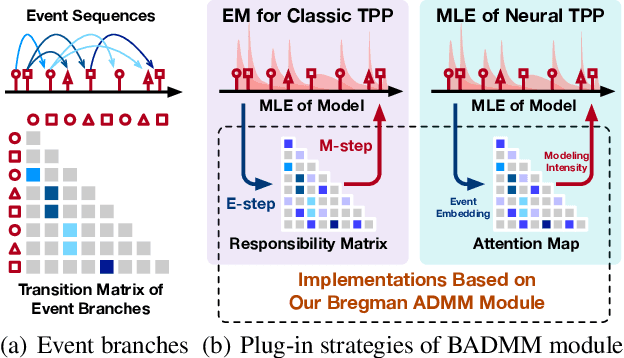
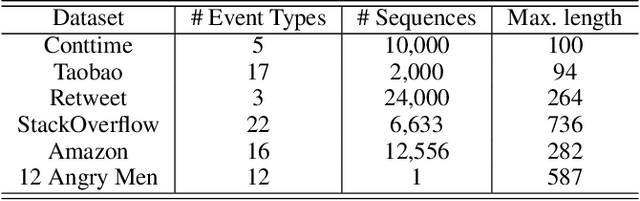
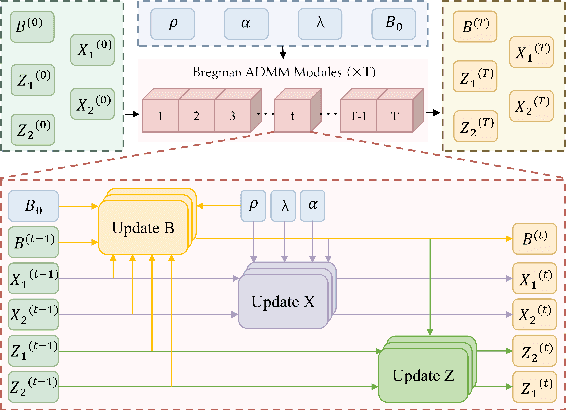
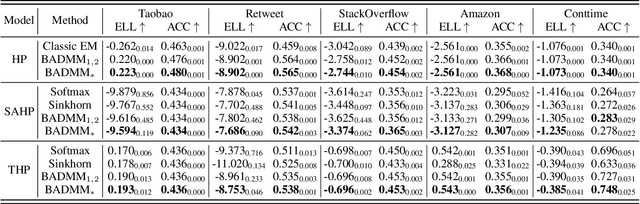
An event sequence generated by a temporal point process is often associated with a hidden and structured event branching process that captures the triggering relations between its historical and current events. In this study, we design a new plug-and-play module based on the Bregman ADMM (BADMM) algorithm, which infers event branches associated with event sequences in the maximum likelihood estimation framework of temporal point processes (TPPs). Specifically, we formulate the inference of event branches as an optimization problem for the event transition matrix under sparse and low-rank constraints, which is embedded in existing TPP models or their learning paradigms. We can implement this optimization problem based on subspace clustering and sparse group-lasso, respectively, and solve it using the Bregman ADMM algorithm, whose unrolling leads to the proposed BADMM module. When learning a classic TPP (e.g., Hawkes process) by the expectation-maximization algorithm, the BADMM module helps derive structured responsibility matrices in the E-step. Similarly, the BADMM module helps derive low-rank and sparse attention maps for the neural TPPs with self-attention layers. The structured responsibility matrices and attention maps, which work as learned event transition matrices, indicate event branches, e.g., inferring isolated events and those key events triggering many subsequent events. Experiments on both synthetic and real-world data show that plugging our BADMM module into existing TPP models and learning paradigms can improve model performance and provide us with interpretable structured event branches. The code is available at \url{https://github.com/qingmeiwangdaily/BADMM_TPP}.