 Add to Chrome
 Add to Firefox
 Add to Edge
LLMs Know More About Numbers than They Can Say
Feb 08, 2026
Although state-of-the-art LLMs can solve math problems, we find that they make errors on numerical comparisons with mixed notation: "Which is larger, $5.7 \times 10^2$ or $580$?" This raises a fundamental question: Do LLMs even know how big these numbers are? We probe the hidden states of several smaller open-source LLMs. A single linear projection of an appropriate hidden layer encodes the log-magnitudes of both kinds of numerals, allowing us to recover the numbers with relative error of about 2.3% (on restricted synthetic text) or 19.06% (on scientific papers). Furthermore, the hidden state after reading a pair of numerals encodes their ranking, with a linear classifier achieving over 90% accuracy. Yet surprisingly, when explicitly asked to rank the same pairs of numerals, these LLMs achieve only 50-70% accuracy, with worse performance for models whose probes are less effective. Finally, we show that incorporating the classifier probe's log-loss as an auxiliary objective during finetuning brings an additional 3.22% improvement in verbalized accuracy over base models, demonstrating that improving models' internal magnitude representations can enhance their numerical reasoning capabilities.

Data Quality Control in Federated Instruction-tuning of Large Language Models
Oct 15, 2024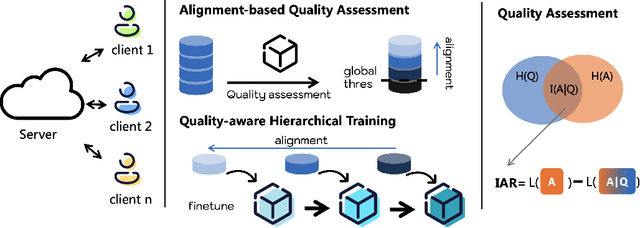
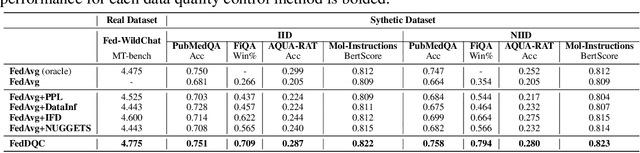
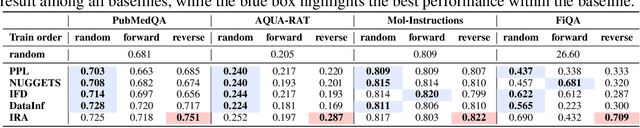
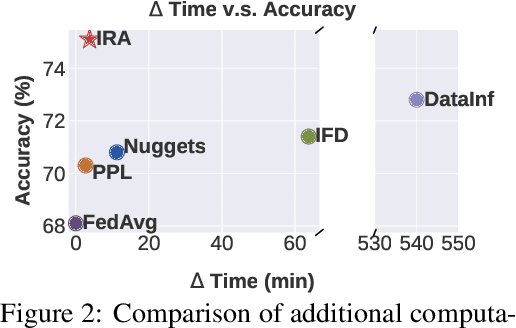
By leveraging massively distributed data, federated learning (FL) enables collaborative instruction tuning of large language models (LLMs) in a privacy-preserving way. While FL effectively expands the data quantity, the issue of data quality remains under-explored in the current literature on FL for LLMs. To address this gap, we propose a new framework of federated instruction tuning of LLMs with data quality control (FedDQC), which measures data quality to facilitate the subsequent filtering and hierarchical training processes. Our approach introduces an efficient metric to assess each client's instruction-response alignment (IRA), identifying potentially noisy data through single-shot inference. Low-IRA samples are potentially noisy and filtered to mitigate their negative impacts. To further utilize this IRA value, we propose a quality-aware hierarchical training paradigm, where LLM is progressively fine-tuned from high-IRA to low-IRA data, mirroring the easy-to-hard learning process. We conduct extensive experiments on 4 synthetic and a real-world dataset, and compare our method with baselines adapted from centralized setting. Results show that our method consistently and significantly improves the performance of LLMs trained on mix-quality data in FL.