 Add to Chrome
 Add to Firefox
 Add to Edge
Cognitive Fusion of ZC Sequences and Time-Frequency Images for Out-of-Distribution Detection of Drone Signals
Jan 26, 2026
We propose a drone signal out-of-distribution detection (OODD) algorithm based on the cognitive fusion of Zadoff-Chu (ZC) sequences and time-frequency images (TFI). ZC sequences are identified by analyzing the communication protocols of DJI drones, while TFI capture the time-frequency characteristics of drone signals with unknown or non-standard communication protocols. Both modalities are used jointly to enable OODD in the drone remote identification (RID) task. Specifically, ZC sequence features and TFI features are generated from the received radio frequency signals, which are then processed through dedicated feature extraction module to enhance and align them. The resultant multi-modal features undergo multi-modal feature interaction, single-modal feature fusion, and multi-modal feature fusion to produce features that integrate and complement information across modalities. Discrimination scores are computed from the fused features along both spatial and channel dimensions to capture time-frequency characteristic differences dictated by the communication protocols, and these scores will be transformed into adaptive attention weights. The weighted features are then passed through a Softmax function to produce the signal classification results. Simulation results demonstrate that the proposed algorithm outperforms existing algorithms and achieves 1.7% and 7.5% improvements in RID and OODD metrics, respectively. The proposed algorithm also performs strong robustness under varying flight conditions and across different drone types.

Discriminability-Driven Spatial-Channel Selection with Gradient Norm for Drone Signal OOD Detection
Jan 26, 2026We propose a drone signal out-of-distribution (OOD) detection algorithm based on discriminability-driven spatial-channel selection with a gradient norm. Time-frequency image features are adaptively weighted along both spatial and channel dimensions by quantifying inter-class similarity and variance based on protocol-specific time-frequency characteristics. Subsequently, a gradient-norm metric is introduced to measure perturbation sensitivity for capturing the inherent instability of OOD samples, which is then fused with energy-based scores for joint inference. Simulation results demonstrate that the proposed algorithm provides superior discriminative power and robust performance via SNR and various drone types.
Improving Physical Layer Security for Reconfigurable Intelligent Surface aided NOMA 6G Networks
Jan 18, 2021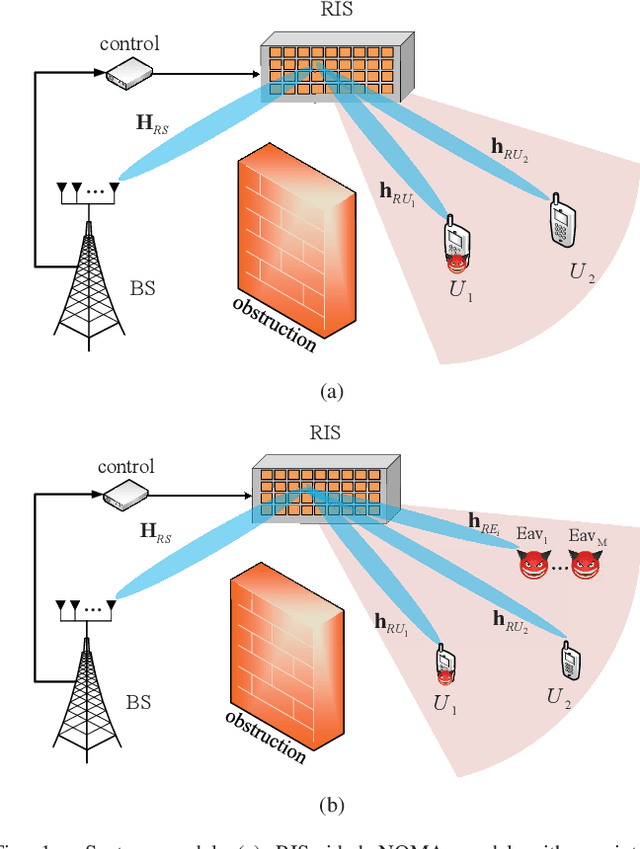
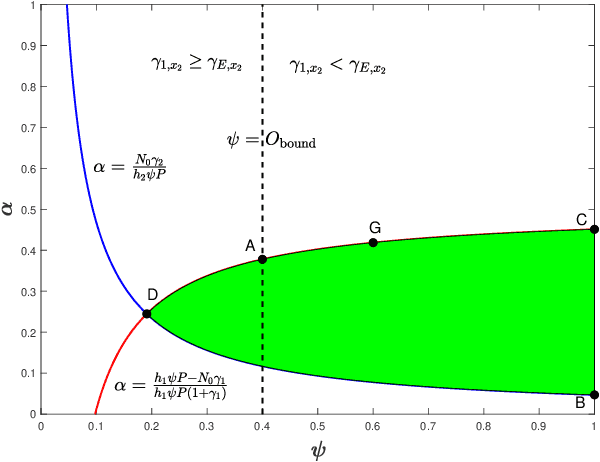
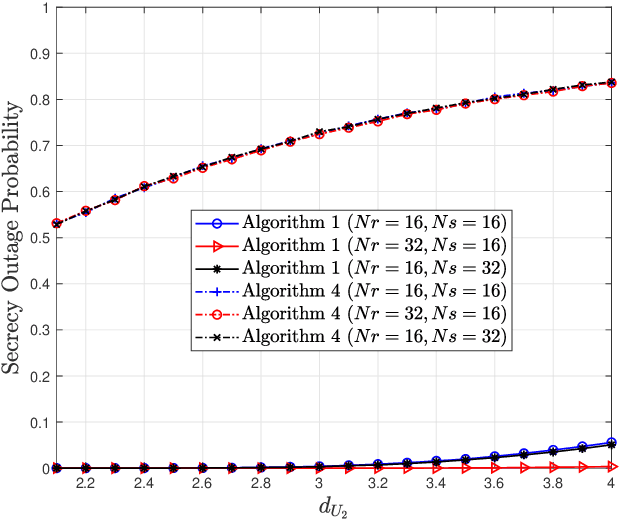
The intrinsic integration of the nonorthogonal multiple access (NOMA) and reconfigurable intelligent surface (RIS) techniques is envisioned to be a promising approach to significantly improve both the spectrum efficiency and energy efficiency for future wireless communication networks. In this paper, the physical layer security (PLS) for a RIS-aided NOMA 6G networks is investigated, in which a RIS is deployed to assist the two "dead zone" NOMA users and both internal and external eavesdropping are considered. For the scenario with only internal eavesdropping, we consider the worst case that the near-end user is untrusted and may try to intercept the information of far-end user. A joint beamforming and power allocation sub-optimal scheme is proposed to improve the system PLS. Then we extend our work to a scenario with both internal and external eavesdropping. Two sub-scenarios are considered in this scenario: one is the sub-scenario without channel state information (CSI) of eavesdroppers, and another is the sub-scenario where the eavesdroppers' CSI are available. For the both sub-scenarios, a noise beamforming scheme is introduced to be against the external eavesdroppers. An optimal power allocation scheme is proposed to further improve the system physical security for the second sub-scenario. Simulation results show the superior performance of the proposed schemes. Moreover, it has also been shown that increasing the number of reflecting elements can bring more gain in secrecy performance than that of the transmit antennas.