 Add to Chrome
 Add to Firefox
 Add to Edge
Cross-Modal Alignment and Fusion for RGB-D Transmission-Line Defect Detection
Feb 03, 2026
Transmission line defect detection remains challenging for automated UAV inspection due to the dominance of small-scale defects, complex backgrounds, and illumination variations. Existing RGB-based detectors, despite recent progress, struggle to distinguish geometrically subtle defects from visually similar background structures under limited chromatic contrast. This paper proposes CMAFNet, a Cross-Modal Alignment and Fusion Network that integrates RGB appearance and depth geometry through a principled purify-then-fuse paradigm. CMAFNet consists of a Semantic Recomposition Module that performs dictionary-based feature purification via a learned codebook to suppress modality-specific noise while preserving defect-discriminative information, and a Contextual Semantic Integration Framework that captures global spatial dependencies using partial-channel attention to enhance structural semantic reasoning. Position-wise normalization within the purification stage enforces explicit reconstruction-driven cross-modal alignment, ensuring statistical compatibility between heterogeneous features prior to fusion. Extensive experiments on the TLRGBD benchmark, where 94.5% of instances are small objects, demonstrate that CMAFNet achieves 32.2% mAP@50 and 12.5% APs, outperforming the strongest baseline by 9.8 and 4.0 percentage points, respectively. A lightweight variant reaches 24.8% mAP50 at 228 FPS with only 4.9M parameters, surpassing all YOLO-based detectors while matching transformer-based methods at substantially lower computational cost.

AviationLLM: An LLM-based Knowledge System for Aviation Training
Jun 17, 2025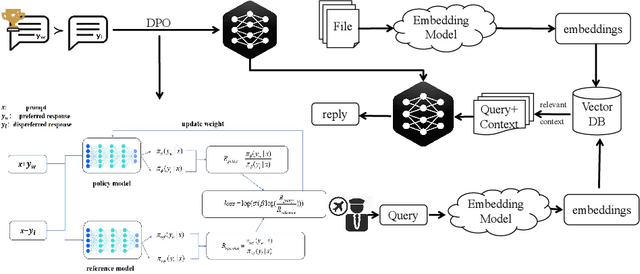
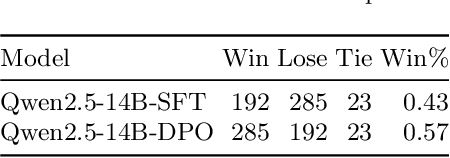
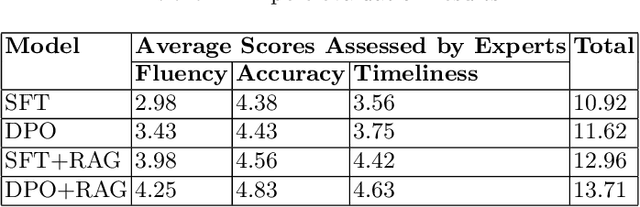
Aviation training is a core link in ensuring flight safety, improving industry efficiency and promoting sustainable development. It not only involves flight simulation but also requires the learning of a great deal of professional aviation theory knowledge. In the existing training system, the knowledge is mainly imparted by the the instructors. However, the number of instructors is limited and the professional answers obtained from the Internet are not accurate enough, resulting in low training efficiency. To address this, we introduced LLM, but the basic pre-trained model cannot provide accurate answers to professional fields, so we fine-tuned it. Traditional Supervised Fine-Tuning (SFT) risk generating superficially plausible but factually incorrect responses due to insufficient data coverage. To address this, we employ Direct Preference Optimization(DPO). This paper proposes Retrieval-Augmented LLM Alignment via Direct Preference Optimization(RALA-DPO). We select open source pre-trained LLM Qwen and adapt it to aviation theory training through DPO-based domain alignment. Simultaneously, to mitigate hallucinations caused by training data biases, knowledge obsolescence, or domain knowledge gaps, we implement Retrieval-Augmented Generation(RAG) technology that combines generative and retrieval models. RALA-DPO effectively retrieves relevant information from external knowledge bases and delivers precise and high-quality responses through the generative model. Experimental results demonstrate that RALA-DPO can improve accuracy in response to professional aviation knowledge. With integrated RAG mechanisms, this system can further improve the accuracy of answers and achieve zero-cost knowledge updates simultaneously.