 Add to Chrome
 Add to Firefox
 Add to Edge
Semantic Feature Segmentation for Interpretable Predictive Maintenance in Complex Systems
May 14, 2026
Predictive maintenance in complex systems is often complicated by the heterogeneity and redundancy of monitored variables,which can obscure fault-relevant information and reduce model interpretability. This work proposes a semantic feature segmentation framework that decomposes the monitored feature space into a canonical component,expected to retain the dominant predictive information, and a residual component containing structurally peripheral signals. The segmentation is defined through domain informed criteria and sets up monitoring variables into functional groups reflecting operational mechanisms such as throughput,latency,pressure,network activity,and structural state. To evaluate the effectiveness of this decomposition, we adopt a predictive perspective in which expected predictive risk is used as an operational proxy for task-relevant information. Experimental results obtained through time-aware cross-validation show that the canonical space consistently achieves lower predictive risk than the residual space across multiple temporal configurations, indicating that the semantic segmentation concentrates the most relevant information for fault anticipation. In addition, the canonical segments exhibit significantly stronger intra-segment coherence than inter-segment dependence, and this structural organization remains stable after redundancy reduction. When compared with the full feature space and with a Principal Component Analysis (PCA) representation, the canonical space carries out comparable predictive performance and furthermore preserves the semantic meaning of the original variables. These findings suggest that semantic feature segmentation provides an interpretable and information-preserving decomposition of monitoring signals, enabling competitive predictive performance without sacrificing the operational interpretability required in predictive maintenance applications.

Multivariate time-series forecasting of ASTRI-Horn monitoring data: A Normal Behavior Model
Feb 23, 2026This study presents a Normal Behavior Model (NBM) developed to forecast monitoring time-series data from the ASTRI-Horn Cherenkov telescope under normal operating conditions. The analysis focused on 15 physical variables acquired by the Telescope Control Unit between September 2022 and July 2024, representing sensor measurements from the Azimuth and Elevation motors. After data cleaning, resampling, feature selection, and correlation analysis, the dataset was segmented into fixed-length intervals, in which the first I samples represented the input sequence provided to the model, while the forecast length, T, indicated the number of future time steps to be predicted. A sliding-window technique was then applied to increase the number of intervals. A Multi-Layer Perceptron (MLP) was trained to perform multivariate forecasting across all features simultaneously. Model performance was evaluated using the Mean Squared Error (MSE) and the Normalized Median Absolute Deviation (NMAD), and it was also benchmarked against a Long Short-Term Memory (LSTM) network. The MLP model demonstrated consistent results across different features and I-T configurations, and matched the performance of the LSTM while converging faster. It achieved an MSE of 0.019+/-0.003 and an NMAD of 0.032+/-0.009 on the test set under its best configuration (4 hidden layers, 720 units per layer, and I-T lengths of 300 samples each, corresponding to 5 hours at 1-minute resolution). Extending the forecast horizon up to 6.5 hours-the maximum allowed by this configuration-did not degrade performance, confirming the model's effectiveness in providing reliable hour-scale predictions. The proposed NBM provides a powerful tool for enabling early anomaly detection in online ASTRI-Horn monitoring time series, offering a basis for the future development of a prognostics and health management system that supports predictive maintenance.
* 15 pages, 12 figures
SERVIMON: AI-Driven Predictive Maintenance and Real-Time Monitoring for Astronomical Observatories
Oct 31, 2025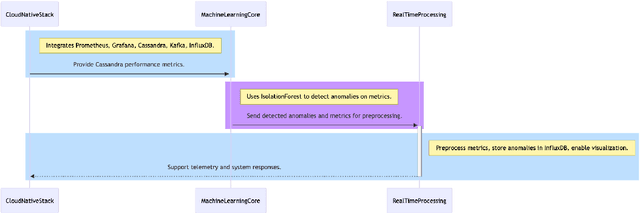
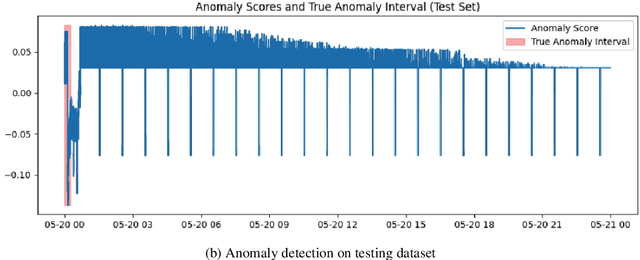
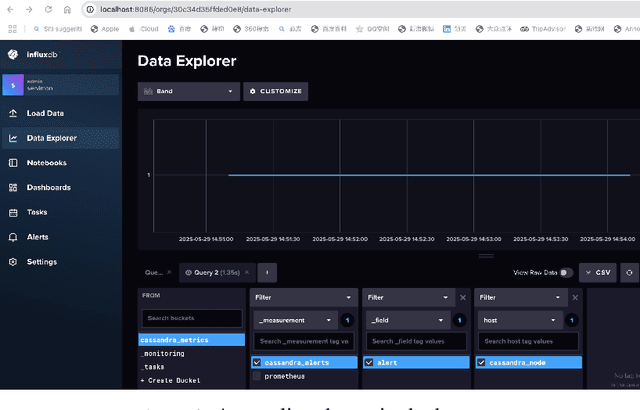
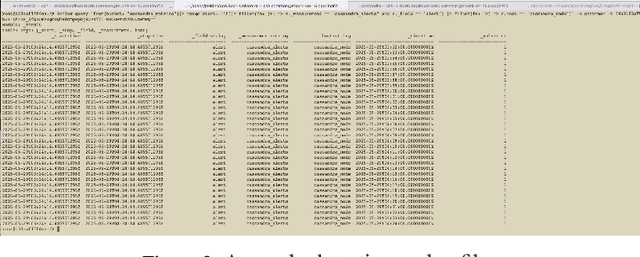
Objective: ServiMon is designed to offer a scalable and intelligent pipeline for data collection and auditing to monitor distributed astronomical systems such as the ASTRI Mini-Array. The system enhances quality control, predictive maintenance, and real-time anomaly detection for telescope operations. Methods: ServiMon integrates cloud-native technologies-including Prometheus, Grafana, Cassandra, Kafka, and InfluxDB-for telemetry collection and processing. It employs machine learning algorithms, notably Isolation Forest, to detect anomalies in Cassandra performance metrics. Key indicators such as read/write latency, throughput, and memory usage are continuously monitored, stored as time-series data, and preprocessed for feature engineering. Anomalies detected by the model are logged in InfluxDB v2 and accessed via Flux for real-time monitoring and visualization. Results: AI-based anomaly detection increases system resilience by identifying performance degradation at an early stage, minimizing downtime, and optimizing telescope operations. Additionally, ServiMon supports astrostatistical analysis by correlating telemetry with observational data, thus enhancing scientific data quality. AI-generated alerts also improve real-time monitoring, enabling proactive system management. Conclusion: ServiMon's scalable framework proves effective for predictive maintenance and real-time monitoring of astronomical infrastructures. By leveraging cloud and edge computing, it is adaptable to future large-scale experiments, optimizing both performance and cost. The combination of machine learning and big data analytics makes ServiMon a robust and flexible solution for modern and next-generation observational astronomy.
Segmentation over Complexity: Evaluating Ensemble and Hybrid Approaches for Anomaly Detection in Industrial Time Series
Oct 30, 2025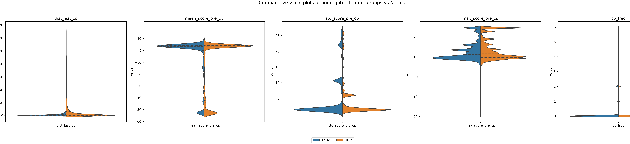
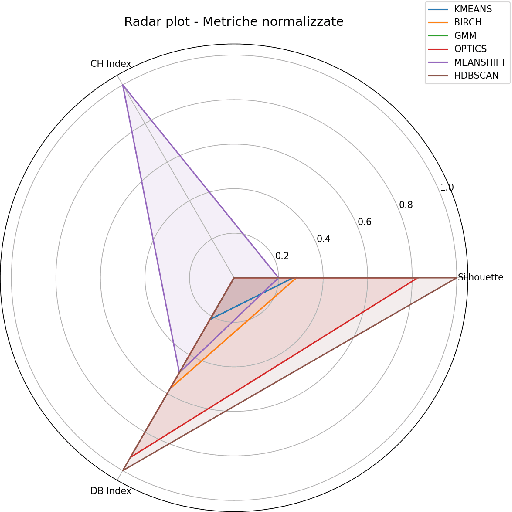
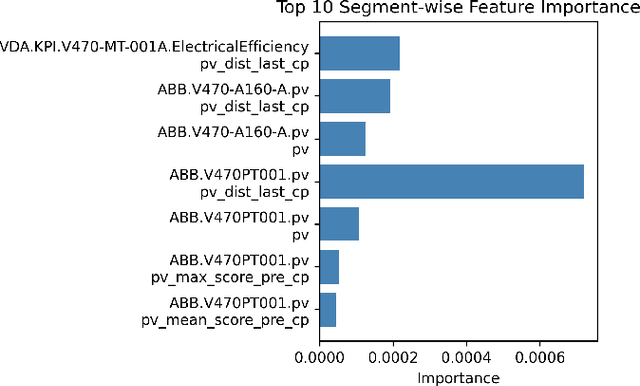
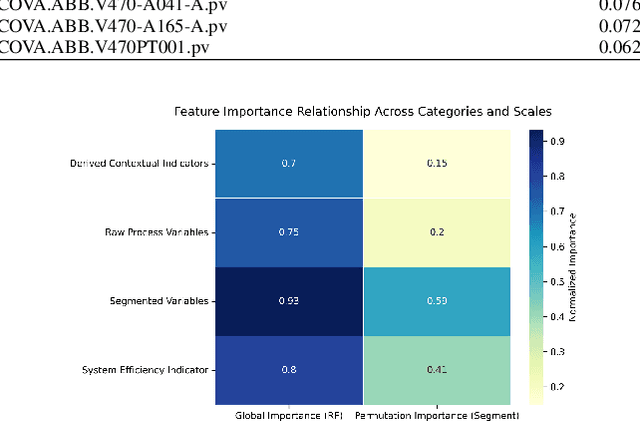
In this study, we investigate the effectiveness of advanced feature engineering and hybrid model architectures for anomaly detection in a multivariate industrial time series, focusing on a steam turbine system. We evaluate the impact of change point-derived statistical features, clustering-based substructure representations, and hybrid learning strategies on detection performance. Despite their theoretical appeal, these complex approaches consistently underperformed compared to a simple Random Forest + XGBoost ensemble trained on segmented data. The ensemble achieved an AUC-ROC of 0.976, F1-score of 0.41, and 100% early detection within the defined time window. Our findings highlight that, in scenarios with highly imbalanced and temporally uncertain data, model simplicity combined with optimized segmentation can outperform more sophisticated architectures, offering greater robustness, interpretability, and operational utility.
Predictive Maintenance Study for High-Pressure Industrial Compressors: Hybrid Clustering Models
Nov 21, 2024This study introduces a predictive maintenance strategy for high pressure industrial compressors using sensor data and features derived from unsupervised clustering integrated into classification models. The goal is to enhance model accuracy and efficiency in detecting compressor failures. After data pre processing, sensitive clustering parameters were tuned to identify algorithms that best capture the dataset's temporal and operational characteristics. Clustering algorithms were evaluated using quality metrics like Normalized Mutual Information (NMI) and Adjusted Rand Index (ARI), selecting those most effective at distinguishing between normal and non normal conditions. These features enriched regression models, improving failure detection accuracy by 4.87 percent on average. Although training time was reduced by 22.96 percent, the decrease was not statistically significant, varying across algorithms. Cross validation and key performance metrics confirmed the benefits of clustering based features in predictive maintenance models.