 Add to Chrome
 Add to Firefox
 Add to Edge
Aerial Inspection Behaviors via RL-based Quadrotor Control for Under-canopy Forest Environments
May 19, 2026
This paper addresses the problem of using a deep Reinforcement Learning (RL)-based low-level Quadrotor controller within an autonomous Quadrotor navigation stack for aerial inspection missions in under-canopy forest environments. Specifically, the article presents an end-to-end (mapping states to RPMs) Quadrotor control policy that achieves inspection view-pose tracking (simultaneous position and yaw reference tracking), which is crucial for various target inspection behaviors and point-to-point navigation in forests. To ensure safe and reliable deployment of the end-to-end RL controller in long-range missions, this article utilizes a higher navigation guidance layer comprising of a Traveling Salesman Problem planner (TSP) and a Rapidly-exploring Random Tree Star (RRT*) planner. Over a known map of a forest and a set of user-specified inspection regions, the TSP planner finds the optimal visitation sequence. Between two target regions, collision-free paths that respect the tracking limitations of the lower end-to-end RL policy are generated by an RRT* planner. Through five target inspection scenarios, this article demonstrates that an RL-based motor-level stabilizing controller, supported by a navigation guidance layer, can be used effectively as the low-level inspection execution module for under-canopy forest inspection missions.

A Heuristic Approach for Performance Tuning in RL-based Quadrotor Control via Reward Design and Termination Conditions
May 18, 2026Reinforcement learning (RL)-based quadrotor control policies have achieved impressive performance in tasks such as fast navigation in cluttered environments and drone racing, where the focus is on speed and agility. However, in several applications, such as infrastructure inspection, it is critical to achieve precise, controlled maneuvers with tunable performance. In this article, we present a novel heuristic approach to achieve tunable performance in RL-based Quadrotor control through reward design and termination conditions. We present a novel reward structure containing dual bandwidth exponentials that achieves a baseline critically damped response in setpoint tracking, with low steady-state errors. When trained with a Proximal Policy Optimization (PPO) algorithm, in conjunction with episode truncation conditions, the desired performance is achieved in 6 million time steps in a sample-efficient manner. In order to tune the performance about the baseline behavior, we present intuitive heuristic rules to adjust the reward weights and exponential coefficients to achieve faster (acrobatic-like) and slower (inspection-like) settling time performance, while retaining the baseline critically damped response and approximately 2\% steady-state error. We evaluate the three RL policies (baseline, acrobatic, and inspection) across 100 trials and show accurate and tunable performance in position and yaw tracking from random initial conditions, thereby demonstrating the effectiveness of the proposed heuristic approach.
Curriculum-based Sample Efficient Reinforcement Learning for Robust Stabilization of a Quadrotor
Jan 30, 2025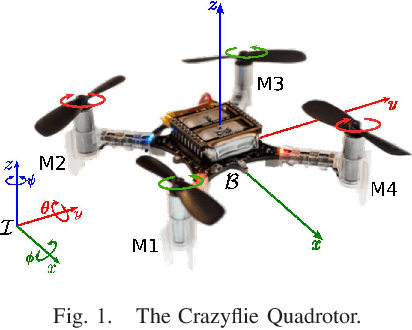
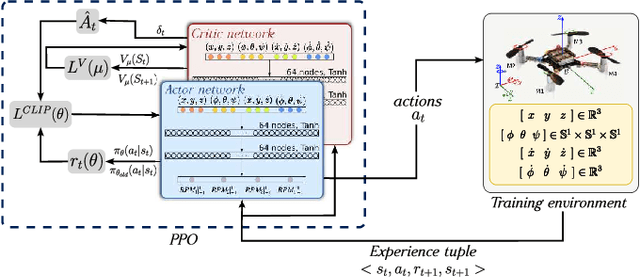
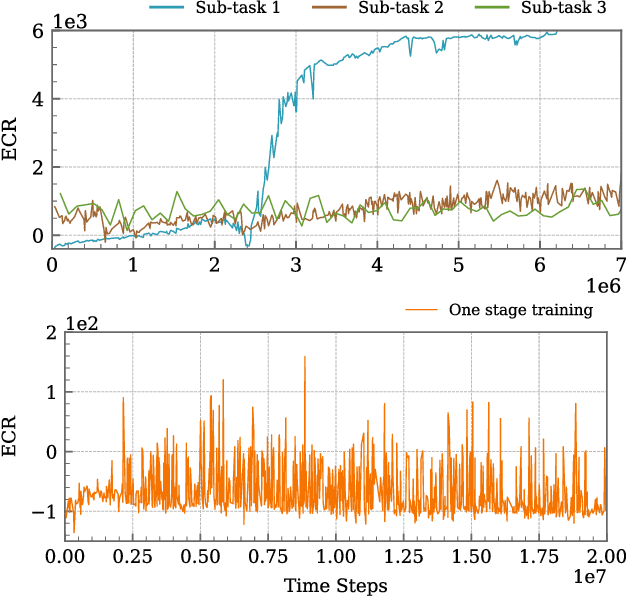
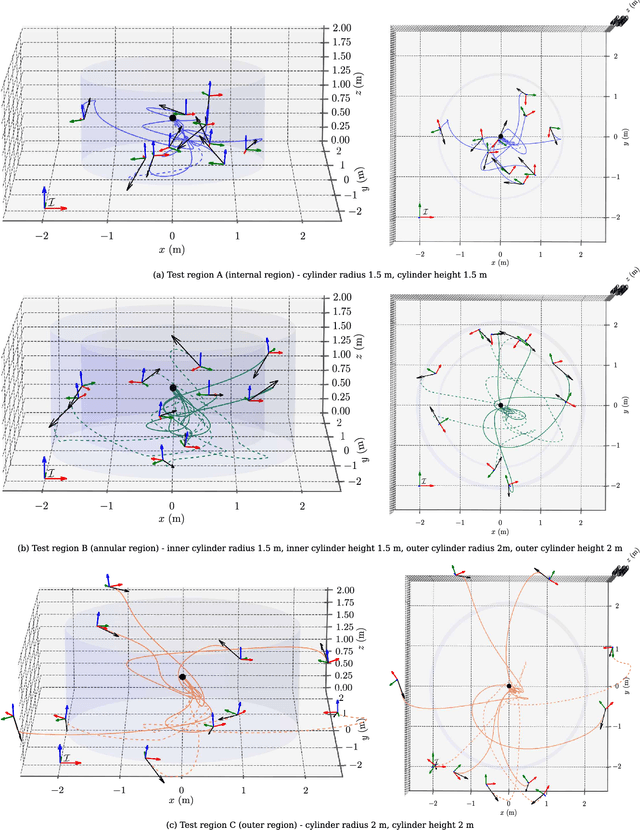
This article introduces a curriculum learning approach to develop a reinforcement learning-based robust stabilizing controller for a Quadrotor that meets predefined performance criteria. The learning objective is to achieve desired positions from random initial conditions while adhering to both transient and steady-state performance specifications. This objective is challenging for conventional one-stage end-to-end reinforcement learning, due to the strong coupling between position and orientation dynamics, the complexity in designing and tuning the reward function, and poor sample efficiency, which necessitates substantial computational resources and leads to extended convergence times. To address these challenges, this work decomposes the learning objective into a three-stage curriculum that incrementally increases task complexity. The curriculum begins with learning to achieve stable hovering from a fixed initial condition, followed by progressively introducing randomization in initial positions, orientations and velocities. A novel additive reward function is proposed, to incorporate transient and steady-state performance specifications. The results demonstrate that the Proximal Policy Optimization (PPO)-based curriculum learning approach, coupled with the proposed reward structure, achieves superior performance compared to a single-stage PPO-trained policy with the same reward function, while significantly reducing computational resource requirements and convergence time. The curriculum-trained policy's performance and robustness are thoroughly validated under random initial conditions and in the presence of disturbances.