 Add to Chrome
 Add to Firefox
 Add to Edge
Information Terra: A Narrative-Anchored Semantic-First Projection of Document Embeddings
Jun 29, 2026
We introduce Information Terra, a narrative-anchored semantic-first projection that places a document corpus on an Earth-like globe whose poles are two user-chosen endpoint documents and whose prime meridian is the great-circle geodesic between them on the embedding hypersphere -- so latitude encodes narrative progress and longitude thematic deviation. Land features are recovered from document density via kernel density estimation and labeled by theme. A narrative trail built from the underlying narrative coherence graph, and constrained to be monotone in geodesic progress, provides a readable storyline. The projection's axes are semantically grounded in the user's chosen narrative endpoints, and the globe metaphor affords rotation and antipodal reading. We demonstrate the method on a 540-article Cuban Protests corpus, showing a storyline from Obama's 2016 visit to the 2021 International Aid during the protests.

Semantic Interaction for Narrative Map Sensemaking: An Insight-based Evaluation
Mar 31, 2026Semantic interaction (SI) enables analysts to incorporate their cognitive processes into AI models through direct manipulation of visualizations. While SI frameworks for narrative extraction have been proposed, empirical evaluations of their effectiveness remain limited. This paper presents a user study that evaluates SI for narrative map sensemaking, involving 33 participants under three conditions: a timeline baseline, a basic narrative map, and an interactive narrative map with SI capabilities. The results show that the map-based prototypes yielded more insights than the timeline baseline, with the SI-enabled condition reaching statistical significance and the basic map condition trending in the same direction. The SI-enabled condition showed the highest mean performance; differences between the map conditions were not statistically significant but showed large effect sizes (d > 0.8), suggesting that the study was underpowered to detect them. Qualitative analysis identified two distinct SI approaches-corrective and additive-that enable analysts to impose quality judgments and organizational structure on extracted narratives. We also find that SI users achieved comparable exploration breadth with less parameter manipulation, suggesting that SI serves as an alternative pathway for model refinement. This work provides empirical evidence that map-based representations outperform timelines for narrative sensemaking, along with qualitative insights into how analysts use SI for narrative refinement.
Explainable AI Components for Narrative Map Extraction
Mar 19, 2025As narrative extraction systems grow in complexity, establishing user trust through interpretable and explainable outputs becomes increasingly critical. This paper presents an evaluation of an Explainable Artificial Intelligence (XAI) system for narrative map extraction that provides meaningful explanations across multiple levels of abstraction. Our system integrates explanations based on topical clusters for low-level document relationships, connection explanations for event relationships, and high-level structure explanations for overall narrative patterns. In particular, we evaluate the XAI system through a user study involving 10 participants that examined narratives from the 2021 Cuban protests. The analysis of results demonstrates that participants using the explanations made the users trust in the system's decisions, with connection explanations and important event detection proving particularly effective at building user confidence. Survey responses indicate that the multi-level explanation approach helped users develop appropriate trust in the system's narrative extraction capabilities. This work advances the state-of-the-art in explainable narrative extraction while providing practical insights for developing reliable narrative extraction systems that support effective human-AI collaboration.
Narrative Trails: A Method for Coherent Storyline Extraction via Maximum Capacity Path Optimization
Mar 19, 2025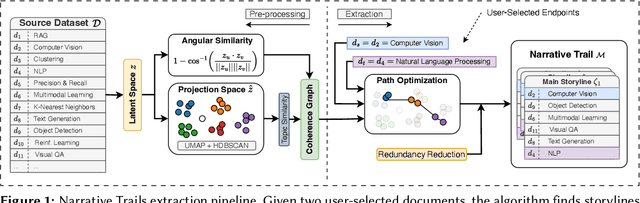
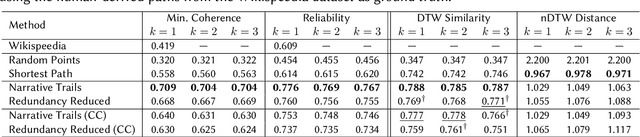
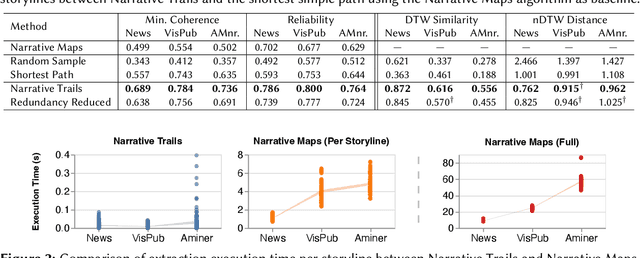
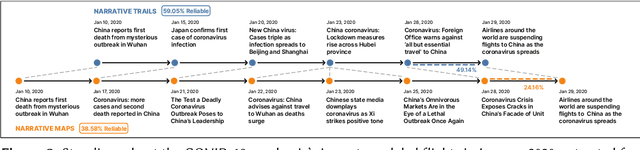
Traditional information retrieval is primarily concerned with finding relevant information from large datasets without imposing a structure within the retrieved pieces of data. However, structuring information in the form of narratives--ordered sets of documents that form coherent storylines--allows us to identify, interpret, and share insights about the connections and relationships between the ideas presented in the data. Despite their significance, current approaches for algorithmically extracting storylines from data are scarce, with existing methods primarily relying on intricate word-based heuristics and auxiliary document structures. Moreover, many of these methods are difficult to scale to large datasets and general contexts, as they are designed to extract storylines for narrow tasks. In this paper, we propose Narrative Trails, an efficient, general-purpose method for extracting coherent storylines in large text corpora. Specifically, our method uses the semantic-level information embedded in the latent space of deep learning models to build a sparse coherence graph and extract narratives that maximize the minimum coherence of the storylines. By quantitatively evaluating our proposed methods on two distinct narrative extraction tasks, we show the generalizability and scalability of Narrative Trails in multiple contexts while also simplifying the extraction pipeline.