 Add to Chrome
 Add to Firefox
 Add to Edge
Concerning Uncertainty -- A Systematic Survey of Uncertainty-Aware XAI
Mar 27, 2026
This paper surveys uncertainty-aware explainable artificial intelligence (UAXAI), examining how uncertainty is incorporated into explanatory pipelines and how such methods are evaluated. Across the literature, three recurring approaches to uncertainty quantification emerge (Bayesian, Monte Carlo, and Conformal methods), alongside distinct strategies for integrating uncertainty into explanations: assessing trustworthiness, constraining models or explanations, and explicitly communicating uncertainty. Evaluation practices remain fragmented and largely model centered, with limited attention to users and inconsistent reporting of reliability properties (e.g., calibration, coverage, explanation stability). Recent work leans towards calibration, distribution free techniques and recognizes explainer variability as a central concern. We argue that progress in UAXAI requires unified evaluation principles that link uncertainty propagation, robustness, and human decision-making, and highlight counterfactual and calibration approaches as promising avenues for aligning interpretability with reliability.

Fast Calibrated Explanations: Efficient and Uncertainty-Aware Explanations for Machine Learning Models
Oct 28, 2024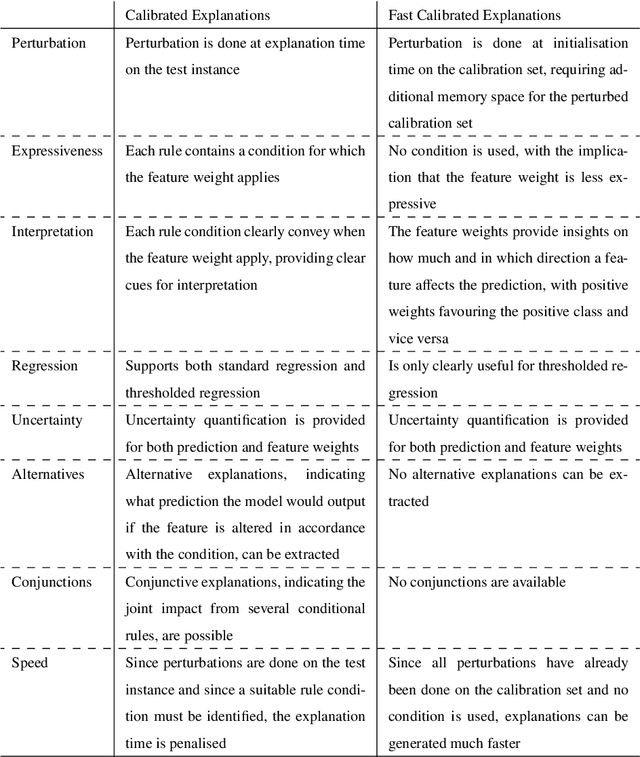
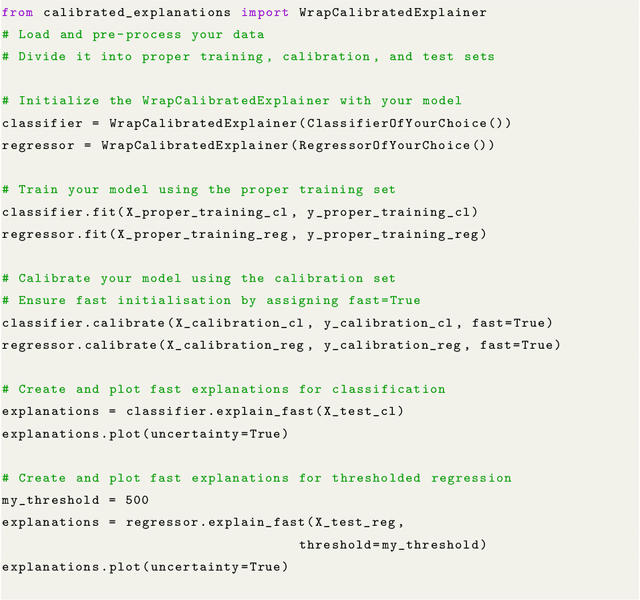

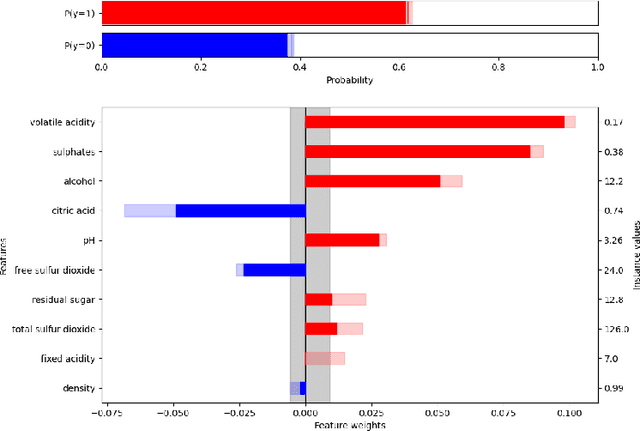
This paper introduces Fast Calibrated Explanations, a method designed for generating rapid, uncertainty-aware explanations for machine learning models. By incorporating perturbation techniques from ConformaSight - a global explanation framework - into the core elements of Calibrated Explanations (CE), we achieve significant speedups. These core elements include local feature importance with calibrated predictions, both of which retain uncertainty quantification. While the new method sacrifices a small degree of detail, it excels in computational efficiency, making it ideal for high-stakes, real-time applications. Fast Calibrated Explanations are applicable to probabilistic explanations in classification and thresholded regression tasks, where they provide the likelihood of a target being above or below a user-defined threshold. This approach maintains the versatility of CE for both classification and probabilistic regression, making it suitable for a range of predictive tasks where uncertainty quantification is crucial.