 Add to Chrome
 Add to Firefox
 Add to Edge
Safe-RULE: Safe Reinforcement UnLEarning
Jun 08, 2026
Offline safe reinforcement learning (Safe RL) enables policy learning without online interactions, making it suitable for safety-critical systems such as robotics systems. However, its reliance on static datasets exposes offline Safe RL to data poisoning attacks, where adversaries inject malicious samples that compromise safety and induce unsafe policy behavior. In this work, we propose a new learning paradigm, named safe reinforcement unlearning (Safe-RULE), used as a defense framework to remove the influence of poisoned data without retraining from scratch or requiring access to the original training environment. We further extend reinforcement unlearning to offline Safe RL by explicitly accounting for both task performance and safety constraints during the unlearning process. Experiments across benchmark Safe RL tasks demonstrate that our approach effectively enhances safety performance against data poisoning attacks.

SafeVLA-Bench: A Benchmark for the Success-Safety Gap in Vision-Language-Action Models
May 30, 2026Vision-language-action (VLA) benchmarks measure whether a policy completes a requested manipulation task, but binary success can hide safety-relevant trajectory behavior: reaching the goal while applying excessive contact, disturbing bystander objects, destabilizing the held object, or entering robot self-contact. We present SafeVLA-Bench, a post-hoc safety-evaluation framework for existing simulator-based VLA benchmarks. It formalizes task-aware safety requirements as Signal Temporal Logic (STL) specifications and reports native success with two unsafe-success metrics: Succ-But-Unsafe (SBU), the fraction of rollouts that both succeed and violate safety, and Violation Severity Index (VSI), a bounded worst-violation depth score. We instantiate SafeVLA-Bench on LIBERO and RoboCasa-365, evaluating nine policy-benchmark entries across tabletop and kitchen manipulation tasks. High task success does not imply safe execution: high-SR tabletop baselines still leave 13 to 15 percent unsafe-episode rates,and 36 to 56 percent of successful RoboCasa-365 rollouts violate at least one active safety clause. Project page: https://safevla.org.
SafePilot: A Framework for Assuring LLM-enabled Cyber-Physical Systems
Mar 23, 2026Large Language Models (LLMs), deep learning architectures with typically over 10 billion parameters, have recently begun to be integrated into various cyber-physical systems (CPS) such as robotics, industrial automation, and autopilot systems. The abstract knowledge and reasoning capabilities of LLMs are employed for tasks like planning and navigation. However, a significant challenge arises from the tendency of LLMs to produce "hallucinations" - outputs that are coherent yet factually incorrect or contextually unsuitable. This characteristic can lead to undesirable or unsafe actions in the CPS. Therefore, our research focuses on assuring the LLM-enabled CPS by enhancing their critical properties. We propose SafePilot, a novel hierarchical neuro-symbolic framework that provides end-to-end assurance for LLM-enabled CPS according to attribute-based and temporal specifications. Given a task and its specification, SafePilot first invokes a hierarchical planner with a discriminator that assesses task complexity. If the task is deemed manageable, it is passed directly to an LLM-based task planner with built-in verification. Otherwise, the hierarchical planner applies a divide-and-conquer strategy, decomposing the task into sub-tasks, each of which is individually planned and later merged into a final solution. The LLM-based task planner translates natural language constraints into formal specifications and verifies the LLM's output against them. If violations are detected, it identifies the flaw, adjusts the prompt accordingly, and re-invokes the LLM. This iterative process continues until a valid plan is produced or a predefined limit is reached. Our framework supports LLM-enabled CPS with both attribute-based and temporal constraints. Its effectiveness and adaptability are demonstrated through two illustrative case studies.
Enhancing LLM-Based Test Generation by Eliminating Covered Code
Feb 25, 2026Automated test generation is essential for software quality assurance, with coverage rate serving as a key metric to ensure thorough testing. Recent advancements in Large Language Models (LLMs) have shown promise in improving test generation, particularly in achieving higher coverage. However, while existing LLM-based test generation solutions perform well on small, isolated code snippets, they struggle when applied to complex methods under test. To address these issues, we propose a scalable LLM-based unit test generation method. Our approach consists of two key steps. The first step is context information retrieval, which uses both LLMs and static analysis to gather relevant contextual information associated with the complex methods under test. The second step, iterative test generation with code elimination, repeatedly generates unit tests for the code slice, tracks the achieved coverage, and selectively removes code segments that have already been covered. This process simplifies the testing task and mitigates issues arising from token limits or reduced reasoning effectiveness associated with excessively long contexts. Through comprehensive evaluations on open-source projects, our approach outperforms state-of-the-art LLM-based and search-based methods, demonstrating its effectiveness in achieving high coverage on complex methods.
Vulnerability Analysis of Safe Reinforcement Learning via Inverse Constrained Reinforcement Learning
Feb 18, 2026Safe reinforcement learning (Safe RL) aims to ensure policy performance while satisfying safety constraints. However, most existing Safe RL methods assume benign environments, making them vulnerable to adversarial perturbations commonly encountered in real-world settings. In addition, existing gradient-based adversarial attacks typically require access to the policy's gradient information, which is often impractical in real-world scenarios. To address these challenges, we propose an adversarial attack framework to reveal vulnerabilities of Safe RL policies. Using expert demonstrations and black-box environment interaction, our framework learns a constraint model and a surrogate (learner) policy, enabling gradient-based attack optimization without requiring the victim policy's internal gradients or the ground-truth safety constraints. We further provide theoretical analysis establishing feasibility and deriving perturbation bounds. Experiments on multiple Safe RL benchmarks demonstrate the effectiveness of our approach under limited privileged access.
Fulfilling Formal Specifications ASAP by Model-free Reinforcement Learning
Apr 25, 2023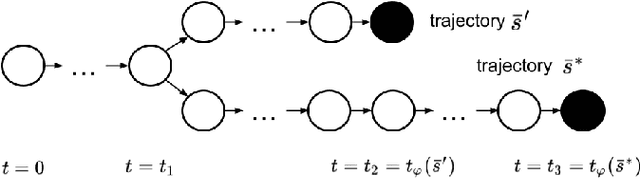
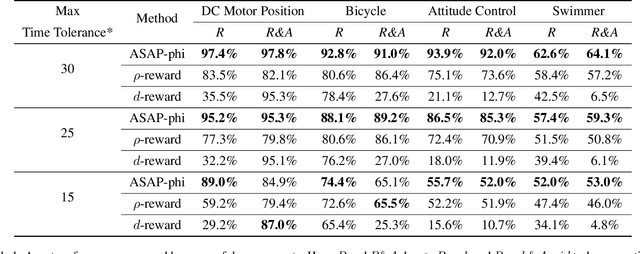
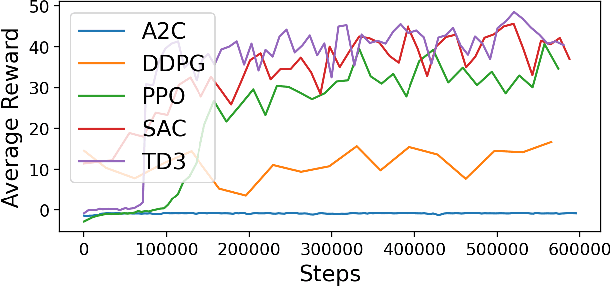
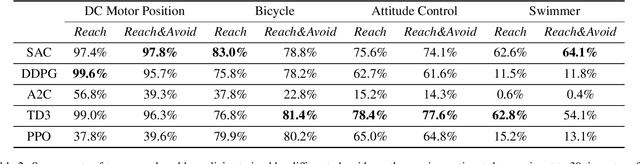
We propose a model-free reinforcement learning solution, namely the ASAP-Phi framework, to encourage an agent to fulfill a formal specification ASAP. The framework leverages a piece-wise reward function that assigns quantitative semantic reward to traces not satisfying the specification, and a high constant reward to the remaining. Then, it trains an agent with an actor-critic-based algorithm, such as soft actor-critic (SAC), or deep deterministic policy gradient (DDPG). Moreover, we prove that ASAP-Phi produces policies that prioritize fulfilling a specification ASAP. Extensive experiments are run, including ablation studies, on state-of-the-art benchmarks. Results show that our framework succeeds in finding sufficiently fast trajectories for up to 97\% test cases and defeats baselines.