 Add to Chrome
 Add to Firefox
 Add to Edge
STAR: Mitigating Cascading Errors in Spatial Reasoning via Turn-point Alignment and Segment-level DPO
Apr 01, 2026
Structured spatial navigation is a core benchmark for Large Language Models (LLMs) spatial reasoning. Existing paradigms like Visualization-of-Thought (VoT) are prone to cascading errors in complex topologies. To solve this, we propose STAR, a two-stage framework grounded on topological anchors, and introduce the RedMaze-23K dataset with human-inspired turnpoint annotations. The first stage uses supervised fine-tuning to help models internalize spatial semantics and prune redundant paths. The second adopts Spatial-aware Segment-level Direct Preference Optimization (SDPO) to refine self-correction in long-horizon navigation. Experiments show STAR achieves state-of-the-art performance among open-source models: its 32B variant outperforms DeepSeek-V3 (29.27% vs. 25.00%) and reaches 82.4% of GPT-4's performance.

EvoEmpirBench: Dynamic Spatial Reasoning with Agent-ExpVer
Sep 16, 2025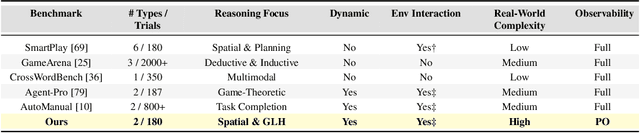
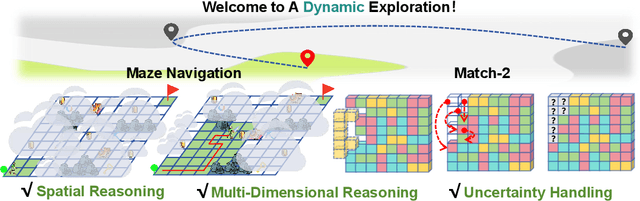

Most existing spatial reasoning benchmarks focus on static or globally observable environments, failing to capture the challenges of long-horizon reasoning and memory utilization under partial observability and dynamic changes. We introduce two dynamic spatial benchmarks, locally observable maze navigation and match-2 elimination that systematically evaluate models' abilities in spatial understanding and adaptive planning when local perception, environment feedback, and global objectives are tightly coupled. Each action triggers structural changes in the environment, requiring continuous update of cognition and strategy. We further propose a subjective experience-based memory mechanism for cross-task experience transfer and validation. Experiments show that our benchmarks reveal key limitations of mainstream models in dynamic spatial reasoning and long-term memory, providing a comprehensive platform for future methodological advances. Our code and data are available at https://anonymous.4open.science/r/EvoEmpirBench-143C/.
FakeHunter: Multimodal Step-by-Step Reasoning for Explainable Video Forensics
Aug 20, 2025FakeHunter is a multimodal deepfake detection framework that combines memory-guided retrieval, chain-of-thought (Observation-Thought-Action) reasoning, and tool-augmented verification to provide accurate and interpretable video forensics. FakeHunter encodes visual content using CLIP and audio using CLAP, generating joint audio-visual embeddings that retrieve semantically similar real exemplars from a FAISS-indexed memory bank for contextual grounding. Guided by the retrieved context, the system iteratively reasons over evidence to localize manipulations and explain them. When confidence is low, it automatically invokes specialized tools-such as zoom-in image forensics or mel-spectrogram inspection-for fine-grained verification. Built on Qwen2.5-Omni-7B, FakeHunter produces structured JSON verdicts that specify what was modified, where it occurs, and why it is judged fake. We also introduce X-AVFake, a benchmark comprising 5.7k+ manipulated and real videos (950+ min) annotated with manipulation type, region/entity, violated reasoning category, and free-form justification. On X-AVFake, FakeHunter achieves an accuracy of 34.75%, outperforming the vanilla Qwen2.5-Omni-7B by 16.87 percentage points and MiniCPM-2.6 by 25.56 percentage points. Ablation studies reveal that memory retrieval contributes a 7.75 percentage point gain, and tool-based inspection improves low-confidence cases to 46.50%. Despite its multi-stage design, the pipeline processes a 10-minute clip in 8 minutes on a single NVIDIA A800 (0.8x real-time) or 2 minutes on four GPUs (0.2x), demonstrating practical deployability.