 Add to Chrome
 Add to Firefox
 Add to Edge
ZS-TreeSeg: A Zero-Shot Framework for Tree Crown Instance Segmentation
Jan 31, 2026
Individual tree crown segmentation is an important task in remote sensing for forest biomass estimation and ecological monitoring. However, accurate delineation in dense, overlapping canopies remains a bottleneck. While supervised deep learning methods suffer from high annotation costs and limited generalization, emerging foundation models (e.g., Segment Anything Model) often lack domain knowledge, leading to under-segmentation in dense clusters. To bridge this gap, we propose ZS-TreeSeg, a Zero-Shot framework that adapts from two mature tasks: 1) Canopy Semantic segmentation; and 2) Cells instance segmentation. By modeling tree crowns as star-convex objects within a topological flow field using Cellpose-SAM, the ZS-TreeSeg framework forces the mathematical separation of touching tree crown instances based on vector convergence. Experiments on the NEON and BAMFOREST datasets and visual inspection demonstrate that our framework generalizes robustly across diverse sensor types and canopy densities, which can offer a training-free solution for tree crown instance segmentation and labels generation.

Building Machine Learning Challenges for Anomaly Detection in Science
Mar 03, 2025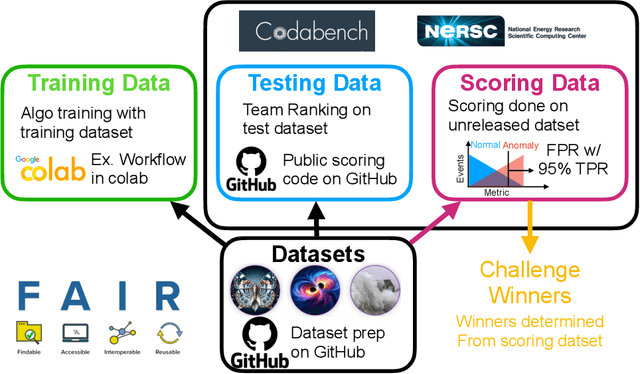
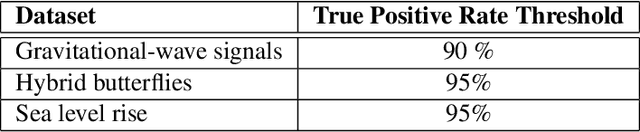
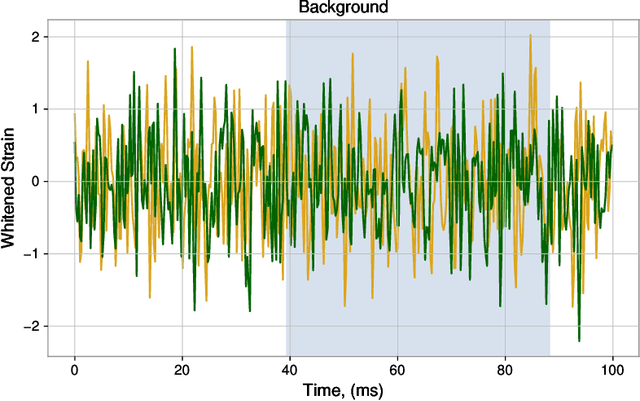
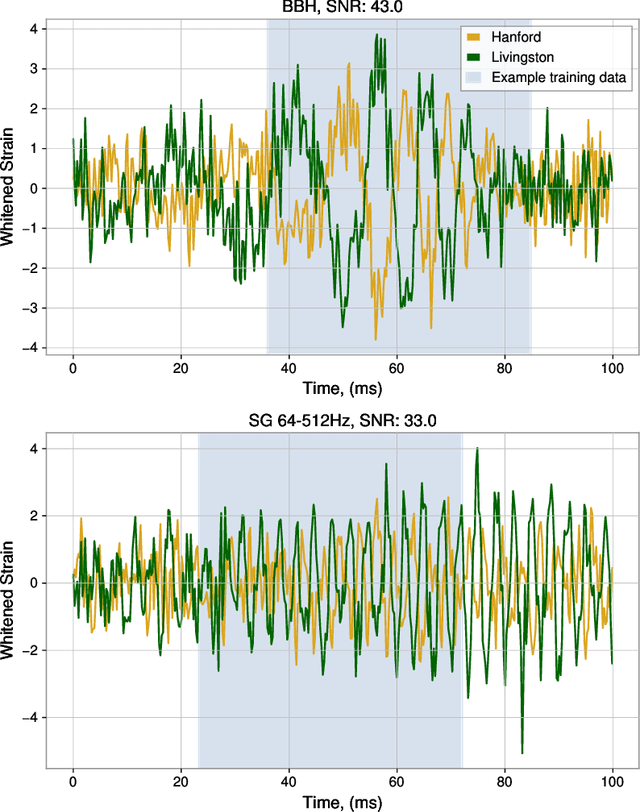
Scientific discoveries are often made by finding a pattern or object that was not predicted by the known rules of science. Oftentimes, these anomalous events or objects that do not conform to the norms are an indication that the rules of science governing the data are incomplete, and something new needs to be present to explain these unexpected outliers. The challenge of finding anomalies can be confounding since it requires codifying a complete knowledge of the known scientific behaviors and then projecting these known behaviors on the data to look for deviations. When utilizing machine learning, this presents a particular challenge since we require that the model not only understands scientific data perfectly but also recognizes when the data is inconsistent and out of the scope of its trained behavior. In this paper, we present three datasets aimed at developing machine learning-based anomaly detection for disparate scientific domains covering astrophysics, genomics, and polar science. We present the different datasets along with a scheme to make machine learning challenges around the three datasets findable, accessible, interoperable, and reusable (FAIR). Furthermore, we present an approach that generalizes to future machine learning challenges, enabling the possibility of large, more compute-intensive challenges that can ultimately lead to scientific discovery.