 Add to Chrome
 Add to Firefox
 Add to Edge
Multi-modal Deepfake Detection and Localization with FPN-Transformer
Nov 11, 2025
The rapid advancement of generative adversarial networks (GANs) and diffusion models has enabled the creation of highly realistic deepfake content, posing significant threats to digital trust across audio-visual domains. While unimodal detection methods have shown progress in identifying synthetic media, their inability to leverage cross-modal correlations and precisely localize forged segments limits their practicality against sophisticated, fine-grained manipulations. To address this, we introduce a multi-modal deepfake detection and localization framework based on a Feature Pyramid-Transformer (FPN-Transformer), addressing critical gaps in cross-modal generalization and temporal boundary regression. The proposed approach utilizes pre-trained self-supervised models (WavLM for audio, CLIP for video) to extract hierarchical temporal features. A multi-scale feature pyramid is constructed through R-TLM blocks with localized attention mechanisms, enabling joint analysis of cross-context temporal dependencies. The dual-branch prediction head simultaneously predicts forgery probabilities and refines temporal offsets of manipulated segments, achieving frame-level localization precision. We evaluate our approach on the test set of the IJCAI'25 DDL-AV benchmark, showing a good performance with a final score of 0.7535 for cross-modal deepfake detection and localization in challenging environments. Experimental results confirm the effectiveness of our approach and provide a novel way for generalized deepfake detection. Our code is available at https://github.com/Zig-HS/MM-DDL

Exploiting Facial Relationships and Feature Aggregation for Multi-Face Forgery Detection
Oct 07, 2023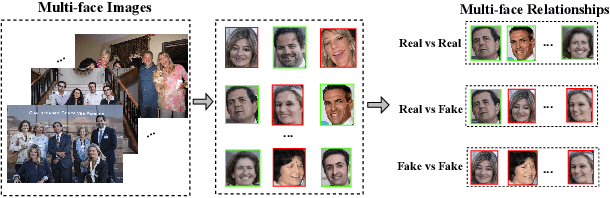
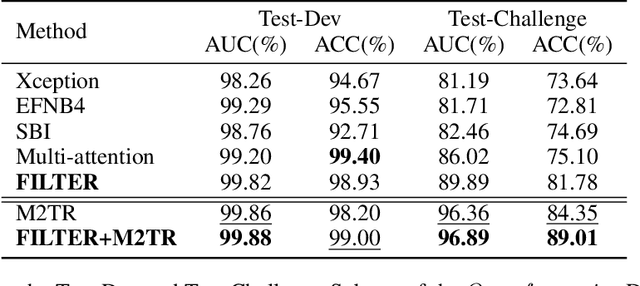
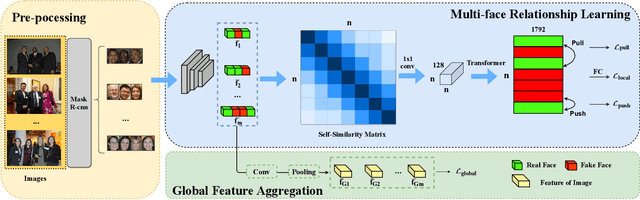
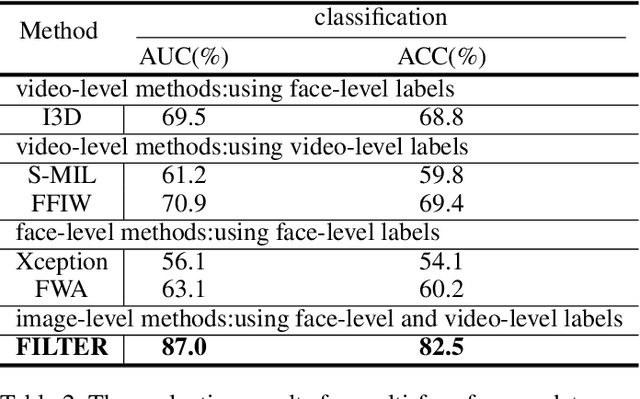
Face forgery techniques have emerged as a forefront concern, and numerous detection approaches have been proposed to address this challenge. However, existing methods predominantly concentrate on single-face manipulation detection, leaving the more intricate and realistic realm of multi-face forgeries relatively unexplored. This paper proposes a novel framework explicitly tailored for multi-face forgery detection,filling a critical gap in the current research. The framework mainly involves two modules:(i) a facial relationships learning module, which generates distinguishable local features for each face within images,(ii) a global feature aggregation module that leverages the mutual constraints between global and local information to enhance forgery detection accuracy.Our experimental results on two publicly available multi-face forgery datasets demonstrate that the proposed approach achieves state-of-the-art performance in multi-face forgery detection scenarios.