 Add to Chrome
 Add to Firefox
 Add to Edge
Self-Evolving Agentic Image Restoration via Deliberate Planning and Intuitive Execution
Jun 27, 2026
Real-world image restoration (IR) remains challenging due to complex and coupled degradations. While recent agentic IR frameworks leverage Large Language Models for flexible tool planning, they face two critical limitations. First, from a search scheme perspective, excessive reliance on greedy strategies fails to balance exploration and exploitation. Second, existing agentic systems underutilize information, exhibiting episodic amnesia. To address these challenges, we propose \textbf{Self-Evolving Agentic Image Restoration (SEAR)}, which formulates restoration as a sequential decision-making problem. Inspired by the dual-process theory, SEAR comprises an Intuitive Executor and a Deliberate Planner, respectively following the fast-thinking \textit{System 1} and slow-thinking \textit{System 2} principles. The Deliberate Planner employs Pruning-Aware Monte Carlo Tree Search for long-horizon reasoning, utilizing a hybrid no-reference reward and a Multimodal Large Language Model (MLLM)-based tournament to prevent metric exploitation. Complementarily, the Intuitive Executor leverages a self-evolving episodic memory indexed by degradation-aware state fingerprints. This mechanism distills expensive search trajectories into adaptive expertise, overcoming episodic amnesia while progressively amortizing cold-start exploration costs through memory reuse. Extensive experiments on synthetic and real-world benchmarks demonstrate its strong perceptual and quantitative performance.

MOST-Net: A Memory Oriented Style Transfer Network for Face Sketch Synthesis
Feb 08, 2022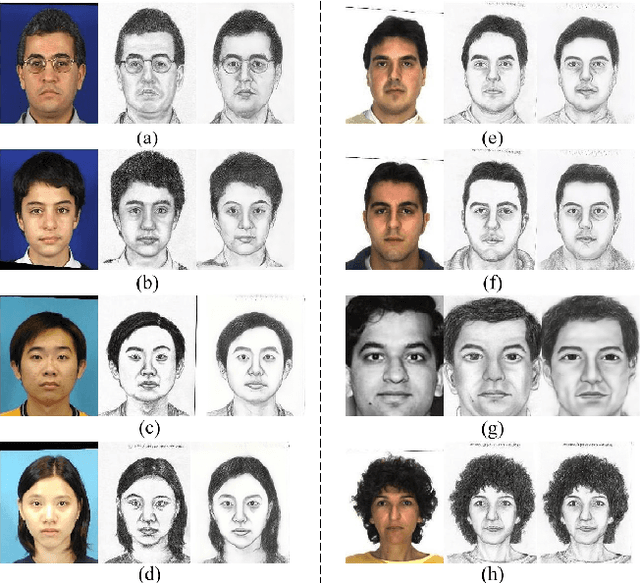
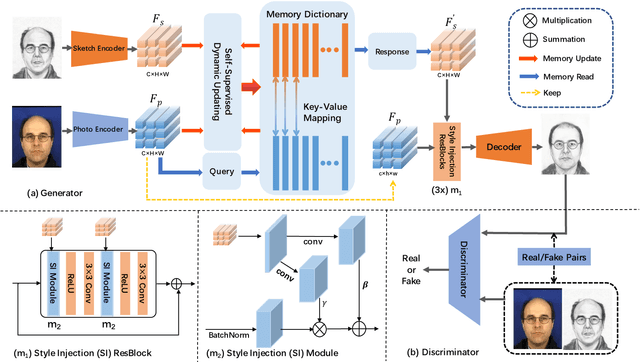
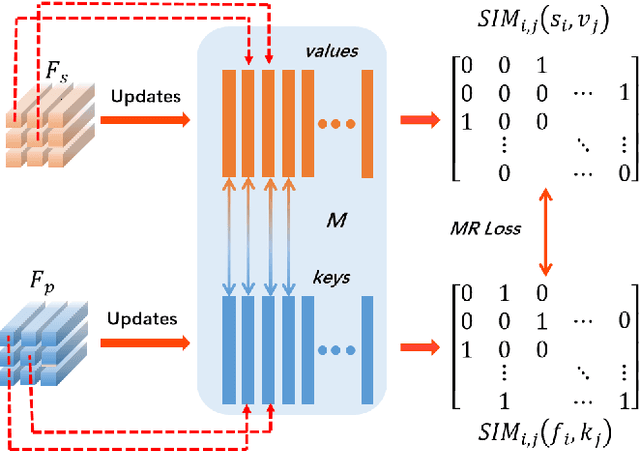
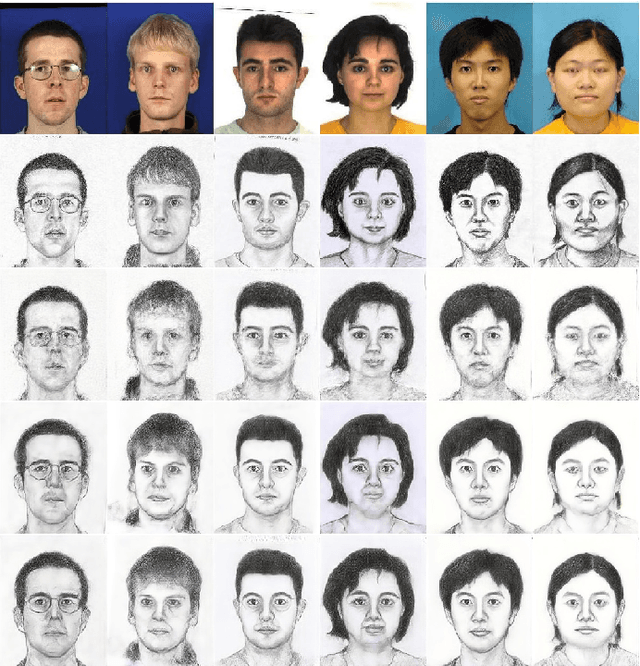
Face sketch synthesis has been widely used in multi-media entertainment and law enforcement. Despite the recent developments in deep neural networks, accurate and realistic face sketch synthesis is still a challenging task due to the diversity and complexity of human faces. Current image-to-image translation-based face sketch synthesis frequently encounters over-fitting problems when it comes to small-scale datasets. To tackle this problem, we present an end-to-end Memory Oriented Style Transfer Network (MOST-Net) for face sketch synthesis which can produce high-fidelity sketches with limited data. Specifically, an external self-supervised dynamic memory module is introduced to capture the domain alignment knowledge in the long term. In this way, our proposed model could obtain the domain-transfer ability by establishing the durable relationship between faces and corresponding sketches on the feature level. Furthermore, we design a novel Memory Refinement Loss (MR Loss) for feature alignment in the memory module, which enhances the accuracy of memory slots in an unsupervised manner. Extensive experiments on the CUFS and the CUFSF datasets show that our MOST-Net achieves state-of-the-art performance, especially in terms of the Structural Similarity Index(SSIM).