 Add to Chrome
 Add to Firefox
 Add to Edge
Analysing User Reviews to Identify User Concerns Around Permissions in AI Apps
Jul 31, 2026
Artificial intelligence is increasingly embedded in everyday software, making its integration into mobile apps inevitable. However, AI mobile app developers are not always versed in security and privacy best practices, leaving users to monitor their own security and understand how apps use their data. App reviews capture real user experiences, helping others make informed decisions before downloading. This paper presents a machine learning model for classifying AI app reviews into permission-related categories. Because user reviews are unstructured, assembling a conventional labeled training set is difficult. To address this, AI-generated security and permission reviews are used to identify relevant training examples from a large corpus of human-written reviews, eliminating the need for manual annotation. The proposed approach classified permission reviews with an accuracy of 82%. Analysis shows that users organise their concerns by sentiment toward the requesting app rather than specific permission types, with implications for users, developers, and platform administrators.

Automated Security Assessment for the Internet of Things
Sep 09, 2021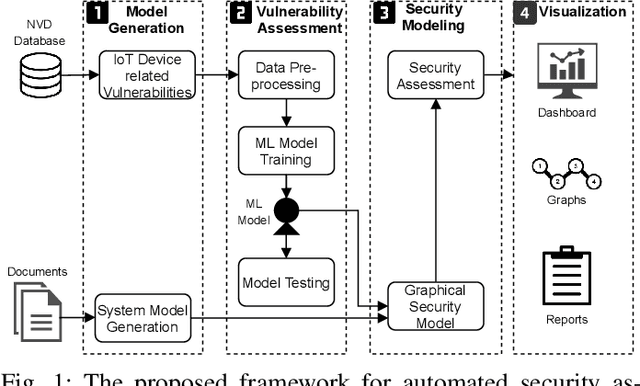
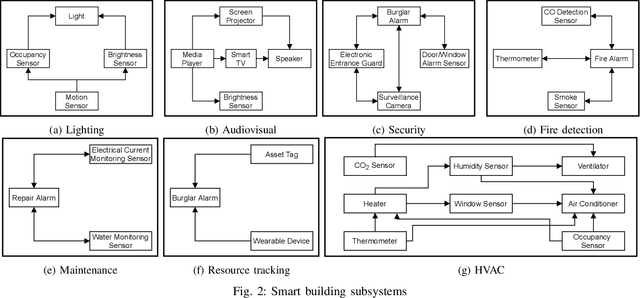
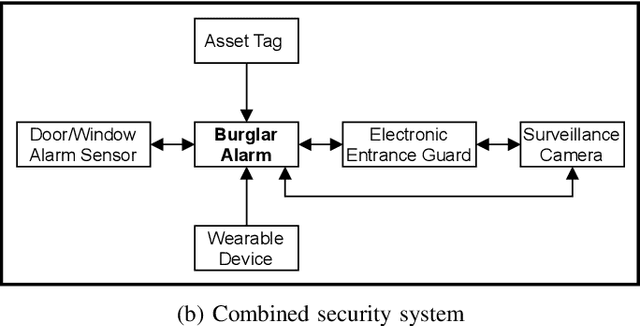
Internet of Things (IoT) based applications face an increasing number of potential security risks, which need to be systematically assessed and addressed. Expert-based manual assessment of IoT security is a predominant approach, which is usually inefficient. To address this problem, we propose an automated security assessment framework for IoT networks. Our framework first leverages machine learning and natural language processing to analyze vulnerability descriptions for predicting vulnerability metrics. The predicted metrics are then input into a two-layered graphical security model, which consists of an attack graph at the upper layer to present the network connectivity and an attack tree for each node in the network at the bottom layer to depict the vulnerability information. This security model automatically assesses the security of the IoT network by capturing potential attack paths. We evaluate the viability of our approach using a proof-of-concept smart building system model which contains a variety of real-world IoT devices and potential vulnerabilities. Our evaluation of the proposed framework demonstrates its effectiveness in terms of automatically predicting the vulnerability metrics of new vulnerabilities with more than 90% accuracy, on average, and identifying the most vulnerable attack paths within an IoT network. The produced assessment results can serve as a guideline for cybersecurity professionals to take further actions and mitigate risks in a timely manner.
Machine Learning for Detecting Data Exfiltration
Dec 17, 2020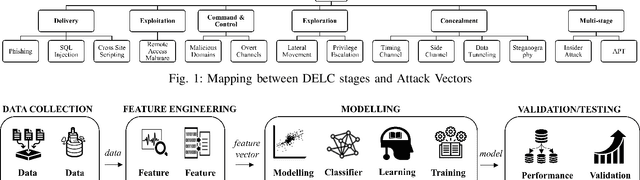
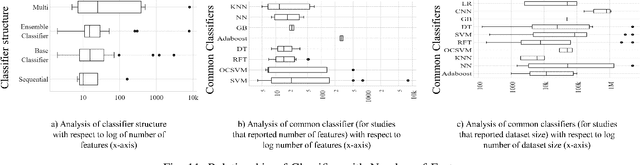
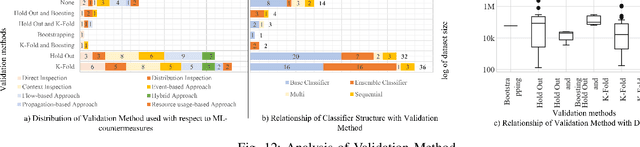
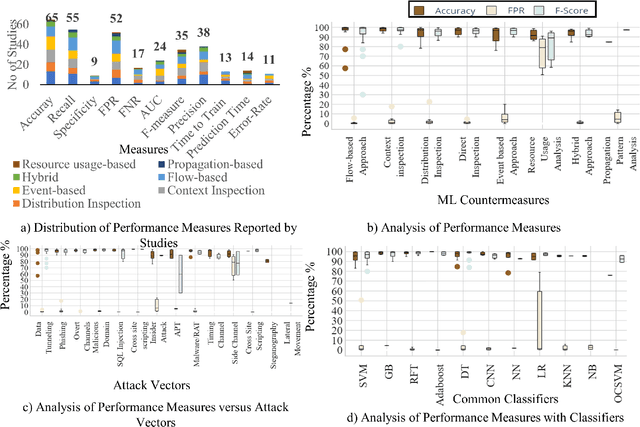
Context: Research at the intersection of cybersecurity, Machine Learning (ML), and Software Engineering (SE) has recently taken significant steps in proposing countermeasures for detecting sophisticated data exfiltration attacks. It is important to systematically review and synthesize the ML-based data exfiltration countermeasures for building a body of knowledge on this important topic. Objective: This paper aims at systematically reviewing ML-based data exfiltration countermeasures to identify and classify ML approaches, feature engineering techniques, evaluation datasets, and performance metrics used for these countermeasures. This review also aims at identifying gaps in research on ML-based data exfiltration countermeasures. Method: We used a Systematic Literature Review (SLR) method to select and review {92} papers. Results: The review has enabled us to (a) classify the ML approaches used in the countermeasures into data-driven, and behaviour-driven approaches, (b) categorize features into six types: behavioural, content-based, statistical, syntactical, spatial and temporal, (c) classify the evaluation datasets into simulated, synthesized, and real datasets and (d) identify 11 performance measures used by these studies. Conclusion: We conclude that: (i) the integration of data-driven and behaviour-driven approaches should be explored; (ii) There is a need of developing high quality and large size evaluation datasets; (iii) Incremental ML model training should be incorporated in countermeasures; (iv) resilience to adversarial learning should be considered and explored during the development of countermeasures to avoid poisoning attacks; and (v) the use of automated feature engineering should be encouraged for efficiently detecting data exfiltration attacks.