 Add to Chrome
 Add to Firefox
 Add to Edge
Curation of a Cardiology Interface Terminology for Highlighting Electronic Health Records using Machine Learning
Jun 06, 2026
Electronic health record (EHR) notes are dense medical documents containing large amounts of information, often filled with complex medical jargon. Highlighting all details in EHRs helps reduce the likelihood of missing crucial information by drawing attention to key content. This study proposes the design of a Cardiology Interface Terminology (CIT) to accurately highlight all details in EHR notes of cardiology patients. We introduce an innovative Machine Learning (ML) technique for the design of CIT. The ML technique requires training data. Manual preparation of such training data is time-consuming and expensive. The process of the CIT design includes three phases. In the first two phases, we innovatively derive a training data CIT to be used by the third phase, ML technique. We start by designing an initial CIT, composed of several components: the cardiology-related sub-hierarchies of SNOMED, other SNOMED concepts mined from EHRs of build set, and necessary components of terms e.g., medical abbreviations and medications. Utilizing an iterative process, fine-grained phrases containing initial CIT concepts are extracted from build set as CIT concept candidates. The candidate concepts are semi-automatically reviewed before being added to CIT, yielding the training data CIT, TCIT. In the third phase, a ML model is trained with TCIT to identify candidates fitting to be concepts in the CIT. This model is used to extract further concepts from build set, yielding the final CIT. The final CIT is then used to highlight the test set and evaluate the extent to which it captures details in an unseen EHR dataset. For this purpose, four evaluation metrics, coverage, breadth, completeness, and conciseness are used. The highlighted test set has a coverage of 74.21%, with a breadth of 1.68. For 20 random notes in test set, the average completeness is 98.2% and average conciseness is 84.2%.

Stock Broad-Index Trend Patterns Learning via Domain Knowledge Informed Generative Network
Feb 27, 2023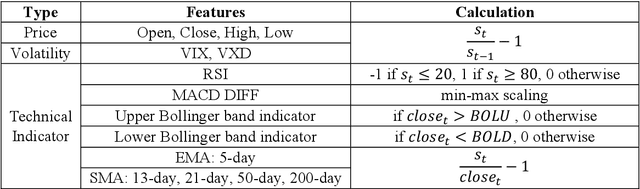
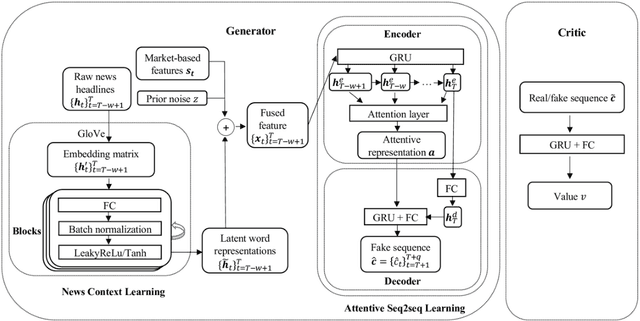
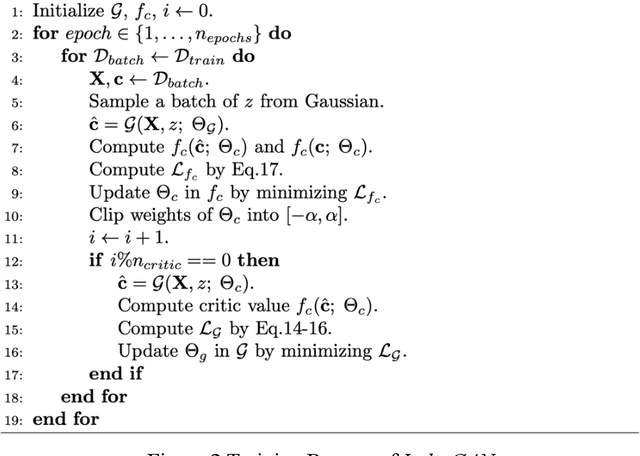
Predicting the Stock movement attracts much attention from both industry and academia. Despite such significant efforts, the results remain unsatisfactory due to the inherently complicated nature of the stock market driven by factors including supply and demand, the state of the economy, the political climate, and even irrational human behavior. Recently, Generative Adversarial Networks (GAN) have been extended for time series data; however, robust methods are primarily for synthetic series generation, which fall short for appropriate stock prediction. This is because existing GANs for stock applications suffer from mode collapse and only consider one-step prediction, thus underutilizing the potential of GAN. Furthermore, merging news and market volatility are neglected in current GANs. To address these issues, we exploit expert domain knowledge in finance and, for the first time, attempt to formulate stock movement prediction into a Wasserstein GAN framework for multi-step prediction. We propose IndexGAN, which includes deliberate designs for the inherent characteristics of the stock market, leverages news context learning to thoroughly investigate textual information and develop an attentive seq2seq learning network that captures the temporal dependency among stock prices, news, and market sentiment. We also utilize the critic to approximate the Wasserstein distance between actual and predicted sequences and develop a rolling strategy for deployment that mitigates noise from the financial market. Extensive experiments are conducted on real-world broad-based indices, demonstrating the superior performance of our architecture over other state-of-the-art baselines, also validating all its contributing components.