 Add to Chrome
 Add to Firefox
 Add to Edge
Risk-Adjusted Harm Scoring for Automated Red Teaming for LLMs in Financial Services
Mar 11, 2026
The rapid adoption of large language models (LLMs) in financial services introduces new operational, regulatory, and security risks. Yet most red-teaming benchmarks remain domain-agnostic and fail to capture failure modes specific to regulated BFSI settings, where harmful behavior can be elicited through legally or professionally plausible framing. We propose a risk-aware evaluation framework for LLM security failures in Banking, Financial Services, and Insurance (BFSI), combining a domain-specific taxonomy of financial harms, an automated multi-round red-teaming pipeline, and an ensemble-based judging protocol. We introduce the Risk-Adjusted Harm Score (RAHS), a risk-sensitive metric that goes beyond success rates by quantifying the operational severity of disclosures, accounting for mitigation signals, and leveraging inter-judge agreement. Across diverse models, we find that higher decoding stochasticity and sustained adaptive interaction not only increase jailbreak success, but also drive systematic escalation toward more severe and operationally actionable financial disclosures. These results expose limitations of single-turn, domain-agnostic security evaluation and motivate risk-sensitive assessment under prolonged adversarial pressure for real-world BFSI deployment.

RiskLabs: Predicting Financial Risk Using Large Language Model Based on Multi-Sources Data
Apr 11, 2024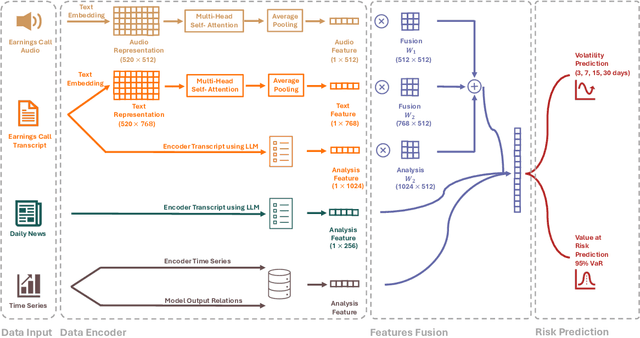
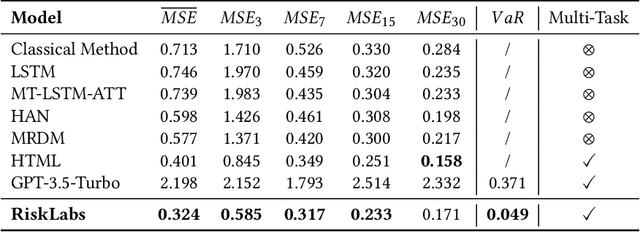
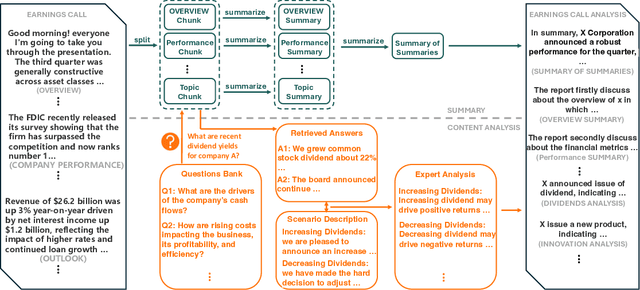

The integration of Artificial Intelligence (AI) techniques, particularly large language models (LLMs), in finance has garnered increasing academic attention. Despite progress, existing studies predominantly focus on tasks like financial text summarization, question-answering (Q$\&$A), and stock movement prediction (binary classification), with a notable gap in the application of LLMs for financial risk prediction. Addressing this gap, in this paper, we introduce \textbf{RiskLabs}, a novel framework that leverages LLMs to analyze and predict financial risks. RiskLabs uniquely combines different types of financial data, including textual and vocal information from Earnings Conference Calls (ECCs), market-related time series data, and contextual news data surrounding ECC release dates. Our approach involves a multi-stage process: initially extracting and analyzing ECC data using LLMs, followed by gathering and processing time-series data before the ECC dates to model and understand risk over different timeframes. Using multimodal fusion techniques, RiskLabs amalgamates these varied data features for comprehensive multi-task financial risk prediction. Empirical experiment results demonstrate RiskLab's effectiveness in forecasting both volatility and variance in financial markets. Through comparative experiments, we demonstrate how different data sources contribute to financial risk assessment and discuss the critical role of LLMs in this context. Our findings not only contribute to the AI in finance application but also open new avenues for applying LLMs in financial risk assessment.