 Add to Chrome
 Add to Firefox
 Add to Edge
Control-Oriented Scenario Tree Construction through Reinforcement Learning
Aug 10, 2026
Multistage stochastic model predictive control (MPC) handles uncertainty by optimizing over a scenario tree, a finite branching approximation of future outcomes constructed from sampled forecasts. To build such a tree, conventional methods focus on matching the underlying probability distribution---e.g., via Wasserstein-based scenario reduction---but improved distributional accuracy does not necessarily yield better control performance. We propose a control-oriented approach that learns scenario tree construction directly from its impact on downstream decisions. Fixing the tree topology, we formulate tree construction as a sequential assignment of sampled scenarios to leaves. This assignment is parameterized by an attention-based policy over the scenario set and trained using reinforcement learning, with closed-loop control profit as the objective. Training is stabilized by an asymmetric critic that leverages realized future trajectories. We evaluate the method on a risk-averse battery arbitrage problem. Across a range of forecast set sizes, the learned construction consistently achieves the highest profit, outperforming classical forward and backward reduction methods and certainty-equivalent (single-trajectory forecast) control. The learned policy also exhibits greater robustness on challenging instances, consistently demonstrating better tail-risk characteristics. Analysis of the resulting trees indicates that our method constructs compact, selectively branching structures that capture high-impact events while keeping most trajectories nearly deterministic. These findings highlight that the value of a scenario tree depends critically on the decisions it supports, and provide an effective framework to train scenario tree constructors merely based on the closed-loop control optimization signal.

Forecasting what Matters: Decision-Focused RL for Controlled EV Charging with Unknown Departure Times
Jun 17, 2026The recent growth of EV adoption poses challenges for power systems, including increased peak demand and potential grid instability. Smart control of EV charging -- e.g., based on reinforcement learning (RL) -- can alleviate these issues by learning temporal and contextual patterns from historical data. Yet, in real-world scenarios, key features, such as departure time, often are unavailable. This, in turn, makes it harder for an RL agent to learn and execute an effective charging policy. To mitigate this uncertainty, a trained forecaster can approximate the unknown features from available data. However, since these forecasting models are typically trained for accuracy (rather than their impact on a downstream agent's decision quality), their errors may propagate and hinder the overall performance of a controller that is using the forecasts. To avoid this, we propose a decision-focused RL (DF-RL) framework in which the forecaster is trained end-to-end, i.e., with feedback from the charging policy actions taken by the RL agent. Such joint training of both the forecaster and controller ultimately results in higher-quality actions: our proposed DF-RL method yields superior charging decisions compared to other baselines, achieving up to a 14% improvement in total reward and a 55% reduction of unsupplied energy (i.e., charging that failed to happen because the EV already left), relative to the RL method without departure time forecasting.
S3TS: Stochastic Scenario-Structured Tree Search for Advanced Planning Under Uncertainty
Jun 01, 2026Effective scheduling in the energy sector is essential to ensure the reliable operation of electrical grids and their connected assets by, for instance, optimizing the dispatch of generation units and storage systems. An effective planning strategy must (a) accommodate advanced and potentially non-linear system models -- exploiting the increasing data availability of modern grids, and (b) explicitly handle uncertainties arising, for instance, from the integration of renewable energy sources. While existing approaches can address either non-linearity (e.g., Monte Carlo Tree Search) or uncertainty (e.g., stochastic mathematical optimization), there is a lack of planning techniques capable of addressing both challenges simultaneously. To bridge this gap, we propose a Stochastic Scenario-Structured Tree Search (S3TS) algorithm that explicitly represents uncertainty through scenario trees while enabling the integration of advanced non-linear models. We evaluate S3TS on a simulated demand response signal publication problem, largely mimicking the imbalance settlement mechanism in Belgium. The results demonstrate near-optimal performance in linear, analytically tractable settings, with costs within 14% of the mathematically optimal solution conditioned to the scenario trees. In highly non-linear scenarios, S3TS significantly outperforms baseline methods, achieving cost reductions of up to 51% and 5.4% compared to a myopic algorithm and deterministic MCTS, respectively.
Predicting and Publishing Accurate Imbalance Prices Using Monte Carlo Tree Search
Nov 06, 2024The growing reliance on renewable energy sources, particularly solar and wind, has introduced challenges due to their uncontrollable production. This complicates maintaining the electrical grid balance, prompting some transmission system operators in Western Europe to implement imbalance tariffs that penalize unsustainable power deviations. These tariffs create an implicit demand response framework to mitigate grid instability. Yet, several challenges limit active participation. In Belgium, for example, imbalance prices are only calculated at the end of each 15-minute settlement period, creating high risk due to price uncertainty. This risk is further amplified by the inherent volatility of imbalance prices, discouraging participation. Although transmission system operators provide minute-based price predictions, the system imbalance volatility makes accurate price predictions challenging to obtain and requires sophisticated techniques. Moreover, publishing price estimates can prompt participants to adjust their schedules, potentially affecting the system balance and the final price, adding further complexity. To address these challenges, we propose a Monte Carlo Tree Search method that publishes accurate imbalance prices while accounting for potential response actions. Our approach models the system dynamics using a neural network forecaster and a cluster of virtual batteries controlled by reinforcement learning agents. Compared to Belgium's current publication method, our technique improves price accuracy by 20.4% under ideal conditions and by 12.8% in more realistic scenarios. This research addresses an unexplored, yet crucial problem, positioning this paper as a pioneering work in analyzing the potential of more advanced imbalance price publishing techniques.
Demand response for residential building heating: Effective Monte Carlo Tree Search control based on physics-informed neural networks
Dec 06, 2023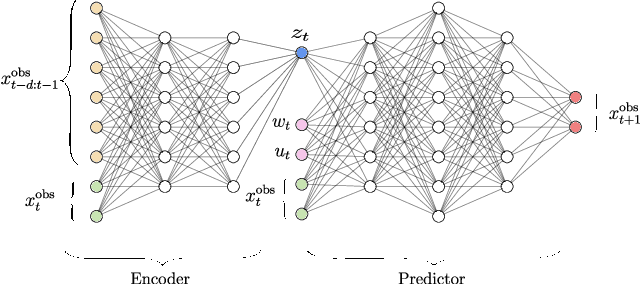

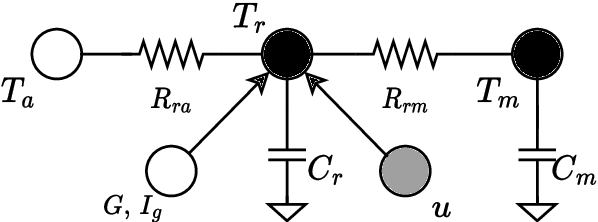
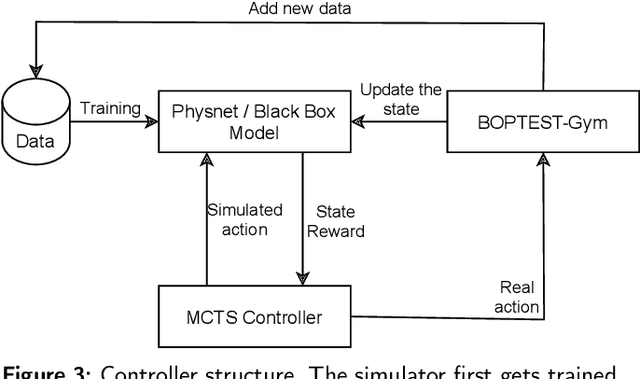
Controlling energy consumption in buildings through demand response (DR) has become increasingly important to reduce global carbon emissions and limit climate change. In this paper, we specifically focus on controlling the heating system of a residential building to optimize its energy consumption while respecting user's thermal comfort. Recent works in this area have mainly focused on either model-based control, e.g., model predictive control (MPC), or model-free reinforcement learning (RL) to implement practical DR algorithms. A specific RL method that recently has achieved impressive success in domains such as board games (go, chess) is Monte Carlo Tree Search (MCTS). Yet, for building control it has remained largely unexplored. Thus, we study MCTS specifically for building demand response. Its natural structure allows a flexible optimization that implicitly integrate exogenous constraints (as opposed, for example, to conventional RL solutions), making MCTS a promising candidate for DR control problems. We demonstrate how to improve MCTS control performance by incorporating a Physics-informed Neural Network (PiNN) model for its underlying thermal state prediction, as opposed to traditional purely data-driven Black-Box approaches. Our MCTS implementation aligned with a PiNN model is able to obtain a 3% increment of the obtained reward compared to a rule-based controller; leading to a 10% cost reduction and 35% reduction on temperature difference with the desired one when applied to an artificial price profile. We further implemented a Deep Learning layer into the Monte Carlo Tree Search technique using a neural network that leads the tree search through more optimal nodes. We then compared this addition with its Vanilla version, showing the improvement in computational cost required.