 Add to Chrome
 Add to Firefox
 Add to Edge
From Data to Device: ELMOD An Efficient German-First 2.7B Language Model for Mobile Inference
Jul 27, 2026
We present ELMOD - Efficient Language Model for On-Device Deployment - a compact (2.7B) German language model designed for efficient inference on resource-constrained hardware. ELMOD was trained on a limited computational budget (55k H100 GPU hours) using exclusively publicly available data. We developed a suite of German-specific data pre-processing, which differ from English-oriented counterparts in their handling of morphological variation, compounding, and orthographic conventions. Furthermore, we introduced a quality filtering and rephrasing step, which increased the instructional quality of the data, improved performance during the annealing phase, and reduced overall compute requirements. Thanks to our architectural model and data choices, including prefiltering, our educational-quality filtering and rephrasal to raise the educational-quality, ELMOD is the strongest performer in its size class (<3B), matching the performance of 7B-parameter models in German.

Introducing Echo Networks for Computational Neuroevolution
Apr 09, 2026For applications on the extreme edge, minimal networks of only a few dozen artificial neurons for event detection and classification in discrete time signals would be highly desirable. Feed-forward networks, RNNs, and CNNs evolved through evolutionary algorithms can all be successful in this respect but pose the problem of allowing little systematicity in mutation and recombination if the standard direct genetic encoding of the weights is used (as for instance in the classic NEAT algorithm). We therefore introduce Echo Networks, a type of recurrent network that consists of the connection matrix only, with the source neurons of the synapses represented as rows, destination neurons as columns and weights as entries. There are no layers, and connections between neurons can be bidirectional but are technically all recurrent. Input and output can be arbitrarily assigned to any of the neurons and only use an additional (optional) function in their computational path, e.g., a sigmoid to obtain a binary classification output. We evaluated Echo Networks successfully on the classification of electrocardiography signals but see the most promising potential in their genome representation as a single matrix, allowing matrix computations and factorisations as mutation and recombination operators.
Stratified Selective Sampling for Instruction Tuning with Dedicated Scoring Strategy
May 28, 2025Recent work shows that post-training datasets for LLMs can be substantially downsampled without noticeably deteriorating performance. However, data selection often incurs high computational costs or is limited to narrow domains. In this paper, we demonstrate that data selection can be both -- efficient and universal -- by using a multi-step pipeline in which we efficiently bin data points into groups, estimate quality using specialized models, and score difficulty with a robust, lightweight method. Task-based categorization allows us to control the composition of our final data -- crucial for finetuning multi-purpose models. To guarantee diversity, we improve upon previous work using embedding models and a clustering algorithm. This integrated strategy enables high-performance fine-tuning with minimal overhead.
Data Processing for the OpenGPT-X Model Family
Oct 11, 2024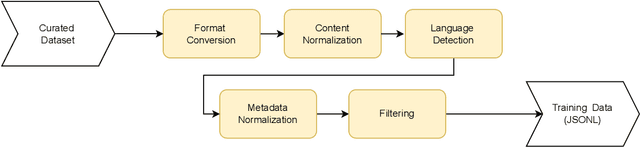


This paper presents a comprehensive overview of the data preparation pipeline developed for the OpenGPT-X project, a large-scale initiative aimed at creating open and high-performance multilingual large language models (LLMs). The project goal is to deliver models that cover all major European languages, with a particular focus on real-world applications within the European Union. We explain all data processing steps, starting with the data selection and requirement definition to the preparation of the final datasets for model training. We distinguish between curated data and web data, as each of these categories is handled by distinct pipelines, with curated data undergoing minimal filtering and web data requiring extensive filtering and deduplication. This distinction guided the development of specialized algorithmic solutions for both pipelines. In addition to describing the processing methodologies, we provide an in-depth analysis of the datasets, increasing transparency and alignment with European data regulations. Finally, we share key insights and challenges faced during the project, offering recommendations for future endeavors in large-scale multilingual data preparation for LLMs.