 Add to Chrome
 Add to Firefox
 Add to Edge
Sensor Calibration Model Balancing Accuracy, Real-time, and Efficiency
Nov 10, 2025
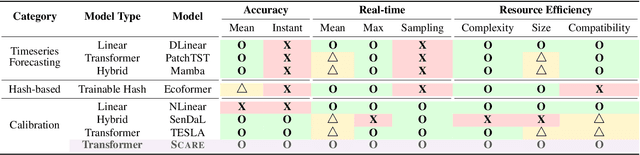
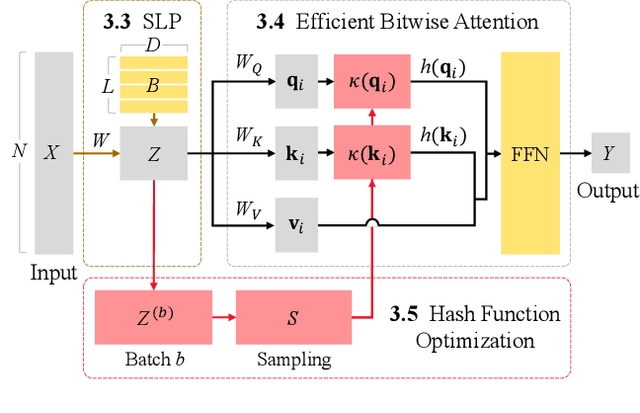
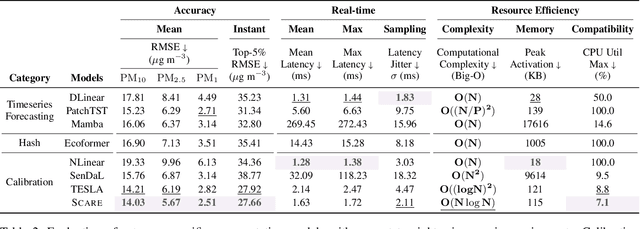
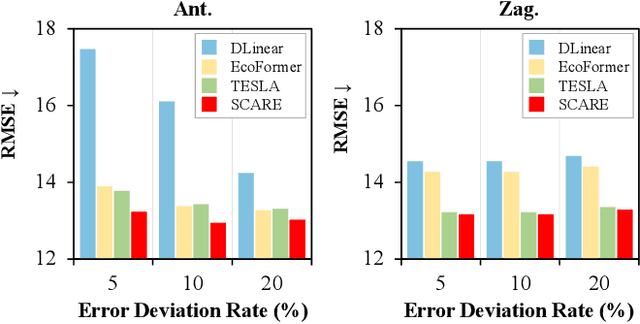
Most on-device sensor calibration studies benchmark models only against three macroscopic requirements (i.e., accuracy, real-time, and resource efficiency), thereby hiding deployment bottlenecks such as instantaneous error and worst-case latency. We therefore decompose this triad into eight microscopic requirements and introduce Scare (Sensor Calibration model balancing Accuracy, Real-time, and Efficiency), an ultra-compressed transformer that fulfills them all. SCARE comprises three core components: (1) Sequence Lens Projector (SLP) that logarithmically compresses time-series data while preserving boundary information across bins, (2) Efficient Bitwise Attention (EBA) module that replaces costly multiplications with bitwise operations via binary hash codes, and (3) Hash optimization strategy that ensures stable training without auxiliary loss terms. Together, these components minimize computational overhead while maintaining high accuracy and compatibility with microcontroller units (MCUs). Extensive experiments on large-scale air-quality datasets and real microcontroller deployments demonstrate that Scare outperforms existing linear, hybrid, and deep-learning baselines, making Scare, to the best of our knowledge, the first model to meet all eight microscopic requirements simultaneously.

DeepHealthNet: Adolescent Obesity Prediction System Based on a Deep Learning Framework
Aug 31, 2023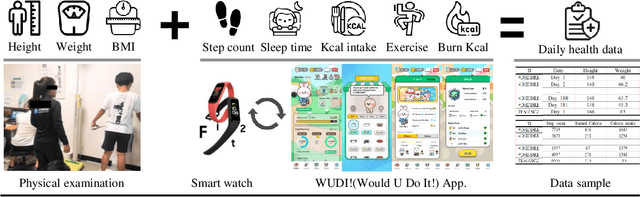
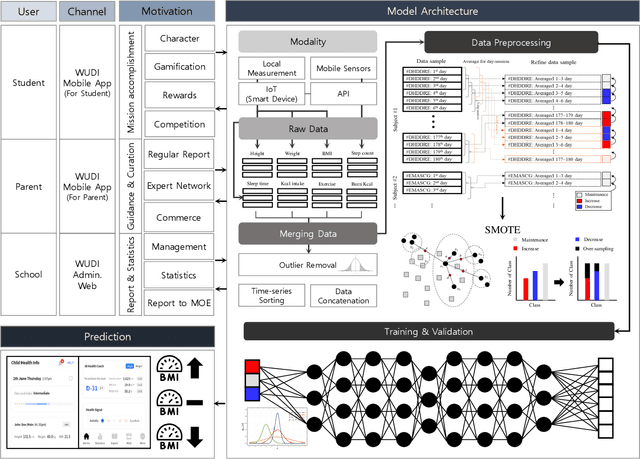

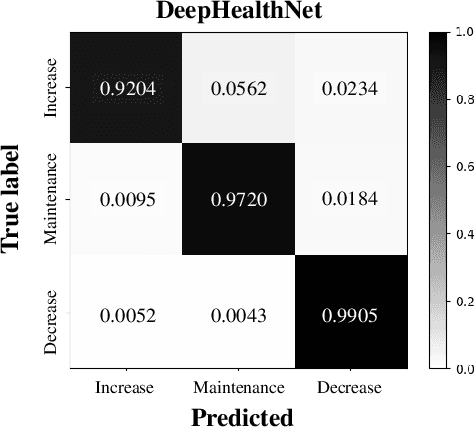
Childhood and adolescent obesity rates are a global concern because obesity is associated with chronic diseases and long-term health risks. Artificial intelligence technology has emerged as a promising solution to accurately predict obesity rates and provide personalized feedback to adolescents. This study emphasizes the importance of early identification and prevention of obesity-related health issues. Factors such as height, weight, waist circumference, calorie intake, physical activity levels, and other relevant health information need to be considered for developing robust algorithms for obesity rate prediction and delivering personalized feedback. Hence, by collecting health datasets from 321 adolescents, we proposed an adolescent obesity prediction system that provides personalized predictions and assists individuals in making informed health decisions. Our proposed deep learning framework, DeepHealthNet, effectively trains the model using data augmentation techniques, even when daily health data are limited, resulting in improved prediction accuracy (acc: 0.8842). Additionally, the study revealed variations in the prediction of the obesity rate between boys (acc: 0.9320) and girls (acc: 0.9163), allowing the identification of disparities and the determination of the optimal time to provide feedback. The proposed system shows significant potential in effectively addressing childhood and adolescent obesity.