 Add to Chrome
 Add to Firefox
 Add to Edge
LLM-Derived Priors for Thompson Sampling in Cold-Start Comment Recommendation
Aug 04, 2026
Multi-armed bandit algorithms, especially Thompson sampling, are widely used in online recommendation. Despite their ability to adapt from online feedback, these methods often suffer from cold-start limitations when newly introduced arms have little or no interaction history. In our setting, the candidate arms are user-generated textual comments, whose semantic content can reveal a title's appeal before sufficient interaction feedback is available. We therefore use large language models (LLMs) to extract semantic signals from comment text and convert them into informative Bayesian priors that warm-start Thompson sampling under sparse early-stage feedback. To account for aggregate segment-level differences in response patterns, we maintain and update posteriors separately for each gender-age segment. In a real-world online A/B/C test, we compare a uniform prior with two LLM-based designs: a Gender Prior for demographic-affinity cues and a Content Prior for title-specific identity cues. The results show that LLM-based priors are most beneficial in sparse-feedback regimes -- with the largest gains emerging once a small amount of interaction evidence has accumulated -- and that prior design leads to distinct funnel-level effects. We further analyze prior-reward alignment and demographic heterogeneity, finding that click-oriented alignment is strongest for the Gender Prior and that treatment effects vary substantially across demographic segments. These findings suggest that LLM-derived priors can serve as a practical warm-start mechanism for text-rich bandit recommendation, while also revealing deployment trade-offs.

Hierarchical Pre-Training of Vision Encoders with Large Language Models
Mar 31, 2026The field of computer vision has experienced significant advancements through scalable vision encoders and multimodal pre-training frameworks. However, existing approaches often treat vision encoders and large language models (LLMs) as independent modules, limiting the integration of hierarchical visual features. In this work, we propose HIVE (Hierarchical Pre-Training of Vision Encoders), a novel framework that enhances vision-language alignment by introducing hierarchical cross-attention between the vision encoder and LLM. Unlike conventional methods that flatten image embeddings, HIVE enables structured feature fusion across multiple layers, improving gradient flow and representation learning. To optimize this interaction, we introduce a three-stage training strategy that progressively aligns the vision encoder with the LLM, ensuring stable optimization and effective multimodal fusion. Empirical evaluations demonstrate that HIVE achieves superior performance not only in image classification but also on various vision-language tasks, outperforming self-attention-based methods in benchmarks such as MME, GQA, OK-VQA, and ScienceQA. Our results highlight the benefits of hierarchical feature integration, paving the way for more efficient and expressive vision-language models.
Learning to Select Visual In-Context Demonstrations
Mar 24, 2026Multimodal Large Language Models (MLLMs) adapt to visual tasks via in-context learning (ICL), which relies heavily on demonstration quality. The dominant demonstration selection strategy is unsupervised k-Nearest Neighbor (kNN) search. While simple, this similarity-first approach is sub-optimal for complex factual regression tasks; it selects redundant examples that fail to capture the task's full output range. We reframe selection as a sequential decision-making problem and introduce Learning to Select Demonstrations (LSD), training a Reinforcement Learning agent to construct optimal demonstration sets. Using a Dueling DQN with a query-centric Transformer Decoder, our agent learns a policy that maximizes MLLM downstream performance. Evaluating across five visual regression benchmarks, we uncover a crucial dichotomy: while kNN remains optimal for subjective preference tasks, LSD significantly outperforms baselines on objective, factual regression tasks. By balancing visual relevance with diversity, LSD better defines regression boundaries, illuminating when learned selection is strictly necessary for visual ICL.
Cross-Resolution Flow Propagation for Foveated Video Super-Resolution
Dec 27, 2022The demand of high-resolution video contents has grown over the years. However, the delivery of high-resolution video is constrained by either computational resources required for rendering or network bandwidth for remote transmission. To remedy this limitation, we leverage the eye trackers found alongside existing augmented and virtual reality headsets. We propose the application of video super-resolution (VSR) technique to fuse low-resolution context with regional high-resolution context for resource-constrained consumption of high-resolution content without perceivable drop in quality. Eye trackers provide us the gaze direction of a user, aiding us in the extraction of the regional high-resolution context. As only pixels that falls within the gaze region can be resolved by the human eye, a large amount of the delivered content is redundant as we can't perceive the difference in quality of the region beyond the observed region. To generate a visually pleasing frame from the fusion of high-resolution region and low-resolution region, we study the capability of a deep neural network of transferring the context of the observed region to other regions (low-resolution) of the current and future frames. We label this task a Foveated Video Super-Resolution (FVSR), as we need to super-resolve the low-resolution regions of current and future frames through the fusion of pixels from the gaze region. We propose Cross-Resolution Flow Propagation (CRFP) for FVSR. We train and evaluate CRFP on REDS dataset on the task of 8x FVSR, i.e. a combination of 8x VSR and the fusion of foveated region. Departing from the conventional evaluation of per frame quality using SSIM or PSNR, we propose the evaluation of past foveated region, measuring the capability of a model to leverage the noise present in eye trackers during FVSR. Code is made available at https://github.com/eugenelet/CRFP.
Few-Shot and Continual Learning with Attentive Independent Mechanisms
Jul 29, 2021
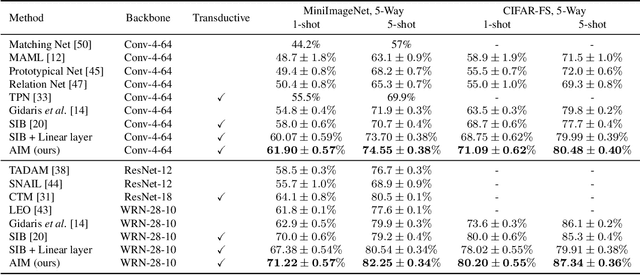


Deep neural networks (DNNs) are known to perform well when deployed to test distributions that shares high similarity with the training distribution. Feeding DNNs with new data sequentially that were unseen in the training distribution has two major challenges -- fast adaptation to new tasks and catastrophic forgetting of old tasks. Such difficulties paved way for the on-going research on few-shot learning and continual learning. To tackle these problems, we introduce Attentive Independent Mechanisms (AIM). We incorporate the idea of learning using fast and slow weights in conjunction with the decoupling of the feature extraction and higher-order conceptual learning of a DNN. AIM is designed for higher-order conceptual learning, modeled by a mixture of experts that compete to learn independent concepts to solve a new task. AIM is a modular component that can be inserted into existing deep learning frameworks. We demonstrate its capability for few-shot learning by adding it to SIB and trained on MiniImageNet and CIFAR-FS, showing significant improvement. AIM is also applied to ANML and OML trained on Omniglot, CIFAR-100 and MiniImageNet to demonstrate its capability in continual learning. Code made publicly available at https://github.com/huang50213/AIM-Fewshot-Continual.
Meta-rPPG: Remote Heart Rate Estimation Using a Transductive Meta-Learner
Jul 14, 2020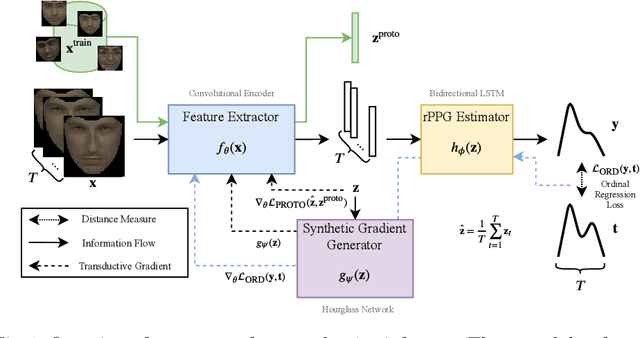
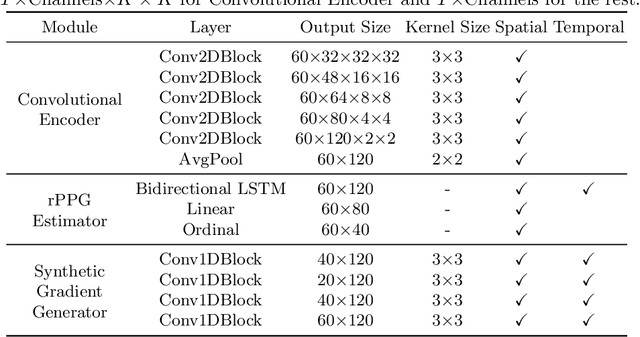
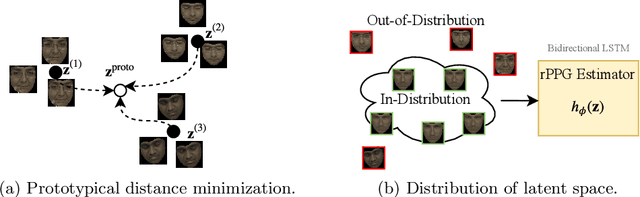

Remote heart rate estimation is the measurement of heart rate without any physical contact with the subject and is accomplished using remote photoplethysmography (rPPG) in this work. rPPG signals are usually collected using a video camera with a limitation of being sensitive to multiple contributing factors, e.g. variation in skin tone, lighting condition and facial structure. End-to-end supervised learning approach performs well when training data is abundant, covering a distribution that doesn't deviate too much from the distribution of testing data or during deployment. To cope with the unforeseeable distributional changes during deployment, we propose a transductive meta-learner that takes unlabeled samples during testing (deployment) for a self-supervised weight adjustment (also known as transductive inference), providing fast adaptation to the distributional changes. Using this approach, we achieve state-of-the-art performance on MAHNOB-HCI and UBFC-rPPG.
NeuralScale: Efficient Scaling of Neurons for Resource-Constrained Deep Neural Networks
Jun 23, 2020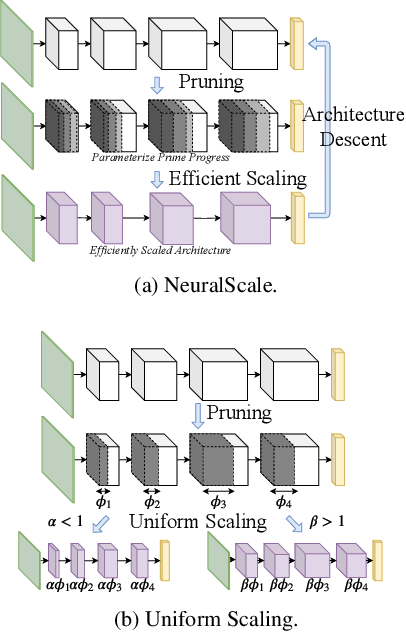

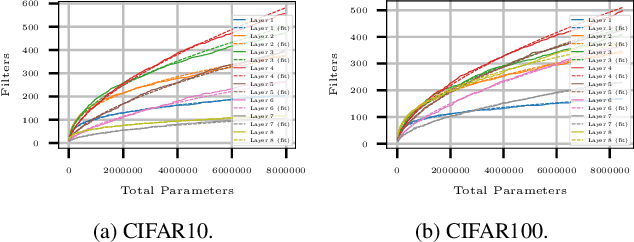
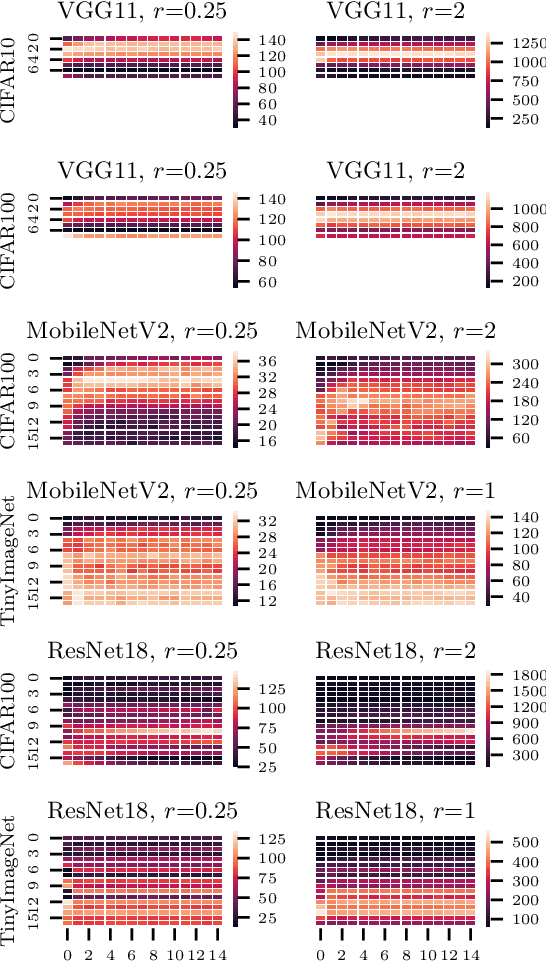
Deciding the amount of neurons during the design of a deep neural network to maximize performance is not intuitive. In this work, we attempt to search for the neuron (filter) configuration of a fixed network architecture that maximizes accuracy. Using iterative pruning methods as a proxy, we parameterize the change of the neuron (filter) number of each layer with respect to the change in parameters, allowing us to efficiently scale an architecture across arbitrary sizes. We also introduce architecture descent which iteratively refines the parameterized function used for model scaling. The combination of both proposed methods is coined as NeuralScale. To prove the efficiency of NeuralScale in terms of parameters, we show empirical simulations on VGG11, MobileNetV2 and ResNet18 using CIFAR10, CIFAR100 and TinyImageNet as benchmark datasets. Our results show an increase in accuracy of 3.04%, 8.56% and 3.41% for VGG11, MobileNetV2 and ResNet18 on CIFAR10, CIFAR100 and TinyImageNet respectively under a parameter-constrained setting (output neurons (filters) of default configuration with scaling factor of 0.25).
* 17 pages, 11 figures, accepted by CVPR as oral paper