 Add to Chrome
 Add to Firefox
 Add to Edge
Explaining and Preventing Alignment Collapse in Iterative RLHF
May 05, 2026
Reinforcement learning from human feedback (RLHF) typically assumes a static or non-strategic reward model (RM). In iterative deployment, however, the policy generates the data on which the RM is retrained, creating a feedback loop. Building on the Stackelberg game formulation of this interaction, we derive an analytical decomposition of the policy's true optimization gradient into a standard policy gradient and a parameter-steering term that captures the policy's influence on the RM's future parameters. We show that standard iterative RLHF, which drops this steering term entirely, suffers from alignment collapse: the policy systematically exploits the RM's blind spots, producing low-quality, high-reward outputs whose feedback reinforces the very errors it exploits. To mitigate this, we propose foresighted policy optimization (FPO), a mechanism-design intervention that restores the missing steering term by regularizing the policy's parameter-steering effect on RM updates. We instantiate FPO via a scalable first-order approximation and demonstrate that it prevents alignment collapse on both controlled environments and an LLM alignment pipeline using Llama-3.2-1B.

Adaptive Coverage Policies in Conformal Prediction
Oct 05, 2025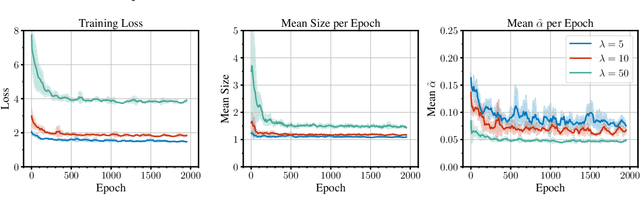

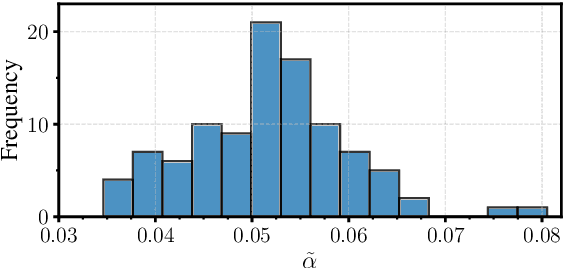
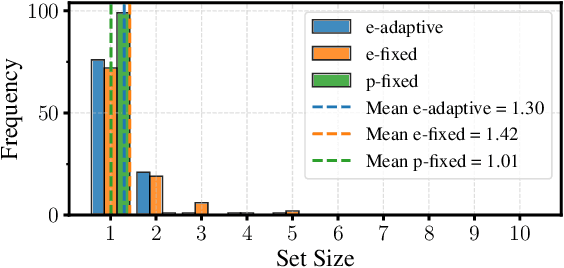
Traditional conformal prediction methods construct prediction sets such that the true label falls within the set with a user-specified coverage level. However, poorly chosen coverage levels can result in uninformative predictions, either producing overly conservative sets when the coverage level is too high, or empty sets when it is too low. Moreover, the fixed coverage level cannot adapt to the specific characteristics of each individual example, limiting the flexibility and efficiency of these methods. In this work, we leverage recent advances in e-values and post-hoc conformal inference, which allow the use of data-dependent coverage levels while maintaining valid statistical guarantees. We propose to optimize an adaptive coverage policy by training a neural network using a leave-one-out procedure on the calibration set, allowing the coverage level and the resulting prediction set size to vary with the difficulty of each individual example. We support our approach with theoretical coverage guarantees and demonstrate its practical benefits through a series of experiments.
Backward Conformal Prediction
May 19, 2025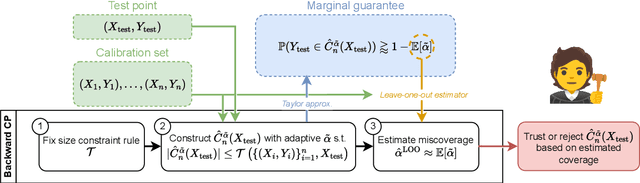
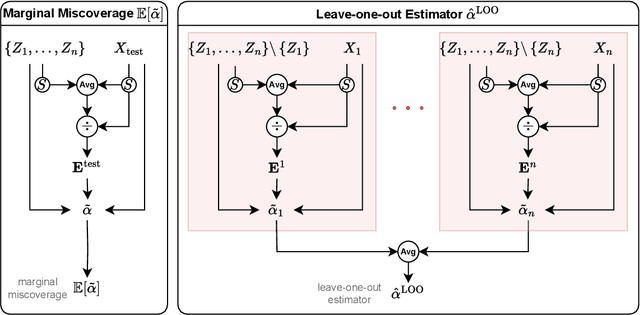
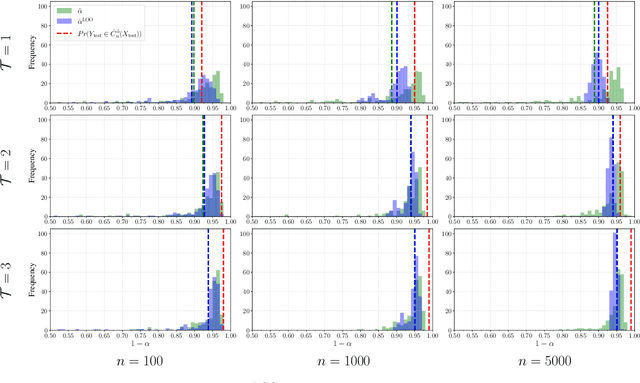
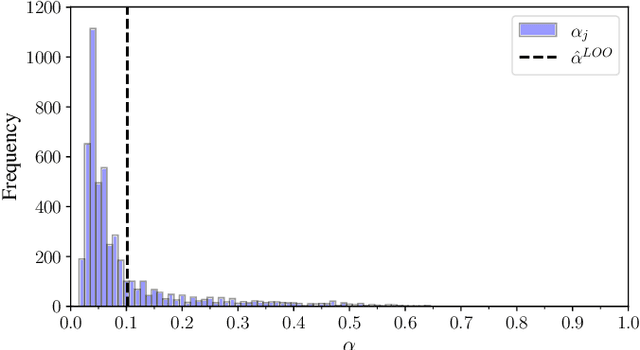
We introduce $\textit{Backward Conformal Prediction}$, a method that guarantees conformal coverage while providing flexible control over the size of prediction sets. Unlike standard conformal prediction, which fixes the coverage level and allows the conformal set size to vary, our approach defines a rule that constrains how prediction set sizes behave based on the observed data, and adapts the coverage level accordingly. Our method builds on two key foundations: (i) recent results by Gauthier et al. [2025] on post-hoc validity using e-values, which ensure marginal coverage of the form $\mathbb{P}(Y_{\rm test} \in \hat C_n^{\tilde{\alpha}}(X_{\rm test})) \ge 1 - \mathbb{E}[\tilde{\alpha}]$ up to a first-order Taylor approximation for any data-dependent miscoverage $\tilde{\alpha}$, and (ii) a novel leave-one-out estimator $\hat{\alpha}^{\rm LOO}$ of the marginal miscoverage $\mathbb{E}[\tilde{\alpha}]$ based on the calibration set, ensuring that the theoretical guarantees remain computable in practice. This approach is particularly useful in applications where large prediction sets are impractical such as medical diagnosis. We provide theoretical results and empirical evidence supporting the validity of our method, demonstrating that it maintains computable coverage guarantees while ensuring interpretable, well-controlled prediction set sizes.
E-Values Expand the Scope of Conformal Prediction
Mar 17, 2025Conformal prediction is a powerful framework for distribution-free uncertainty quantification. The standard approach to conformal prediction relies on comparing the ranks of prediction scores: under exchangeability, the rank of a future test point cannot be too extreme relative to a calibration set. This rank-based method can be reformulated in terms of p-values. In this paper, we explore an alternative approach based on e-values, known as conformal e-prediction. E-values offer key advantages that cannot be achieved with p-values, enabling new theoretical and practical capabilities. In particular, we present three applications that leverage the unique strengths of e-values: batch anytime-valid conformal prediction, fixed-size conformal sets with data-dependent coverage, and conformal prediction under ambiguous ground truth. Overall, these examples demonstrate that e-value-based constructions provide a flexible expansion of the toolbox of conformal prediction.
Statistical Collusion by Collectives on Learning Platforms
Feb 07, 2025

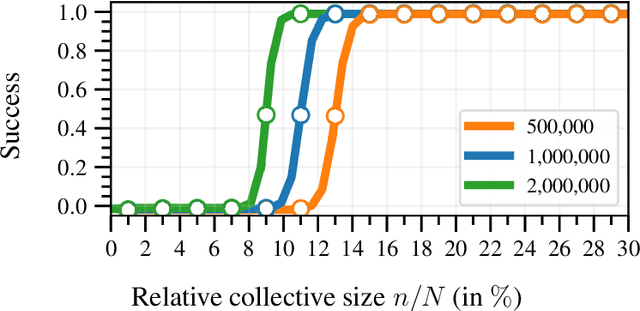

As platforms increasingly rely on learning algorithms, collectives may form and seek ways to influence these platforms to align with their own interests. This can be achieved by coordinated submission of altered data. To evaluate the potential impact of such behavior, it is essential to understand the computations that collectives must perform to impact platforms in this way. In particular, collectives need to make a priori assessments of the effect of the collective before taking action, as they may face potential risks when modifying their data. Moreover they need to develop implementable coordination algorithms based on quantities that can be inferred from observed data. We develop a framework that provides a theoretical and algorithmic treatment of these issues and present experimental results in a product evaluation domain.