 Add to Chrome
 Add to Firefox
 Add to Edge
Surface Sensitivity in Lean 4 Autoformalization
Apr 25, 2026
Natural-language variation poses a key challenge in Lean autoformalization: semantically equivalent paraphrases of the same theorem statements can induce divergent formal outputs, yet it remains unclear whether this variation reflects semantic disagreements or shallower failures. We investigate this question in Lean 4 using 60 deterministic paraphrase rules applied to ProofNet\# and miniF2F. Across four GPT-family models and three open-weight 7B autoformalizers, we find that the observed paraphrase sensitivity reflects compilation-boundary failures rather than semantic divergence among successful formalizations. In particular, when both baseline and perturbed outputs compile, paired predictions are semantically equivalent under BEq+ and structurally near-identical under GTED. By contrast, paraphrasing substantially affects whether outputs compile, with failure modes varying across datasets and perturbation classes. Our results suggest that future training-time interventions should target the compile boundary rather than the semantic layer, and that benchmarks should separate compile-conditional equivalence from surface consistency.

Revisiting the Necessity of Graph Learning and Common Graph Benchmarks
Dec 09, 2024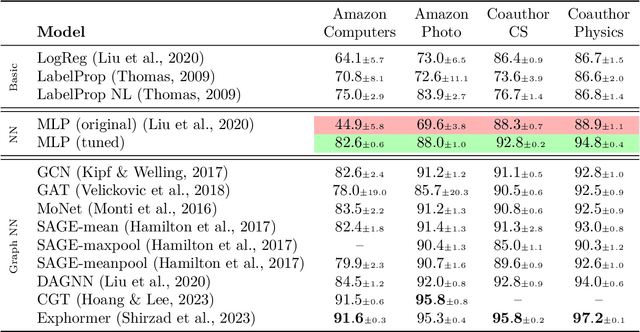
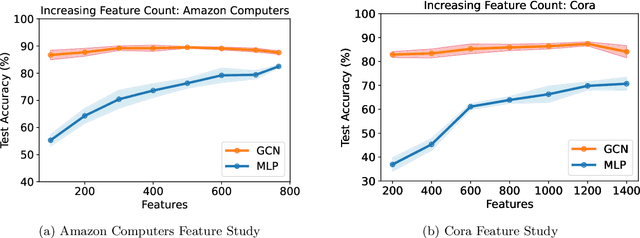
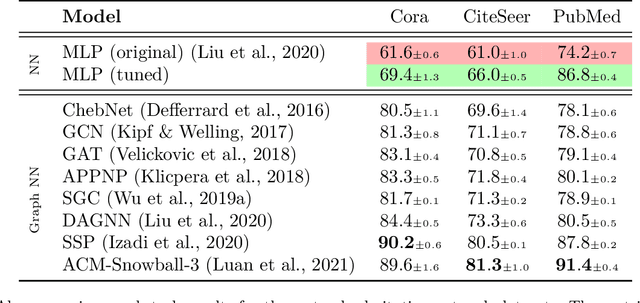
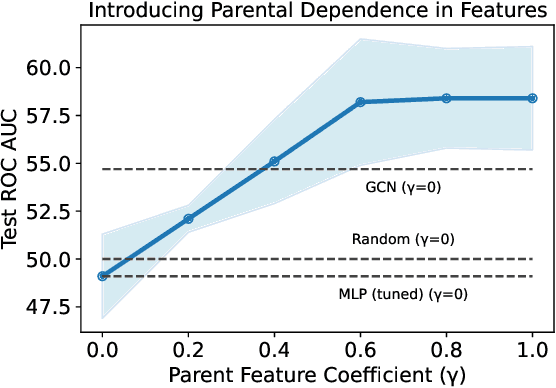
Graph machine learning has enjoyed a meteoric rise in popularity since the introduction of deep learning in graph contexts. This is no surprise due to the ubiquity of graph data in large scale industrial settings. Tacitly assumed in all graph learning tasks is the separation of the graph structure and node features: node features strictly encode individual data while the graph structure consists only of pairwise interactions. The driving belief is that node features are (by themselves) insufficient for these tasks, so benchmark performance accurately reflects improvements in graph learning. In our paper, we challenge this orthodoxy by showing that, surprisingly, node features are oftentimes more-than-sufficient for many common graph benchmarks, breaking this critical assumption. When comparing against a well-tuned feature-only MLP baseline on seven of the most commonly used graph learning datasets, one gains little benefit from using graph structure on five datasets. We posit that these datasets do not benefit considerably from graph learning because the features themselves already contain enough graph information to obviate or substantially reduce the need for the graph. To illustrate this point, we perform a feature study on these datasets and show how the features are responsible for closing the gap between MLP and graph-method performance. Further, in service of introducing better empirical measures of progress for graph neural networks, we present a challenging parametric family of principled synthetic datasets that necessitate graph information for nontrivial performance. Lastly, we section out a subset of real-world datasets that are not trivially solved by an MLP and hence serve as reasonable benchmarks for graph neural networks.