 Add to Chrome
 Add to Firefox
 Add to Edge
Multi-fidelity aerodynamic data fusion by autoencoder transfer learning
Dec 15, 2025
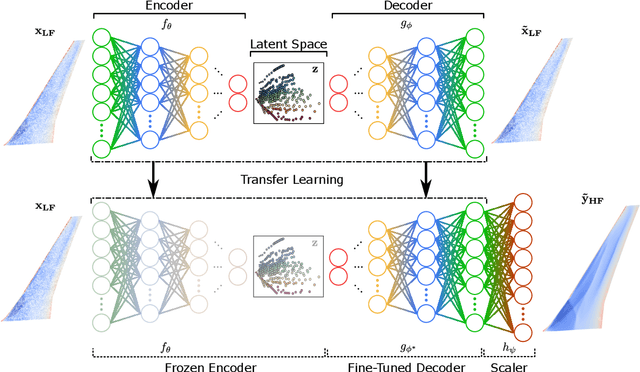
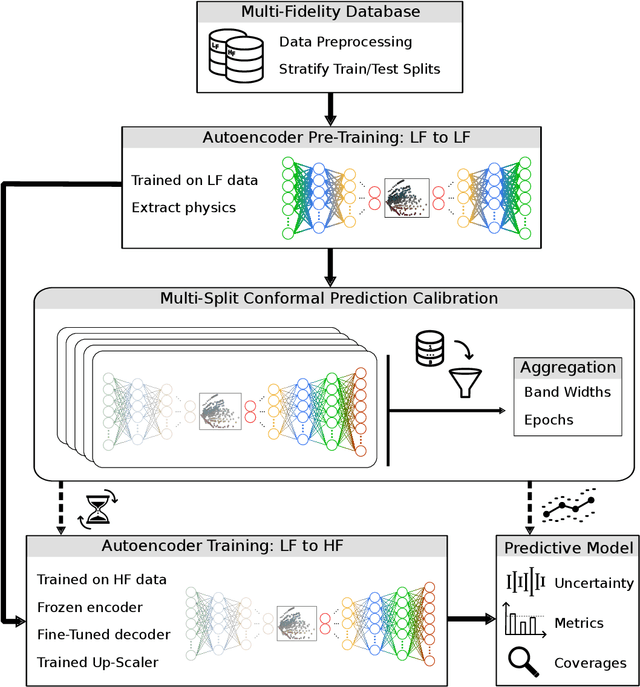
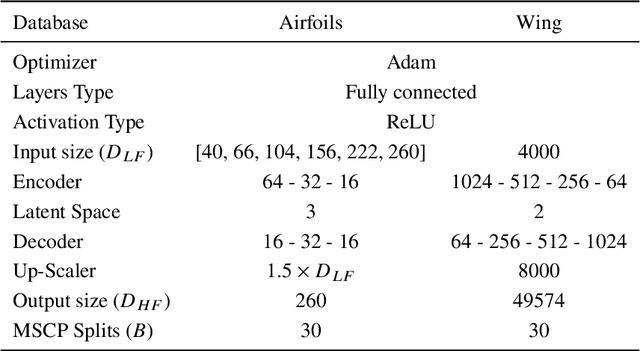
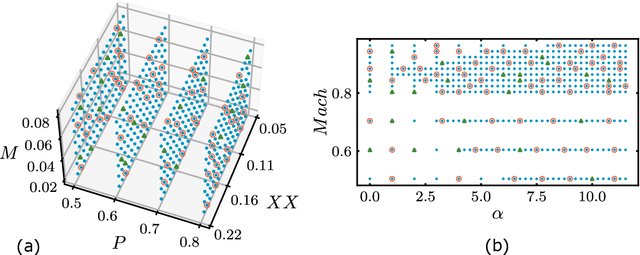
Accurate aerodynamic prediction often relies on high-fidelity simulations; however, their prohibitive computational costs severely limit their applicability in data-driven modeling. This limitation motivates the development of multi-fidelity strategies that leverage inexpensive low-fidelity information without compromising accuracy. Addressing this challenge, this work presents a multi-fidelity deep learning framework that combines autoencoder-based transfer learning with a newly developed Multi-Split Conformal Prediction (MSCP) strategy to achieve uncertainty-aware aerodynamic data fusion under extreme data scarcity. The methodology leverages abundant Low-Fidelity (LF) data to learn a compact latent physics representation, which acts as a frozen knowledge base for a decoder that is subsequently fine-tuned using scarce HF samples. Tested on surface-pressure distributions for NACA airfoils (2D) and a transonic wing (3D) databases, the model successfully corrects LF deviations and achieves high-accuracy pressure predictions using minimal HF training data. Furthermore, the MSCP framework produces robust, actionable uncertainty bands with pointwise coverage exceeding 95%. By combining extreme data efficiency with uncertainty quantification, this work offers a scalable and reliable solution for aerodynamic regression in data-scarce environments.

Towards aerodynamic surrogate modeling based on $β$-variational autoencoders
Aug 09, 2024Surrogate models combining dimensionality reduction and regression techniques are essential to reduce the need for costly high-fidelity CFD data. New approaches using $\beta$-Variational Autoencoder ($\beta$-VAE) architectures have shown promise in obtaining high-quality low-dimensional representations of high-dimensional flow data while enabling physical interpretation of their latent spaces. We propose a surrogate model based on latent space regression to predict pressure distributions on a transonic wing given the flight conditions: Mach number and angle of attack. The $\beta$-VAE model, enhanced with Principal Component Analysis (PCA), maps high-dimensional data to a low-dimensional latent space, showing a direct correlation with flight conditions. Regularization through $\beta$ requires careful tuning to improve the overall performance, while PCA pre-processing aids in constructing an effective latent space, improving autoencoder training and performance. Gaussian Process Regression is used to predict latent space variables from flight conditions, showing robust behavior independent of $\beta$, and the decoder reconstructs the high-dimensional pressure field data. This pipeline provides insight into unexplored flight conditions. Additionally, a fine-tuning process of the decoder further refines the model, reducing dependency on $\beta$ and enhancing accuracy. The structured latent space, robust regression performance, and significant improvements from fine-tuning collectively create a highly accurate and efficient surrogate model. Our methodology demonstrates the effectiveness of $\beta$-VAEs for aerodynamic surrogate modeling, offering a rapid, cost-effective, and reliable alternative for aerodynamic data prediction.