 Add to Chrome
 Add to Firefox
 Add to Edge
Position: RL Researchers Need to Distinguish Between Solving Simulators and Using Simulators as a Proxy
Jun 26, 2026
One goal in reinforcement learning (RL) research is to understand general-purpose sequential decision-making, using benchmark simulators as a proxy for learning in deployment settings. When running experiments, however, the goal of achieving high performance in the simulator can mutate into focusing exclusively on solving the simulator. To achieve high scores, researchers may adopt solutions exclusively meant for solving simulators, rather than learning while the agent is deployed outside a simulator. Solving simulators is also worthy of investigation, but it is a fundamentally different RL research question. In this paper, we argue that RL researchers need to distinguish between two use cases of simulators: solving simulators and using simulators as a proxy for learning in deployment. We first discuss how these two use-cases are importantly different, in terms of constraints on how the agent can use the simulator, which algorithms are appropriate, and which evaluation metrics are appropriate. We then highlight several issues and misleading conclusions that can occur by not making the distinction between these two settings clear, supported with examples and simple experiments. This work is a call to the community to begin clearly distinguishing how they are using simulators in their work, hopefully sparking further discussion on which empirical practices work best in each setting.
* This work has been accepted at the ICML 2026 position paper track. The peer reviewed reference is provided in the public OpenReview page at https://openreview.net/forum?id=KIobEIpCkp Additionally the publication can be seen at this link : https://icml.cc/virtual/2026/poster/67184

Rethinking the Foundations for Continual Reinforcement Learning
Apr 10, 2025Algorithms and approaches for continual reinforcement learning have gained increasing attention. Much of this early progress rests on the foundations and standard practices of traditional reinforcement learning, without questioning if they are well-suited to the challenges of continual learning agents. We suggest that many core foundations of traditional RL are, in fact, antithetical to the goals of continual reinforcement learning. We enumerate four such foundations: the Markov decision process formalism, a focus on optimal policies, the expected sum of rewards as the primary evaluation metric, and episodic benchmark environments that embrace the other three foundations. Shedding such sacredly held and taught concepts is not easy. They are self-reinforcing in that each foundation depends upon and holds up the others, making it hard to rethink each in isolation. We propose an alternative set of all four foundations that are better suited to the continual learning setting. We hope to spur on others in rethinking the traditional foundations, proposing and critiquing alternatives, and developing new algorithms and approaches enabled by better-suited foundations.
Real-Time Recurrent Learning using Trace Units in Reinforcement Learning
Sep 02, 2024


Recurrent Neural Networks (RNNs) are used to learn representations in partially observable environments. For agents that learn online and continually interact with the environment, it is desirable to train RNNs with real-time recurrent learning (RTRL); unfortunately, RTRL is prohibitively expensive for standard RNNs. A promising direction is to use linear recurrent architectures (LRUs), where dense recurrent weights are replaced with a complex-valued diagonal, making RTRL efficient. In this work, we build on these insights to provide a lightweight but effective approach for training RNNs in online RL. We introduce Recurrent Trace Units (RTUs), a small modification on LRUs that we nonetheless find to have significant performance benefits over LRUs when trained with RTRL. We find RTUs significantly outperform other recurrent architectures across several partially observable environments while using significantly less computation.
Investigating the Histogram Loss in Regression
Feb 20, 2024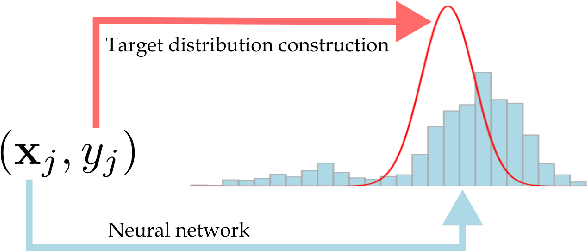
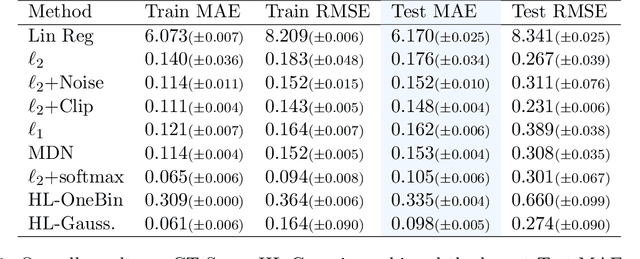
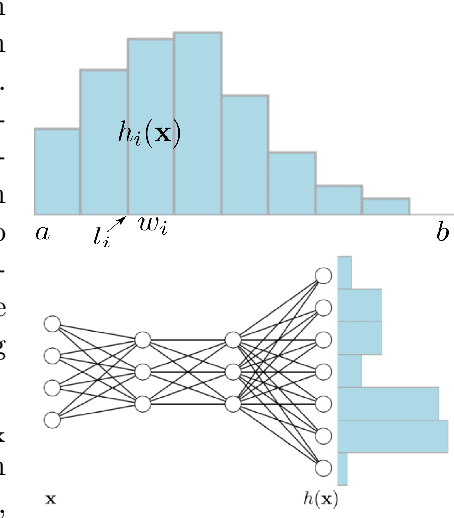

It is becoming increasingly common in regression to train neural networks that model the entire distribution even if only the mean is required for prediction. This additional modeling often comes with performance gain and the reasons behind the improvement are not fully known. This paper investigates a recent approach to regression, the Histogram Loss, which involves learning the conditional distribution of the target variable by minimizing the cross-entropy between a target distribution and a flexible histogram prediction. We design theoretical and empirical analyses to determine why and when this performance gain appears, and how different components of the loss contribute to it. Our results suggest that the benefits of learning distributions in this setup come from improvements in optimization rather than learning a better representation. We then demonstrate the viability of the Histogram Loss in common deep learning applications without a need for costly hyperparameter tuning.
Recurrent Linear Transformers
Oct 24, 2023The self-attention mechanism in the transformer architecture is capable of capturing long-range dependencies and it is the main reason behind its effectiveness in processing sequential data. Nevertheless, despite their success, transformers have two significant drawbacks that still limit their broader applicability: (1) In order to remember past information, the self-attention mechanism requires access to the whole history to be provided as context. (2) The inference cost in transformers is expensive. In this paper we introduce recurrent alternatives to the transformer self-attention mechanism that offer a context-independent inference cost, leverage long-range dependencies effectively, and perform well in practice. We evaluate our approaches in reinforcement learning problems where the aforementioned computational limitations make the application of transformers nearly infeasible. We quantify the impact of the different components of our architecture in a diagnostic environment and assess performance gains in 2D and 3D pixel-based partially-observable environments. When compared to a state-of-the-art architecture, GTrXL, inference in our approach is at least 40% cheaper while reducing memory use in more than 50%. Our approach either performs similarly or better than GTrXL, improving more than 37% upon GTrXL performance on harder tasks.